

What if the fifty minutes you spend in your therapist’s office weren’t just for surviving your week, but for architecting your entire future? Many high achievers hesitate to begin because they feel they aren’t “sick enough” for clinical intervention. They worry about wasting time on surface level conversation or face anxiety about exactly what to talk about in therapy when the external world appears stable. It’s a valid concern. Your time is your most precious asset, and you shouldn’t spend it merely rehashing the mundane details of your schedule.
You deserve a space that functions as more than a relief valve for daily stress. This guide reveals how to transform your sessions into a high level laboratory for personal and professional transformation. We’ll provide a clear framework to help you move beyond simple emotional discharge and toward a strategic alignment of your inner life and executive success. By the end, you’ll have actionable insights to unlock your latent potential and turn every session into a catalyst for your visionary destiny.
Key Takeaways
- Challenge the “not sick enough” fallacy by reframing therapy as a strategic laboratory for visionary growth rather than just a crisis intervention tool.
- Identify the four essential domains of self-exploration to provide a structured framework for what to talk about in therapy during every session.
- Discover how to leverage the synergy between your inner emotional life and your professional executive success to accelerate your career trajectory.
- Master the “Session Audit” and “Visionary Agenda” techniques to ensure your time in the room translates into high-level ROI for your personal destiny.
The Threshold of Vulnerability: Why We Hesitate to Speak
Hesitation is often the first hurdle on the path to visionary growth. High achievers frequently view vulnerability as a strategic liability, something to be managed or suppressed rather than explored. You might feel you aren’t “sick enough” to justify a seat in the clinician’s office, especially when your external life appears successful. This resistance is a natural part of the growth process. It stems from a fundamental misunderstanding of why high-performers seek mentorship. You aren’t just looking for a safe space to vent; you’re entering a strategic partnership for transformation. When you wonder what to talk about in therapy, the answer doesn’t lie in your past failures. It lies in your future potential.
The relationship between a visionary and their therapist is built on mutual respect and clinical authority. It’s a laboratory where the inner life is examined with the same rigor you apply to your business operations. By acknowledging this threshold of vulnerability, you stop viewing self-reflection as a weakness. Instead, you begin to see it as the ultimate competitive advantage. This proactive intervention ensures that your internal foundation is strong enough to support the weight of your external ambitions.
Deconstructing the ‘Crisis’ Myth
The cultural narrative often suggests that Psychotherapy is a reactive measure, something reserved exclusively for trauma or clinical disorders. This “crisis” myth creates a significant barrier for those who are functioning well but feeling unaligned. It’s vital to shift from a maintenance mindset to an optimization mindset. While maintenance focuses on keeping things from breaking, optimization focuses on reaching a peak state of being. Proactive conversation prevents professional burnout by identifying subtle stressors before they compromise your executive capacity. It turns the therapeutic hour into a preventive strike against the stagnation that often follows high-level success.
The Visionary Lens on Emotional Health
At LEAPS Inc., our therapeutic philosophy centers on reaching your maximum potential. We believe that your internal worldview is the primary driver for your external success. Defining this worldview serves as the bedrock for every session topic. When you engage in individual therapy, you’re investing in your leadership capacity. Emotional vulnerability, when handled with professional expertise, increases your ability to lead with clarity and strategic purpose. It allows you to dismantle the internal blocks that prevent you from fulfilling your destiny. This visionary lens reframes emotional health as a vital component of your professional development, ensuring that your growth is both holistic and sustainable.
Mapping the Landscape: Four Essential Domains of Therapeutic Conversation
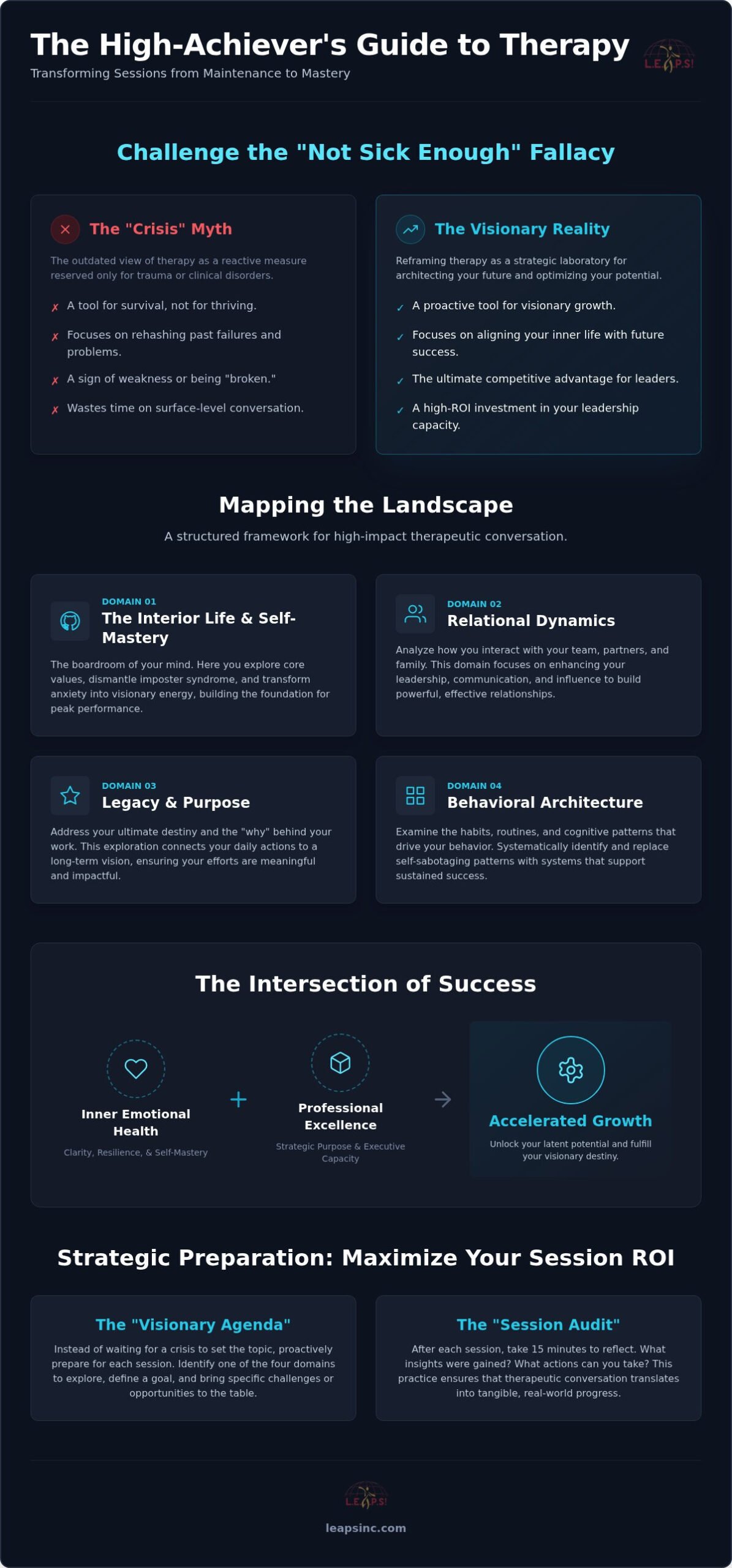
To move beyond surface level conversation, you need a structured framework that categorizes your internal experiences. Think of your psyche not as a chaotic storm, but as a landscape that can be mapped and mastered. When determining what to talk about in therapy, it helps to view your life through four essential lenses. The Interior Life focuses on self-mastery and emotional regulation. Relational Dynamics analyze how you interact with the world around you. Legacy and Purpose address your ultimate destiny and the meaning behind your work. Finally, Behavioral Architecture examines the habits and cognitive patterns that either support or sabotage your progress.
This organized approach allows you to enter every session with a sense of strategic purpose. Instead of waiting for a crisis to dictate the agenda, you can proactively explore these domains to reveal latent potential. Many resources, such as this guide on what to talk about in therapy, suggest starting with immediate stressors. While that’s a valid entry point, a visionary approach uses those stressors as data points to map out a broader plan for personal and professional evolution.
The Interior Life and Self-Mastery
For the business owner or high level executive, the “Interior Life” is the boardroom of the mind. This domain is where we address the specific nuances of anxiety that often accompany high stakes leadership. Rather than viewing anxiety as a clinical flaw, we treat it as misdirected visionary energy. Through clinical dialogue, you can unearth your core values, which serve as the internal compass for every decision you make. We also confront the “imposter syndrome” that frequently haunts entrepreneurs. By dismantling these internal blocks, you gain a level of self-mastery that translates directly into executive presence and decisive action.
Relational Patterns and Attachment
Your private relationships and professional performance are two sides of the same coin. It’s common to find that childhood family dynamics manifest in the boardroom, influencing how you handle authority, conflict, and delegation. Analyzing these patterns is a vital part of the therapeutic process. While you might seek couples counseling to address specific marital issues, these same relational insights are invaluable in individual sessions. Incorporating elements of family therapy helps you build emotional resilience by understanding the attachment styles that drive your social interactions. Mastering these dynamics ensures your leadership is grounded in empathy and strategic clarity. If you’re ready to begin this mapping process, you can schedule an appointment to start your journey.
The Intersection of Professional Excellence and Emotional Health
Your professional life isn’t a separate entity from your emotional well-being; it’s a direct reflection of it. For many high achievers, the boardroom is where internal conflicts play out in real-time, making your career a vital topic for exploration. When you consider what to talk about in therapy, don’t feel limited to personal trauma or family history. Your professional identity, your ambitions, and the pressures of leadership are essential data points for growth. There’s a powerful synergy between individual therapy and high-level performance. By refining your internal world, you naturally increase your external impact. Developing high emotional intelligence (EQ) isn’t just a soft skill. It’s a strategic asset that translates directly into business ROI by improving team cohesion and decision-making clarity.
Entrepreneurs face a unique set of pressures that standard clinical approaches often overlook. We call this the “Founder’s Edge.” It’s the ability to maintain clarity and purpose while navigating the extreme volatility of building a company. Therapy provides a confidential laboratory to process these pressures, allowing you to transform raw stress into strategic insight. This ensures that your drive for success doesn’t lead to burnout, but to a sustainable, visionary destiny where your professional achievements are supported by a resilient internal foundation.
Leadership as an Emotional Discipline
Leadership is often described in terms of strategy and logistics, but it’s fundamentally an emotional discipline. Decision-making fatigue is real. It drains your cognitive reserves and clouds your judgment, often leading to unforced errors. Strategic isolation is another common burden. When you’re at the helm, there are few people you can speak to with complete transparency. Processing the emotional weight of corporate visioning and the immense responsibility you feel for your team is crucial. This work often serves as a natural progression into executive coaching. It bridges the gap between clinical depth and professional execution, ensuring you lead from a place of abundance rather than depletion.
Scaling Sanity Alongside Growth
Scaling a business requires more than just capital; it requires a psychological expansion. You can’t scale a company if you haven’t scaled your own internal capacity for complexity. We focus on work-life integration rather than the myth of “balance.” Balance implies a static, unachievable state, while integration suggests a fluid, visionary harmony between your roles. Therapy helps you refine your strategic marketing and brand identity from the inside out. Your brand is an extension of your inner life. When your internal values are clear, your external messaging becomes authentic and magnetic. This holistic approach ensures that your sanity and purpose scale alongside your revenue.
Strategic Preparation: How to Maximize Your Session ROI
High-level investment requires high-level preparation. You wouldn’t enter a board meeting without an agenda. Yet, many approach their psychological development with a passive attitude. Maximizing your session ROI means moving beyond the immediate and into the strategic. Deciding what to talk about in therapy shouldn’t be a last-minute decision made in the waiting room. It should be the result of a deliberate, ongoing process of self-observation. This shift from reactive reporting to proactive architecting is what separates standard counseling from visionary mentorship.
Moving from “what happened” to “what this means” is the core of this transition. When you recount a weekly event, you’re merely reporting. When you analyze the event’s impact on your future destiny, you’re growing. For leaders who need to accelerate this process, therapy intensives offer a high-impact alternative to traditional formats. These sessions allow for rapid, deep-dive progress that bypasses the limitations of the standard hourly model, providing the space needed for profound breakthroughs.
The Art of the ‘Session Audit’
The ‘Session Audit’ is a specialized tool for clinical mindfulness that transforms fleeting emotional reactions into structured data for psychological growth. By keeping a log of emotional triggers throughout your week, you can identify ‘thematic loops’ that repeat in your daily life. These loops often reveal hidden beliefs that dictate your responses to stress or authority. It’s essential to distinguish between ‘venting’ and ‘strategic processing.’ Venting offers a temporary relief valve for pressure. Strategic processing, however, uses your experiences as raw material to refine your executive presence and internal stability.
Leveraging Between-Session Momentum
The true measure of therapeutic success is how insights are applied to real-world business challenges. Insight without action is merely intellectual entertainment. To bridge this gap, life coaching intensives can help you translate internal revelations into concrete strategic moves. Consistent clinical engagement ensures that your evolution remains a steady momentum rather than a series of sporadic bursts. By maintaining this focus, you ensure that every insight gained in the room becomes a permanent part of your leadership toolkit. If you’re ready to move beyond surface-level conversation and start architecting your future, schedule an appointment to begin your strategic preparation.
Beyond Symptom Management: Entering the Visionary State with LEAPS
Therapy is often mischaracterized as a repair shop for the broken, a place where individuals go to patch up psychological wounds. This narrow view ignores the transformative potential of the clinical space. True healing isn’t the absence of symptoms; it’s the presence of personal power. Once you’ve established a baseline of stability, the question of what to talk about in therapy shifts from survival to strategy. You begin to architect your destiny, using every session as a catalyst for the visionary state. At LEAPS Inc., we view this as the ultimate investment in your future self.
This evolution requires a fundamental shift in perspective. You aren’t just looking for relief from immediate stressors. You’re looking for the clarity to lead with conviction. The transition from individual healing to corporate and organizational impact is the natural result of this work. When you’re internally aligned, your external impact becomes undeniable. You stop reacting to the world and start shaping it.
The Integrated Growth Model
The LEAPS Inc. therapeutic philosophy is built on the principle of holistic integration. We merge deep clinical insights with the practical demands of professional executive success. This isn’t just about feeling better; it’s about performing better. Our visionary mentor approach challenges you to meet your future self, the version of you that has already achieved your highest ambitions. While individual work is foundational, group therapy offers a unique environment for collective visionary growth. In these settings, you see your internal patterns reflected in others, which often accelerates your path to self-mastery.
Your Next Leap: From Insight to Impact
The path from individual therapy to large-scale business development is shorter than you think. A healthy, visionary leader creates a healthy, visionary organization. When you invest in your own clinical support, you’re setting the stage for corporate health and sustainable expansion. Don’t let the fear of “not being sick enough” hold you back from your maximum potential. The most successful leaders aren’t those without problems; they’re those with the courage to face them in a strategic setting. Your next leap starts with a single decision to prioritize your inner life. We invite you to schedule a consultation today and begin the journey toward your visionary destiny.
Architecting Your Future Through Strategic Self-Discovery
Transforming your therapeutic experience requires a shift from passive reporting to active architecting. By embracing the essential domains of conversation and utilizing tools like the Session Audit, you ensure your time in the room translates into tangible growth. Deciding what to talk about in therapy is no longer a source of anxiety but a strategic opportunity to align your inner life with your external ambitions. This holistic integration is the foundation of visionary leadership and sustainable success.
LEAPS Inc., led by Dr. John E. N. Daniel, provides the sophisticated clinical authority needed to navigate this transformation. Whether you require the deep, focused intervention of our specialized therapy intensives or seek to implement integrated Employee Assistance Programs for your firm, we’re committed to your maximum potential. It’s time to move beyond simple maintenance and begin the work of fulfilling your purpose.
Schedule your visionary consultation with LEAPS Inc. today. Your destiny is waiting for you to take the first leap.
Frequently Asked Questions
What if I feel like I have nothing important to talk about in therapy?
Feeling like you have nothing to say often indicates you’ve reached a plateau in your current self-perception. This is the perfect time to explore your latent potential rather than just managing problems. When you’re unsure what to talk about in therapy, we shift the focus to your future destiny and the subtle internal blocks preventing your next leap. These quiet sessions often yield the most profound strategic insights for your personal and professional evolution.
Can I talk about my business or career problems in a therapy session?
Yes, your professional life is a vital domain for clinical exploration. At LEAPS Inc., we view your career as an extension of your inner life. Processing business challenges in a therapeutic setting allows you to address the emotional roots of executive stress and decision-making. This holistic approach ensures that your professional excellence is supported by a resilient psychological foundation, turning individual therapy into a powerful engine for your organizational impact and leadership success.
How do I know if I’m talking about the ‘right’ things with my therapist?
Productive therapeutic conversation is marked by a sense of movement toward your maximum potential. If you feel challenged to look at your future self and your core values, you’re likely on the right track. The right things aren’t always the most comfortable topics. They’re the ones that bridge the gap between your current state and your ultimate purpose. Your therapist acts as a visionary mentor, guiding you toward insights that facilitate lasting transformation.
Is it okay to bring a list of topics to my therapy session?
Bringing a prepared list is a highly effective way to maximize your session ROI. We encourage clients to keep a digital or physical log of emotional triggers and strategic questions between sessions. This Visionary Agenda ensures that you don’t waste time on surface level venting. By arriving with clear themes, you take ownership of your growth process and transform the fifty minute hour into a high level laboratory for your personal and professional development.
What is the difference between talking to a therapist and talking to a coach?
Therapy primarily explores the psychological roots of your behavior and emotional health, while coaching focuses on strategic execution and external performance. However, LEAPS Inc. integrates these disciplines to provide a comprehensive growth model. While a coach might help you scale your business, a therapist ensures you have the internal capacity to handle that growth. Combining these approaches allows for a more thorough transformation, addressing both the architect and the architecture of your life.
How much of my past do I need to talk about to see progress in the present?
You only need to explore your past to the extent that it informs your future destiny. We don’t believe in endless rehashing of old wounds for the sake of it. Instead, we analyze historical patterns to understand how they manifest in your current leadership and relationships. Once these patterns are identified and addressed, the focus shifts back to your peak potential. The goal is always to use the past as data for a better future.
Can therapy help me with my professional leadership and decision-making?
Clinical intervention is one of the most effective ways to enhance your leadership and decision-making capacity. By developing high emotional intelligence and addressing decision fatigue, you gain a significant executive edge. Therapy helps you navigate strategic isolation and the immense responsibility of corporate visioning. When your internal world is structured and secure, you lead with a level of clarity and empathy that naturally inspires your team and drives organizational success.
What happens if I run out of things to say during a session?
Silence during a session is not a failure; it’s a strategic opportunity. These moments often allow deeper, more vulnerable truths to rise to the surface of your consciousness. Your therapist will use these pauses to help you observe your internal state without the distraction of constant reporting. Running out of things to say usually means you’ve exhausted the surface level and are ready to enter a more profound laboratory of self-discovery and visionary insight.