

With 66% of employees reporting persistent burnout symptoms in 2026, the cost of organizational silence has reached a breaking point. You’ve likely seen the fallout in your own halls: high executive turnover, low engagement with legacy EAPs, and the constant struggle to prove that wellness initiatives actually drive your mission forward. It’s frustrating to watch talented leaders walk away when you know their potential hasn’t been fully unlocked; it’s even harder to bridge the gap between “perks” and true psychological safety.
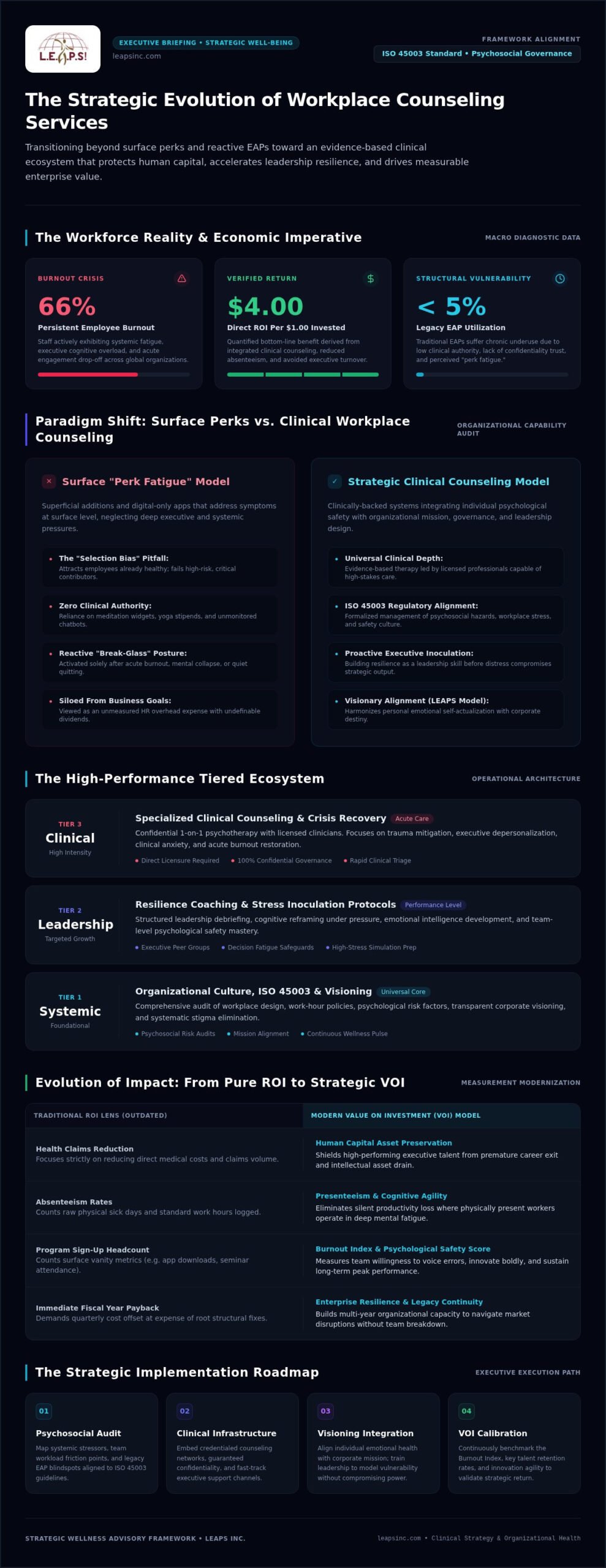
You understand that a resilient, high-performing workforce is the bedrock of your corporate destiny. This guide promises to help you transition from superficial office perks to a robust, clinically-backed workplace counseling services strategy that aligns employee well-being with your long-term vision. We’ll examine how to move beyond “check-the-box” solutions by integrating ISO 45003 standards, leveraging a $4.00 return on every dollar invested in mental health, and cultivating a culture where individual emotional depth fuels collective professional success. Through a visionary lens, we’ll map out a path to organizational health that secures your legacy and empowers your people to reach their peak state.
Key Takeaways
- Discover how to redefine mental health support as a strategic asset that fuels holistic human development rather than just a reactive safety net.
- Understand why clinical authority and evidence-based therapy provide the necessary depth to overcome “perk fatigue” and support high-level leaders.
- Learn to design a tiered support ecosystem that integrates individual therapy with corporate visioning to align personal growth with organizational goals.
- Shift your success metrics from traditional ROI to a “Value on Investment” (VOI) model that tracks performance, retention, and the Burnout Index.
- Explore how integrating workplace counseling services with business development creates a visionary framework for your organization’s long-term transformation.
Redefining Workplace Counseling Services as a Strategic Asset
In the high-stakes corporate environment of 2026, workplace counseling services have evolved far beyond the reactive, “break-glass-in-case-of-emergency” protocols of the past. Today, visionary leaders recognize these services as a structured clinical system designed to safeguard the mental and emotional health of their most valuable asset: their people. This shift reflects a move from a narrow focus on basic health toward a philosophy of holistic human development. It isn’t just about fixing what’s broken; it’s about optimizing the internal depth and resilience required to sustain long-term excellence and fulfill an organization’s ultimate destiny.
Traditional employee assistance programs often fail because they lack the clinical authority needed to address complex psychological barriers. When an organization relies on surface-level delivery, it creates a disconnect between the company’s stated values and the deep, unmet needs of its workforce. From the perspective of a visionary mentor, true wellness isn’t a luxury or a distraction. It’s a prerequisite for reaching your organizational potential. By treating emotional health as a strategic priority, you empower your team to move past immediate problems and look toward their future potential.
To better understand the necessity of this strategic shift, watch this insightful presentation on fostering mental health in the workplace:
The Core Pillars of Visionary Wellness
Effective support requires a clear distinction between general stress management apps and clinical mental health support. While digital tools offer convenience, they often lack the expertise to facilitate genuine transformation or handle high-stakes executive pressure. A robust strategy integrates high-level therapeutic interventions with professional coaching to cultivate resilience, unlock latent abilities, and foster leadership-level growth. By embedding corporate visioning into the organizational DNA, you set a tone where emotional vulnerability and professional power coexist. This alignment ensures that every team member feels secure enough to innovate and bold enough to lead.
Why Organizational Wellness Matters in 2026
The 2026 talent market has undergone a fundamental transformation. High-performers no longer prioritize salary as their sole metric for success; they demand emotional safety and specific frameworks for internal growth. Recent academic studies have highlighted the “selection bias” problem, where generic wellness programs only attract those who are already healthy, leaving high-risk, high-impact employees behind. Modern firms must look toward comprehensive clinical models to bypass this plateau and provide support that actually reaches the executive level. Workplace counseling services act as a strategic performance catalyst that transforms psychological resilience into a sustainable competitive advantage.
Beyond Surface Perks: The Clinical Depth of Effective Employee Assistance
By 2026, the corporate world has reached a state of “perk fatigue.” High-level executives and ambitious staff members are no longer swayed by office yoga sessions or curated fruit baskets. These superficial offerings fail to address the underlying psychological complexities of high-stakes environments. When you implement workplace counseling services, you’re moving beyond temporary distractions toward a foundation of clinical authority. This shift is essential because evidence-based therapy provides the cognitive and emotional tools that generic wellness apps simply cannot replicate. It requires a commitment to internal depth, ensuring that every intervention is grounded in professional credibility rather than trendy convenience.
Resilience isn’t a personality trait; it’s a skill built through structured support. Integrating individual therapy at the corporate level allows employees to process personal and professional blockers in a secure environment. This approach aligns with the latest World Health Organization guidance on workplace mental health, which emphasizes the need for systemic interventions to mitigate the global economic impact of psychological distress. To succeed, organizations must also solve the “privacy paradox” by utilizing third-party clinical experts. When employees trust that their vulnerability is protected by strict confidentiality, they’re more likely to engage with the support they truly need to reach their maximum potential.
The Problem with Surface-Level Solutions
Gym discounts and meditation apps often fall into the “selection bias” trap. Data suggests that the healthiest employees, who are already managing their stress well, are the primary users of these lightweight perks. Meanwhile, the 66% of the workforce experiencing significant burnout symptoms remains underserved. These surface-level solutions do not solve systemic issues like role ambiguity or workload imbalances. Transitioning to a depth-psychology approach allows your organization to address behavioral patterns and cultural stressors at their root. It’s about moving from a “check-the-box” mentality to a transformative strategy that honors the inner life of the individual.
Integrating Clinical Therapy into the Corporate Fabric
Modern Employee Assistance Programs (EAP) must offer more than a triage hotline. They should provide direct access to licensed clinicians who understand the intersection of emotional health and executive performance. For teams facing rapid transitions or high-pressure milestones, therapy intensives can facilitate breakthroughs in days rather than months. Understanding the synergy between different types of support is vital; you can explore this further in our Therapy vs. Coaching: A Visionary Guide. If you’re ready to evolve your support system, you can consult with a visionary mentor to begin your organizational transformation.
Designing a High-Performance Workplace Wellness Ecosystem
Building a high-performance ecosystem requires more than a program focused on the floor of legality; it demands a framework for excellence that treats psychological health as a core business driver. In 2026, visionary leaders move beyond basic compliance to create workplace health promotion programs that are scientifically grounded and strategically aligned. This process begins with auditing your “Emotional Infrastructure.” You must assess whether your current support systems actually reflect your company goals and your team’s ultimate destiny. Without this alignment, even the most expensive initiatives will fail to gain traction or produce a meaningful transformation.
Once the audit is complete, you can implement tiered support that addresses the full spectrum of human need. This isn’t a one-size-fits-all approach. It ranges from broad group workshops that build a collective language of resilience to high-impact executive coaching for your most influential leaders. Integrating these workplace counseling services into the daily workflow ensures that support is proactive rather than reactive. To maintain this momentum, establish continuous feedback loops through strategic professional consultation. This structured approach allows the organization to evolve, identifying emerging stressors before they manifest as burnout or turnover.
Leadership as the Wellness Catalyst
Wellness doesn’t trickle up; it must be championed from the peak of the organization. When the C-Suite prioritizes their own growth through leadership coaching, they set a powerful standard for the entire hierarchy. Modeling vulnerability and professional openness de-stigmatizes mental health support, making it a badge of high performance rather than a sign of weakness. You can find deeper strategies on this in our guide to visionary leadership through Executive Coaching for C-Suite. By showing that emotional intelligence is a prerequisite for power, leaders become the primary catalysts for a culture of peak psychological health.
The Technical Components of the 2026 Model
A modern ecosystem requires dynamic EAPs that provide direct clinical access, bypassing the outdated triage hotlines that many employees find frustrating. For founders and high-stakes innovators, specialized support through entrepreneurship coaching is essential to manage the unique pressures of scaling a vision. These technical components must be supported by strategic marketing within the firm. You don’t just “offer” wellness; you promote it with the same vigor as a new product launch. This internal brand development ensures maximum employee adoption and secures the cultural buy-in necessary for long-term organizational success.
Measuring Strategic Impact: Why Traditional ROI Fails and What to Track
Traditional ROI models fail because they focus on a narrow slice of data: immediate medical expenditures. In 2026, visionary organizations have transitioned to a Value on Investment (VOI) model. This framework prioritizes performance metrics, talent retention, and long-term strategic execution over simple healthcare savings. When you evaluate workplace counseling services, you must look at how they empower your team to reach their peak state. It isn’t just about reducing costs; it’s about expanding the capacity of your human capital to innovate and lead.
Academic studies often highlight a “selection bias” in generic wellness programs, noting that they frequently fail to impact medical spending because only the healthiest employees use them. We view these findings as a powerful endorsement for a more integrated, clinically-led approach. If your perks only reach those who are already thriving, your strategy isn’t fulfilling its purpose. A robust, clinically-backed program targets the high-impact individuals who drive your mission forward, ensuring that support reaches those who need it most. This alignment is essential for effective corporate visioning, as a firm’s destiny is tied to the psychological health of its architects.
The Hidden Costs of Unaddressed Mental Health
Presenteeism remains a silent drain on your bottom line. It occurs when employees are physically present but psychologically absent, leading to a significant drop in creative output and operational efficiency. For high-specialty roles, the cost of turnover can be astronomical, often exceeding 200% of the individual’s annual salary. Investing in a robust counseling program is a fraction of that cost. A leader’s capacity for high-stakes decision-making is directly proportional to their level of psychological resilience and emotional clarity.
New Metrics for Organizational Health in 2026
To measure success in this new era, you must track engagement rates with clinically-led group therapy sessions rather than just app downloads. Monitor the alignment scores between personal growth milestones and your company’s strategic goals. These metrics provide a clearer picture of how well your “Culture of Care” is taking root. Long-term screening rates serve as a proxy for trust, showing that your employees feel secure enough to be vulnerable. If you are ready to move beyond basic metrics and measure true organizational transformation, schedule a strategic consultation today to align your wellness data with your corporate vision.
Partnering for Transformation: The LEAPS Inc. Visionary Approach
LEAPS Inc. serves as the Visionary Mentor for organizations ready to evolve their emotional and professional landscapes. We recognize that sustainable growth requires more than a standard benefit package; it demands a synergy between business development and high-level clinical psychological expertise. By integrating these disciplines, we offer workplace counseling services that don’t just solve immediate crises but actively facilitate your company’s ultimate destiny. This approach ensures that every intervention strengthens the individual while simultaneously advancing the corporate mission. It’s about moving from a reactive stance to a proactive, mission-oriented framework for growth.
Our customized EAP solutions are designed specifically for high-stakes environments where traditional, low-utilization models fail. We understand the unique pressures faced by executive teams and the specialized support required to maintain peak performance under stress. Moving from simple organizational health to organizational destiny means treating your workforce as a collection of high-potential individuals whose internal depth is the engine of your success. We challenge you to look beyond the immediate problems of 2026 and focus on the peak state your organization is meant to achieve.
Clinical Authority Meets Strategic Vision
The advantage of our model lies in the multi-disciplinary approach led by Dr. John E. N. Daniel. He bridges the gap between therapeutic depth and executive leadership, ensuring that your wellness strategy has the clinical authority to drive real change. For teams seeking rapid alignment, our corporate consulting intensives accelerate cultural shifts by addressing systemic blockers in a condensed, high-impact format. Additionally, we offer the flexibility to integrate faith-based perspectives for organizations operating within a specific Christian worldview, ensuring your support systems reflect your foundational values and spiritual commitments.
Getting Started with Your Visionary Program
Your journey toward a peak organizational state begins with an initial consultation to identify the specific gaps in your current wellness and counseling ecosystem. We don’t believe in generic templates. Instead, we craft a bespoke roadmap that includes the strategic marketing and brand development of your initiatives to ensure maximum engagement. This ensures that your workplace counseling services are viewed as a prestige resource rather than a hidden benefit, fostering a culture where seeking growth is celebrated.
Schedule a Consultation with LEAPS Inc. to begin your organizational transformation and unlock the maximum potential of your leaders and teams today.
Securing Your Organizational Destiny Through Visionary Health
The transition from superficial office perks to a clinically-backed framework is the defining challenge for leaders in 2026. You now understand that sustainable excellence requires a shift from tracking simple medical spend to measuring the Value on Investment through resilience and strategic execution. By integrating workplace counseling services into your corporate fabric, you don’t just solve immediate problems; you unlock the latent abilities of your entire workforce and align their internal growth with your long-term mission.
True transformation happens when clinical authority meets strategic vision. Led by Dr. John E. N. Daniel, LEAPS Inc. provides the integrated clinical and business strategic expertise necessary to navigate high-stakes environments. We’re nationally recognized for visionary leadership coaching that bridges the gap between individual emotional health and professional peak performance. It’s time to move beyond standard organizational health and step into your company’s ultimate destiny.
Elevate your organization with LEAPS Inc. Workplace Counseling Solutions and begin your journey toward a resilient, high-performing future today. Your team’s maximum potential is waiting to be realized.
Frequently Asked Questions
What are the main components of workplace counseling services in 2026?
Modern services integrate clinical therapy, executive coaching, and organizational consultation to support the whole individual. In 2026, these programs prioritize accessibility through digital-first clinical networks and specialized therapy intensives. They bridge the gap between individual emotional health and professional excellence. By offering tiered support, organizations ensure that every employee, from entry-level to C-Suite, has a structured path toward their maximum potential and professional destiny.
How do you measure the ROI of a corporate mental health initiative?
You measure success by shifting from traditional ROI to a Value on Investment (VOI) model that tracks performance and retention. While medical spend is a factor, visionary leaders focus on presenteeism, innovation scores, and the Burnout Index. Data from 2026 shows that every $1.00 invested in evidence-based workplace mental health yields a return of $3.70 to $4.00. Tracking these metrics aligns your wellness initiatives with long-term corporate visioning goals.
Why do most traditional Employee Assistance Programs (EAPs) have low engagement?
Low engagement stems from a lack of clinical depth and the selection bias of surface-level offerings. Traditional EAPs often provide basic triage hotlines that fail to address complex psychological barriers or executive-level pressure. When programs feel like check-the-box compliance tools rather than strategic assets, employees hesitate to use them. Modern workplace counseling services solve this by offering high-touch, confidential access to licensed clinicians who understand the specific demands of high-stakes corporate environments.
Can workplace counseling services help with executive burnout?
Yes, these services provide the clinical authority needed to identify and reverse the deep-seated causes of executive exhaustion. Executive burnout often involves a disconnect between an individual’s internal depth and their high-pressure professional role. Through specialized workplace counseling services and executive coaching, leaders can process emotional vulnerability in a secure environment. This structured support allows them to reclaim their visionary energy and fulfill their organizational purpose without sacrificing their mental well-being.
What is the difference between a wellness perk and a wellness strategy?
A wellness perk is a reactive, surface-level benefit while a wellness strategy is a proactive, mission-aligned framework. Perks like gym discounts or meditation apps often fail to produce lasting behavioral change because they don’t address systemic stressors. A strategy integrates clinical therapy with business development to create a sustainable Culture of Care. It ensures that mental health support isn’t just an add-on but a prerequisite for achieving the organization’s ultimate destiny.
How can we ensure employee confidentiality in a company-sponsored therapy program?
Confidentiality is secured by utilizing independent, third-party clinical providers who maintain strict separation from internal HR systems. At LEAPS Inc., we ensure that all therapeutic interventions are protected by clinical standards of privacy, sharing only anonymized, aggregate data with the organization. This privacy paradox is solved when employees trust that their vulnerability won’t impact their career trajectory. Building this trust is essential for creating a safe space for genuine transformation and growth.
How does corporate visioning impact employee well-being?
Corporate visioning provides a sense of purpose and destiny that acts as a psychological buffer against stress. When employees understand how their personal growth milestones align with the company’s strategic goals, they experience higher levels of engagement and resilience. This alignment transforms work from a series of tasks into a meaningful pursuit of potential. Visionary leadership ensures that the organizational mission supports the inner life of the individual, fostering a deep sense of belonging and well-being.
Are therapy intensives effective for corporate teams in crisis?
Therapy intensives are highly effective for teams facing rapid transitions, high-pressure milestones, or internal conflicts. These sessions provide deep, focused clinical intervention over a condensed timeframe, allowing for breakthroughs that traditional weekly therapy might take months to achieve. By addressing the root causes of team dysfunction in a structured, high-energy environment, intensives accelerate cultural shifts and restore organizational health. They serve as a powerful catalyst for team alignment and collective professional success.