
Table of Contents
- The Limitation of Secular Executive Coaching for Relationship Crises
- Understanding the Unique Pain of Infidelity in Faith-Centered Lives
- Why Our Trauma-Informed Approach Transforms Recovery Outcomes
- How We Integrate Faith, Science, and Therapeutic Expertise
- The LEAPS Intensive Model: Accelerated Healing for Couples
- Rebuilding Trust Through Specialized Infidelity Recovery Protocols
- Our Evidence-Based Clinical Framework Versus Generic Solutions
- Real Transformation: From Betrayal to Renewed Purpose
- Begin Your Faith-Centered Infidelity Recovery Journey With Us
- Frequently Asked Questions (FAQ)
The Limitation of Secular Executive Coaching for Relationship Crises
When infidelity shatters a marriage, the pain extends far deeper than the emotional wound itself. For couples grounded in faith, the betrayal carries spiritual dimensions that generic relationship coaching simply cannot address. You’re not just navigating broken trust; you’re grappling with violated vows, questions of forgiveness rooted in your beliefs, and uncertainty about whether reconciliation aligns with your spiritual values.
At LEAPS Inc., we understand that faith-integrated infidelity recovery requires more than standard therapeutic techniques. It demands expertise that honors both the scientific foundations of trauma healing and the spiritual framework that gives your life meaning. We’ve spent years developing an approach that bridges this gap, helping couples move from devastation toward genuine restoration.
Many high-achieving professionals turn to executive coaches when their marriages falter, assuming that leadership skills and communication strategies will fix what’s broken at home. While business coaching excels at organizational challenges and performance goals, it operates within a fundamentally different framework than what infidelity recovery requires.
Secular coaching typically focuses on forward momentum, problem-solving, and behavioral change without exploring the deeper emotional or spiritual dimensions of betrayal. A coach might teach conflict resolution techniques or help couples set boundaries, but these surface-level tools miss the core issue: how does someone rebuild trust when the deepest part of their relational foundation has crumbled? How do they reconcile their faith with the desire to forgive?
This gap becomes even more pronounced for couples whose faith directly informs their commitment to marriage. Generic approaches treat infidelity as a communication failure or a skills deficit. They don’t address the spiritual confusion, the reframing of vows, or the theological questions about grace, forgiveness, and restoration that faith-centered couples must navigate.
When you’re facing a crisis this profound, you need more than tactics. You need therapeutic expertise grounded in trauma-informed practice, combined with genuine understanding of how faith shapes your path forward.
Understanding the Unique Pain of Infidelity in Faith-Centered Lives
For couples rooted in Christian faith, infidelity represents a violation on multiple levels. Beyond the emotional betrayal lies a spiritual one: a promise made before God has been broken. This reality creates distinct challenges that secular recovery models don’t adequately address.
Many faith-centered individuals experience a complex mix of emotions that generic counseling approaches often oversimplify. You might feel called to forgive according to your beliefs while simultaneously wrestling with legitimate anger and hurt. You may wonder whether forgiveness requires staying in the marriage, or whether protecting yourself and your family is equally valid spiritually. These aren’t weaknesses or failures; they’re authentic spiritual and emotional struggles.
We’ve worked with many couples who felt shame or judgment seeking help, afraid that admitting marital crisis meant they’d failed spiritually or that their faith wasn’t strong enough. That belief system itself becomes an obstacle to healing. Effective infidelity recovery in faith-centered lives requires a therapeutic environment where spiritual convictions are respected and integrated, not dismissed or treated as secondary to the emotional work.
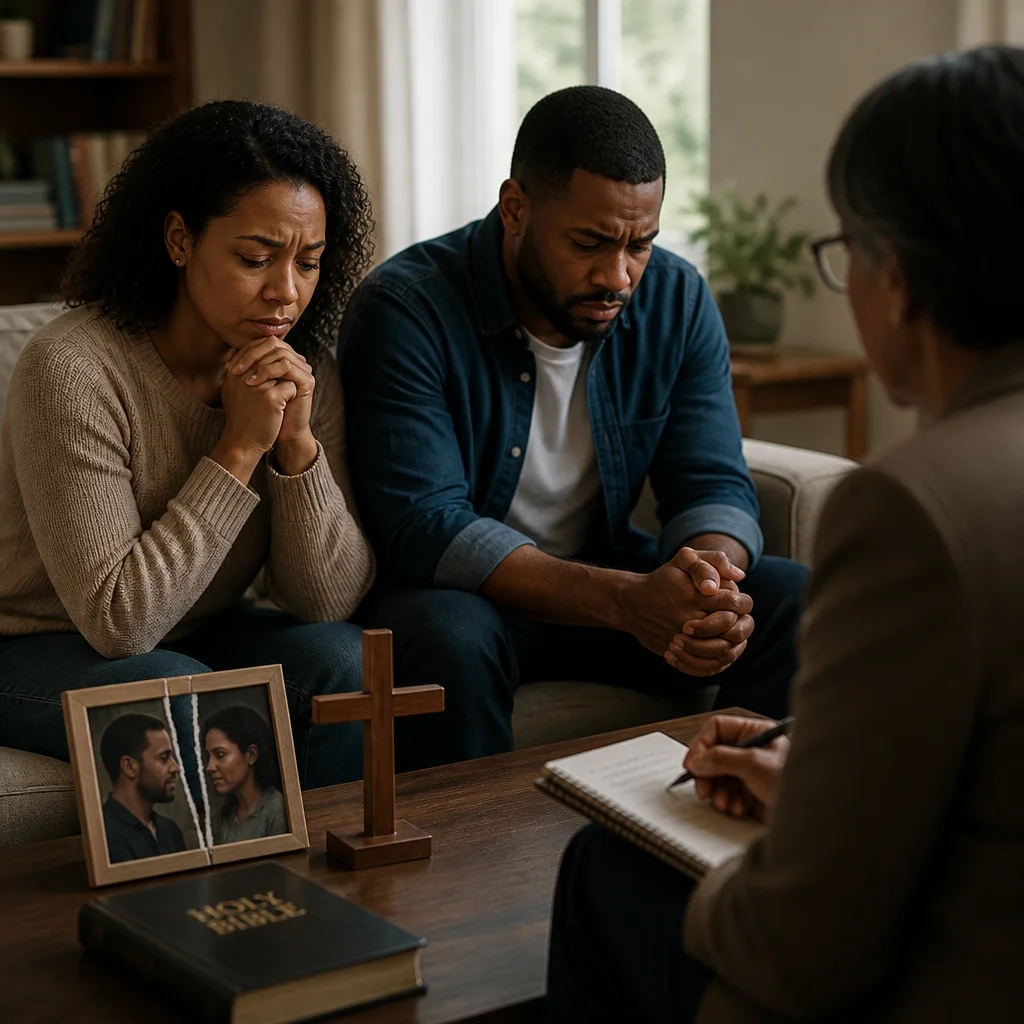
Additionally, faith-centered couples often carry the weight of what others in their community might think. The pressure to “look fine” publicly while privately hurting can intensify isolation and prevent access to the support you genuinely need. Recovery that honors your faith must also create safety to be honest about struggle.
Why Our Trauma-Informed Approach Transforms Recovery Outcomes
Infidelity is a trauma. The betrayal destabilizes your sense of safety, rewrites your understanding of your partner, and disrupts the narrative you believed about your relationship and future. Without acknowledging this reality, couples often get stuck in blame cycles or premature attempts at forgiveness that haven’t actually processed the underlying hurt.
Our trauma-informed framework recognizes that recovery requires sequential, intentional steps. First, you must achieve stabilization and safety. This means creating a therapeutic space where both partners can name what happened and what they’re experiencing without dismissal or defensiveness. It’s not about assigning blame; it’s about truthful acknowledgment that forms the ground on which healing can build.
From there, we work through the actual trauma response. Infidelity activates the nervous system’s threat detection. Your brain may replay scenarios obsessively, creating hypervigilance about your partner’s whereabouts or communications. These aren’t character flaws; they’re expected trauma responses. Trauma-informed care helps you understand and gradually regulate these responses through evidence-based techniques.
Only after stabilization and trauma processing can genuine relational repair begin. This is where faith-integrated work deepens. Your spiritual beliefs become a resource for understanding forgiveness not as immediate emotional absolution, but as a long-term practice of releasing resentment and rebuilding connection according to your values.
This sequenced approach dramatically improves outcomes because it respects the actual neurobiology and spiritual reality of recovery rather than rushing couples toward reconciliation before the foundation is secure.
How We Integrate Faith, Science, and Therapeutic Expertise
Our clinical team brings credentials that span both domains. We employ licensed therapists trained in evidence-based modalities like Emotionally Focused Therapy (EFT) and trauma-informed care, combined with deep expertise in Christian counseling and the spiritual dimensions of healing. This isn’t a surface-level acknowledgment of faith; it’s integrated throughout every phase of treatment.
When we work with you, faith isn’t compartmentalized into occasional reflection. Instead, we explore how your beliefs inform your understanding of forgiveness, reconciliation, covenant, and purpose. We might examine scriptural perspectives on forgiveness while simultaneously validating that true healing is a process, not an instantaneous decision. We recognize that your faith tradition offers wisdom for moving through crisis, and we help you access that wisdom in ways that feel authentic rather than imposed.
Simultaneously, we ground everything in what research shows actually heals trauma and restores relationships. This means using proven techniques for processing betrayal trauma, rebuilding safety, and reestablishing emotional connection. Scientific evidence and spiritual truth aren’t in conflict; they’re complementary frameworks.
Our therapists also maintain cultural competency and denominational awareness. Recovery looks different for Baptist couples than for Pentecostal ones, different for interfaith couples than homogeneous faith partnerships. We honor these distinctions rather than applying a one-size-fits-all approach.
The LEAPS Intensive Model: Accelerated Healing for Couples

For couples who need more than weekly hour-long sessions, we offer intensive therapy and coaching retreats designed specifically for relationship crises. These concentrated experiences create conditions for significant breakthrough that standard once-weekly appointments often cannot achieve.
During an intensive, you remove yourselves from the daily distractions and stressors that normally consume your attention. You engage in multiple therapy sessions across consecutive days, allowing emotional momentum to build naturally. Couples frequently report that they accomplish in a few days what might take months in traditional weekly therapy.
Our intensives combine individual and couples work. The therapist meets with each partner separately to understand their experience without the other’s presence or defenses, then facilitates couples work where breakthroughs can happen in real time. We integrate spiritual reflection, guided conversations about values and faith, and practical tools for moving forward.
For many couples, an intensive serves as a catalyst that either confirms their commitment to repair and moves them into active healing, or creates clarity that the relationship cannot be restored. Either outcome is valuable because it’s rooted in honest engagement rather than avoidance.
Rebuilding Trust Through Specialized Infidelity Recovery Protocols
Trust isn’t rebuilt through declarations or promises. It’s rebuilt through thousands of small, consistent interactions where a partner demonstrates reliability and transparency. Our infidelity recovery therapy protocols help couples establish this foundation methodically.
We work with the unfaithful partner to understand what led to the infidelity. This isn’t about blame-shifting or minimizing responsibility; it’s about genuine insight. Often, infidelity emerges from personal vulnerabilities, unmet needs, or avoidance patterns that existed before the affair. Understanding these doesn’t excuse the betrayal, but it prevents repeating the cycle.
Simultaneously, we help the betrayed partner understand that their pain is valid and that rebuilding trust is their decision to make on their timeline, not their partner’s. We establish agreements that support transparency without creating surveillance-based relationships that simply move trauma into a different form.
Protocols include structured conversations about what happened, what needs to shift going forward, and how both partners will respond when trust-breaking moments surface again (because recovery is nonlinear). We help couples develop rituals of reconnection, establish healthy boundaries, and create communication systems that support ongoing repair.
Our Evidence-Based Clinical Framework Versus Generic Solutions
The difference between our approach and generic solutions becomes clearest when examining outcomes. Couples who engage in intentional, trauma-informed, faith-integrated recovery show dramatically better long-term stability and satisfaction than those who attempt quick reconciliation or rely on self-help strategies alone.
Our framework draws on decades of research in attachment theory, trauma neurobiology, and therapeutic approaches proven effective for infidelity recovery. We measure progress not just through self-report but through observable shifts in nervous system regulation, communication patterns, and relational safety. When a partner can discuss the affair without their heart rate spiking, when conversations can happen without escalation, you’re seeing genuine healing.
Generic solutions often rely on willpower and positive thinking. “Just move past it.” “Forgive and forget.” These directives ignore the actual work of trauma recovery and the realistic timeline for rebuilding trust. They also typically ignore faith dimensions entirely, leaving couples to integrate these pieces on their own or suppress their spiritual questions to comply with secular recovery models.
By contrast, our evidence-based approach acknowledges that healing is both neurobiological and spiritual. It requires processing emotion, rewiring nervous system responses, establishing new behavioral patterns, and integrating meaning through your faith framework. This comprehensive work takes time, but it produces lasting transformation.
Real Transformation: From Betrayal to Renewed Purpose
Many couples who engage deeply in faith-centered infidelity recovery report that their marriage emerges not just intact but actually deeper and more meaningful than before. This isn’t because the infidelity was good; it’s because working through profound crisis with professional support and spiritual commitment creates a new relationship built on honest awareness and intentional choice.
We’ve worked with couples who moved from contemplating divorce to rebuilding intimacy and recommitment. They often describe a shift in how they understand forgiveness, vulnerability, and their faith. Many report that the crisis became a turning point where they finally addressed patterns that had been weakening the marriage for years. Others clarify that they cannot reconcile, and they do so with clarity and integrity rather than lingering resentment.
What changes through our work isn’t just the marriage or the relationship status. It’s often the individuals themselves. Partners develop deeper self-awareness, greater emotional regulation, and clearer alignment between their values and their choices moving forward.
Begin Your Faith-Centered Infidelity Recovery Journey With Us
If infidelity has shattered your marriage and you need support that honors both your faith and the actual neurobiology of healing, we’re here. Our team at LEAPS Inc. specializes in exactly this intersection: clinical expertise, trauma-informed care, and genuine respect for faith-centered recovery.
Start by contacting us to discuss your situation confidentially. We can help you determine whether intensive work, ongoing therapy, or another approach fits your timeline and needs. Our goal isn’t to convince you to stay married; it’s to help you move through this crisis with honesty, professional support, and integration of your deepest values.
Your marriage crisis doesn’t have to define your future. With intentional, faith-integrated, evidence-based support, couples move from devastation toward clarity, healing, and genuine restoration. We’re ready to support that journey.
Call us today for a free 15 minute consultation.
Frequently Asked Questions (FAQ)
How do we integrate faith with evidence-based therapy in infidelity recovery?
We combine clinical best practices with Christian values and biblical principles to address both the emotional trauma of betrayal and the spiritual dimensions of healing. Our therapists understand that for faith-centered individuals, recovery isn’t complete without addressing how infidelity affects your relationship with God, your spouse, and your sense of purpose. We’ve developed specialized protocols that honor your beliefs while utilizing trauma-informed therapeutic techniques proven to restore trust and rebuild marriages.
Why is our approach different from generic relationship coaching for affairs?
We recognize that infidelity in faith-based relationships carries unique pain and complexity that standard coaching cannot adequately address. Our team holds advanced clinical credentials and specializes specifically in affair recovery rather than offering generalized relationship advice. We work with the spiritual dimensions of betrayal, guilt, and redemption alongside the psychological and relational factors, which creates deeper and more lasting transformation for couples navigating this crisis.
What makes our intensive retreat model effective for accelerated healing?
Our LEAPS Intensive Model removes you from daily distractions and creates a concentrated environment where couples can process trauma, rebuild communication, and reconnect under professional guidance. We combine individual therapy, couples sessions, and faith-integrated coaching over several days, allowing you to make significant progress rather than waiting months between weekly appointments. This immersive approach has consistently helped our clients move from crisis and betrayal toward genuine restoration and renewed purpose in their marriages.