

What if the most intimidating hour of your week actually became the catalyst for your relationship’s greatest evolution? It’s natural to feel a heavy weight of anxiety as you consider opening your private life to a professional. You might fear being ganged up on or worry that a therapist will confirm your worst suspicion; that the connection is simply too far gone to save. These feelings are common, yet they often stem from a misunderstanding of the modern therapeutic process.
In this guide, we reframe that initial meeting from a clinical interrogation into a strategic consultation. You’ll discover exactly how to navigate couples therapy what to expect first session by viewing it as a visionary blueprint for your shared future rather than a post-mortem of your past. We’ll outline the structured roadmap of your first hour, explain how to prepare your mindset for maximum impact, and show you how a seasoned mentor ensures every voice is heard without judgment. By the end, you’ll see that transformation isn’t just possible; it’s a strategic objective designed to unlock the peak potential of your family ecosystem.
Key Takeaways
- Shift your perspective from a defensive courtroom mindset to a collaborative strategic milestone where your relationship’s peak potential is the primary focus.
- Gain clarity on couples therapy what to expect first session by reviewing the methodical steps of the intake process, from setting borders to revisiting your original bond.
- Prepare for deep, visionary inquiries that move beyond surface-level complaints to address the underlying health of your partnership and its impact on your family ecosystem.
- Discover practical tools like the I-Statement audit to help you show up with emotional ownership and a mindset ready for professional transformation.
- Evaluate whether your current goals require the steady rhythm of traditional sessions or the accelerated, high-impact results of a specialized Therapy Intensive.
Navigating the Threshold: Why the First Session is a Strategic Milestone
Entering a therapist’s office for the first time isn’t a sign of relational failure; it’s a strategic pivot toward a more intentional future. While many couples view this meeting as a passive “meet-and-greet,” it is actually the critical “Intake and Alignment” phase. This hour serves as the diagnostic foundation where your family ecosystem is mapped and your collective goals are codified. Understanding What is Couples Therapy? involves recognizing it as a professional intervention designed to audit the health of your bond. When exploring couples therapy what to expect first session, it helps to view the experience as a high-level consultation for your most important partnership.
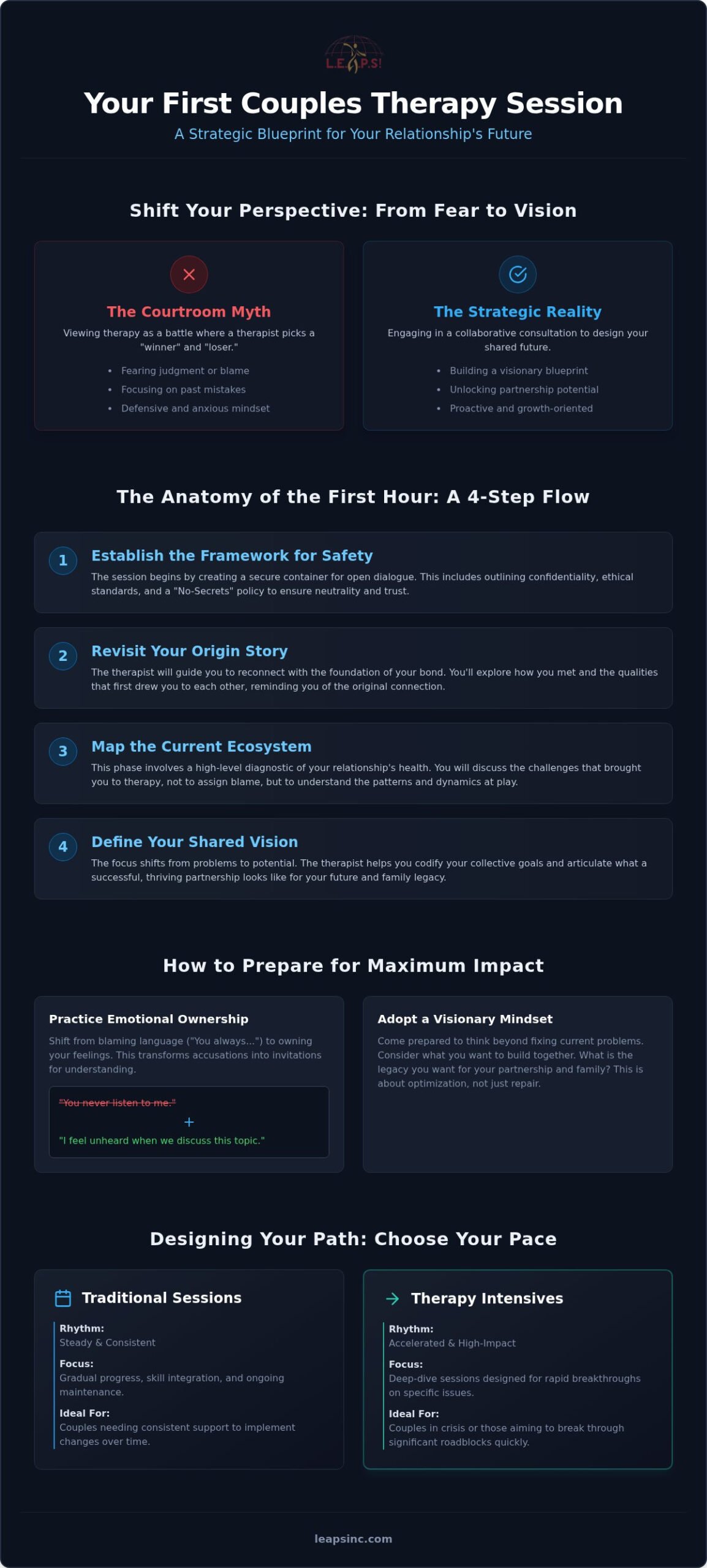
One of the most pervasive fears is the “Courtroom Myth,” where partners expect the therapist to act as a judge who declares a winner and a loser. In a professional clinical setting, the therapist never takes sides. Instead, the focus shifts from individual “personal power” and being “right” to the “partnership potential” that exists between you. This transition requires significant courage, especially when embarking on the path of Modern Connection. It’s about moving from a defensive posture to a visionary one.
To better understand this concept, watch this helpful video:
The Psychology of the “First Step” Anxiety
It’s natural to feel a surge of vulnerability before you begin. If you’re wondering about couples therapy what to expect first session, start by normalizing your anxiety. Apprehension isn’t a warning to stay away; it’s a signal of how much you still value the relationship. Investment often feels like nervousness. Your therapist acts as a “secure container,” providing the structure and professional boundaries needed to hold difficult conversations that might otherwise spiral at home. This safety allows both individuals to speak their truth without the fear of immediate retaliation or dismissal.
The Visionary Perspective on Relationship Growth
We often think of therapy as a reactive measure, but the most successful couples use it as a proactive tool for optimization. There are many reasons people go to therapy, ranging from crisis restoration to high-performance tuning. This visionary approach moves the conversation beyond simple problem-solving and toward “purpose-finding.” You aren’t just fixing what’s broken; you’re designing a legacy of emotional depth and shared destiny. This sets a sophisticated tone for the work ahead, treating your partnership with the same strategic rigor you’d apply to an executive leadership role within a business.
The Anatomy of the Intake: A Step-by-Step Flow of the First Hour
The first sixty minutes of your therapeutic journey follow a deliberate, methodical sequence designed to move you from initial apprehension toward a strategic vision. This isn’t a casual chat; it’s a high-level diagnostic session. When considering couples therapy what to expect first session, it’s helpful to view the intake as a structured process that builds a secure foundation for the transformative work ahead. This hour is about alignment, not just conversation.
Establishing the Framework for Safety
The hour begins with a rigorous establishment of ground rules and professional boundaries. Your mentor will outline the therapeutic philosophy that guides the practice, emphasizing confidentiality and ethical standards. A critical component here is the “No-Secrets” policy. This ensures that the therapist maintains a transparent, neutral stance, preventing any one partner from creating a private alliance that excludes the other. By managing interruptions and ensuring both voices carry equal weight, the therapist creates a secure container where vulnerability is protected and respect is mandated from the very first minute.
Mapping the Relationship History
Once the framework is set, the focus shifts to your “Origin Story.” This isn’t just a trip down memory lane; it’s a strategic exploration of the initial bond and shared history that brought you together. As noted by The Gottman Institute on the first therapy session, revisiting these early successes helps identify where the vision for the relationship first became clouded. We examine family-of-origin influences to understand how past programming impacts current behavior within your ecosystem. This mapping allows us to see the “Presenting Problem”-the surface-level argument-and distinguish it from the “Root Dynamic,” which is the underlying cycle of conflict.
The final phase of the hour involves preliminary goal setting. We move beyond simply wanting the fighting to stop and begin defining what “success” looks like for both individuals and the partnership. You’ll articulate a shared vision for your future, ensuring that the roadmap we create is aligned with your collective destiny. This structured approach ensures that when you leave the first hour, you aren’t just relieved; you’re equipped with a sense of direction. If you’re ready to begin this diagnostic alignment, you can initiate your consultation to start the process of restoration and growth.
Strategic Inquiry: Core Questions You Should Expect to Answer
Strategic inquiry is the engine of the first hour. Your therapist won’t simply ask how you’re feeling; they will probe for the structural integrity of your connection. When preparing for couples therapy what to expect first session, anticipate questions that challenge your current perspective. These inquiries are designed to reveal the latent potential within your partnership and uncover the behavioral blueprints that either support or sabotage your bond. This high-level diagnostic approach is a hallmark of professional couples therapy.
Expect to address these four visionary questions during your consultation:
- “What is the primary cycle of conflict that brings you here today?” This shifts the focus from individual blame to the recurring pattern you both inhabit.
- “How does your individual growth impact the health of the partnership?” A relationship is an ecosystem; when one part evolves, the whole system must adapt to maintain equilibrium.
- “What are the shared values that still serve as the foundation of your home?” We look for the “bedrock” that remains even when the surface of the relationship is stormy.
- “If this therapy is successful, how will your daily life feel different in six months?” This defines the strategic objective for our work together and creates a measurable vision for success.
Addressing Divergent Goals
It’s common for one partner to arrive with a “burning desire” for change while the other feels hesitant or even ready to exit. This is known as a mixed-agenda dynamic. In these cases, the first session serves as a space for Discernment Counseling. This specialized intervention isn’t about fixing the relationship immediately; it’s about deciding whether the relationship is a candidate for restoration. By finding a “common denominator,” we ensure that both individuals feel represented in the roadmap. For a deeper look at these initial hurdles, consult this guide to your first couples counseling session.
The “Conflict Cycle” Discovery
Most couples enter therapy identifying their partner as the problem. A visionary mentor reframes this by identifying the systemic loops, such as the pursuer-distancer or the attack-defend patterns, that dictate your interactions. We move the focus from individual flaws to the “system” that exists between you. The Cycle of Conflict is the true antagonist of the relationship. By mapping this system, we stop fighting each other and start fighting the cycle together. This transition is essential for moving from reactive defense to proactive alignment, ensuring the partnership ecosystem can reach its maximum potential. Complementing this work with structured emotional intimacy exercises for couples can accelerate the process of rebuilding psychological safety and deepening your connection between sessions.
Preparation for the Visionary Couple: How to Show Up Ready
Preparation is the bridge between a chaotic discussion and a strategic breakthrough. While the therapist provides the structure, your internal readiness determines the speed of your progress. When you understand couples therapy what to expect first session, you realize that the work begins before you even enter the room. Arriving with a “Growth Mindset” means viewing your therapist as a high-level consultant for your partnership’s future rather than a judge of its past. This shift in perspective allows you to move from defensive justification to collaborative exploration.
To maximize your time, complete the new client intake form ahead of your appointment. This logistical step ensures that the entire hour is dedicated to clinical work rather than administrative data entry. Additionally, practicing an “I-Statement” audit before you arrive can be transformative. Instead of cataloging your partner’s perceived failures, focus on taking ownership of your own emotional experience. This preparation creates a fertile ground for the therapist to help you unlock the latent abilities within your relationship ecosystem.
The High-Achiever’s Trap in Therapy
For executive leaders and high-performing professionals, there is a tendency to treat therapy like a high-stakes business negotiation. You might find yourself “intellectualizing” the conflict, using logic to bypass the deeper emotional vulnerability required for true change. This is the High-Achiever’s Trap. To find success, you must intentionally switch from “Executive Leader” mode to “Partner” mode. In this space, your credentials and strategic wins matter less than your ability to feel and express your internal depth. Transformation happens when you stop managing the session and start participating in it.
Practical Readiness Checklist
Showing up ready involves more than just emotional alignment; it requires logistical clarity. Use this checklist to ensure you are fully prepared for the diagnostic hour:
- Commitment Alignment: Arrive with a shared understanding of the financial and time commitment required for professional growth.
- Pre-Session Dialogue: Spend ten minutes with your partner briefly discussing your primary hope for the consultation.
- The Reflection Buffer: Plan for a “Post-Session Hangover” by setting aside 30 minutes of buffer time after the hour.
This buffer time is essential for decompression and reflection. It prevents you from rushing back into a high-pressure work environment or a household routine while your emotional system is still processing the session’s insights. If you are ready to apply this level of strategic rigor to your connection, schedule your initial couples consultation and begin the journey toward your relationship’s peak potential.
Designing Your Path: Traditional Sessions vs. Therapy Intensives
The conclusion of your first hour marks the transition from diagnostic mapping to strategic action. Once your mentor has audited the health of your partnership ecosystem, they will propose a clinical path tailored to your specific goals. While understanding couples therapy what to expect first session provides the necessary clarity to begin, the choice of how you move forward determines the velocity of your growth. Most couples find themselves evaluating two distinct models: the steady rhythm of traditional weekly sessions or the high-impact acceleration of a therapy intensive.
Traditional weekly therapy offers a structured environment for long-term, incremental evolution. This model is ideal for couples who prefer a consistent, recurring space to integrate small, sustainable changes over several months. It provides a steady cadence for restoration, allowing you to process life events as they happen. However, for couples who feel they are “racing against time” or those who want to bypass months of slow progress, the visionary mentor approach often points toward a more immersive experience.
The Intensive Advantage for Busy Leaders
For high-achieving professionals and executive leaders, the traditional 50-minute hour can sometimes feel insufficient. Standard sessions often require “warm-up” time to reach the core issues, followed by a wind-down period to ensure you are regulated before leaving. By contrast, therapy intensives eliminate this repetitive ramp-up phase. By dedicating several hours or an entire weekend to a Therapy Intensive, you create the space for profound breakthroughs that might otherwise take half a year to achieve. This model is specifically designed for couples in acute crisis or those seeking a total relationship reset, focusing on rapid transformation rather than incremental change.
Next Steps: Committing to the Journey
The final phase of your clinical alignment involves confirming the “fit” between your partnership and your therapist. A visionary mentor acts as a high-level consultant for your bond, so mutual trust and professional chemistry are essential. If the alignment is clear, the path forward involves scheduling your initial appointment or securing a block for an intensive deep-dive. Your apprehension about couples therapy what to expect first session has now been replaced by a strategic blueprint. Your relationship’s maximum potential is no longer a distant hope; it is a defined objective. Committing to this path is the ultimate act of leadership for your shared future.
Your Strategic Pivot Toward Relational Excellence
You’ve moved past the uncertainty of the unknown. By understanding couples therapy what to expect first session, you’ve transformed a moment of vulnerability into a strategic advantage. You now recognize that the intake is a diagnostic foundation designed to map your family ecosystem and identify the systemic cycles that hinder your growth. Whether you choose the steady rhythm of weekly sessions or the high-impact acceleration of our specialized Therapy Intensives, you are no longer drifting. You are designing a legacy.
LEAPS Inc., clinically led by Dr. John E. N. Daniel, is nationally recognized for integrating visionary leadership with deep emotional health. We don’t just solve problems; we facilitate peak potential. It’s time to stop surviving your relationship and start leading it toward its true destiny. The tools for restoration and optimization are ready. Your connection’s greatest evolution starts with a single, intentional choice.
Begin your journey toward a visionary partnership by scheduling your initial appointment today.
Frequently Asked Questions
Do we have to talk about our childhood in the first session?
We focus primarily on your current dynamics, though we do explore family-of-origin context to understand your emotional programming. The first hour is about mapping your ecosystem, so we look for patterns that started early but manifest today. You won’t spend the whole time on the past. Instead, we use those insights to unlock your future potential and break cycles that no longer serve your visionary partnership.
What if my partner refuses to speak or is hostile during the session?
A seasoned therapist acts as a secure container for these difficult moments. If a partner is resistant or hostile, the mentor uses professional interventions to de-escalate and ensure safety. We don’t force participation; we invite it by addressing the underlying fears. Managing these defensive cycles is a core part of the work. It allows both individuals to feel heard without the session devolving into a courtroom battle.
How many sessions will it take before we see real improvement?
While every ecosystem is unique, a full course of therapy typically spans 12 to 25 sessions. Some couples experience a shift in perspective immediately after the first hour, while others require more time to dismantle deep-seated patterns. For those seeking rapid transformation, a Therapy Intensive can condense months of work into a single weekend. The goal is always sustainable, peak-state alignment rather than a temporary fix.
Will the therapist tell us if we should get a divorce?
Your therapist will not tell you whether to separate or stay together. Our role is to provide the clinical framework and strategic insights you need to make that decision yourselves. We help you map the health of the partnership and explore its latent potential. If the relationship is in a state of mixed-agenda conflict, we utilize Discernment Counseling to help you gain clarity on your shared destiny.
Is couples therapy covered by insurance, or is it an out-of-pocket investment?
Most insurance plans do not cover couples therapy as a standalone service unless one partner has a diagnosed mental health condition. In those cases, the sessions are framed as part of that individual’s treatment. Many high-achieving couples view this as a strategic investment in their family ecosystem rather than a medical expense. You should check with your provider regarding EAP benefits or specific 90847 billing codes for conjoint therapy.
Can we do the first session virtually, or is in-person better?
Research indicates that online therapy is as effective as in-person sessions, with one study showing an 86% improvement rate for virtual participants. When considering couples therapy what to expect first session, the format depends on your logistical needs and comfort. Virtual sessions offer accessibility for busy leaders, while in-person meetings provide a physical secure container. Both avenues allow for deep, visionary work and professional clinical alignment.
What happens if I feel like the therapist is taking my partner’s side?
Neutrality is a foundational ethical standard in couples work. If you feel the therapist is taking sides, it’s essential to voice this during the session. This feeling is often a reflection of the conflict cycle itself rather than a clinical reality. A visionary mentor uses these moments to audit the dynamic and ensure both partners are moving toward their maximum potential without any one voice being sidelined or judged.
Should we have an individual session before the first joint session?
We typically recommend a joint session first to establish the partnership as the primary client. This prevents the formation of secret alliances and ensures transparency from the start. Some clinical frameworks include individual assessments later in the intake process to explore internal depth. Starting together sets a collaborative tone for couples therapy what to expect first session, emphasizing that the focus is on the ecosystem rather than individual flaws.