

What if the missing link to your next professional breakthrough isn’t a new business strategy, but a therapeutic partnership that mirrors your ambition? You’ve likely felt the frustration of being treated as a clinical case study rather than a high-achiever with a destiny to fulfill. It’s exhausting to spend valuable hours explaining the nuances of a high-pressure lifestyle to someone who doesn’t grasp the weight of visionary leadership or the complexities of executive life.
Understanding how to find a therapist that fits you shouldn’t feel like a compromise between your mental health and your professional identity. This guide provides a methodical framework for selecting a practitioner who aligns with your personal worldview and professional aspirations. We’ll move beyond the standard clinical search to help you identify a visionary mentor who acts as a catalyst for your transformation. You’ll gain a clear roadmap for the selection process, ensuring you achieve a state of peak emotional and professional performance without wasting time on misaligned philosophies or rigid systems that fail to see your maximum potential.
Key Takeaways
- Understand why the therapeutic alliance is the primary predictor of successful outcomes and how shared visionary goals accelerate your personal growth.
- Master the strategic process of how to find a therapist that fits you by evaluating the three pillars: clinical credentials, worldview alignment, and long-term vision.
- Compare the benefits of consistent, incremental progress in traditional sessions against the deep-dive clinical intervention provided by therapy intensives.
- Learn high-level consultation questions designed to vet a therapist’s ability to support both your emotional vulnerability and your professional ambition.
- Discover how integrating clinical excellence with executive development can unlock your maximum potential and align your internal well-being with your ultimate destiny.
Beyond the Directory: Why Strategic Fit is the Foundation of Growth
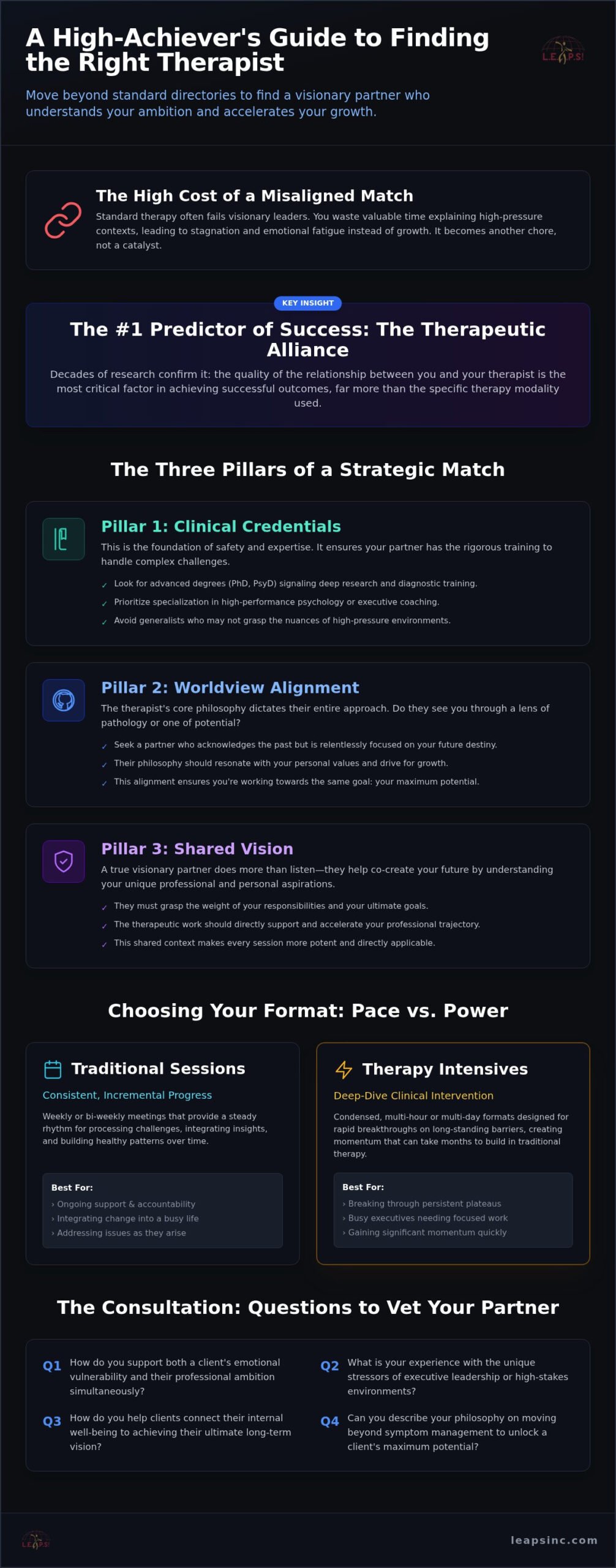
Finding a provider often feels like a logistical hurdle rather than a strategic decision. Most directories prioritize geographic proximity or insurance panels, treating your mental health like a commodity. However, true growth requires more than just an open time slot. It demands therapeutic fit: a precise synergy between clinical skill, the therapist’s personality, and your specific long-term goals. This alignment is the bedrock of the therapeutic alliance, which decades of research consistently identify as the primary predictor of successful outcomes, regardless of the different types of psychotherapy employed.
For high-achievers, the stakes are even higher. You aren’t just looking for symptom management to get through the week. You’re seeking visionary transformation. Standard clinical systems often fail because they view you as a patient to be stabilized rather than a leader to be empowered. When you understand how to find a therapist that fits you, you stop looking for a “fixer” and start looking for a strategic partner who understands the high-pressure environment you inhabit every day. If you are also looking for a comprehensive suite of medical services that includes both primary health care and psychiatric support, click here.
For high-achieving women, this strategic partnership often requires a deeper understanding of how biological transitions and hormonal health impact professional performance. To see how virtual, hormone-informed care can be integrated into your personal development plan, learn more about Women’s Mental Health Specialist.
The Cost of a Misaligned Match
Settling for a therapist who doesn’t understand your professional context leads to profound stagnation. You might spend half your session explaining industry jargon or the weight of fiduciary responsibility, leaving little room for actual clinical work. For those in the medical sector, managing a career often involves complex business decisions, where firms like Healthcare Biz Brokers, Inc. are vital for navigating practice sales or valuations. This mismatch creates emotional fatigue. Retelling your story to multiple ill-fitted providers isn’t just a waste of time; it’s a drain on your resilience. Without a shared understanding of your drive, therapy becomes another chore on your calendar rather than a catalyst for your destiny.
Defining Your Search Parameters
Reframing your search as an investment in your future self changes your criteria. Move beyond zip codes and look for specialized expertise that mirrors your aspirations. You need to determine if your current needs are best met through individual therapy or if a more intensive intervention is required to break through long-standing barriers. Choosing a partner who aligns with your worldview is the first step toward peak performance. It’s about finding someone who sees your maximum potential and possesses the clinical rigor to help you reach it. Learning how to find a therapist that fits you is the most important executive decision you’ll make this year.
The Three Pillars of Therapeutic Match: Credentials, Worldview, and Vision
Moving beyond a simple list of names requires a structured evaluation of what truly constitutes a “match.” Learning how to find a therapist that fits you requires a rigorous assessment of three specific pillars: clinical credentials, philosophical worldview, and a shared vision for your future. While most directories focus on insurance codes, your search must prioritize the depth of expertise required to handle high-level personal and professional challenges. Selecting a provider is not just about finding someone to listen; it’s about identifying a strategic partner—such as the specialists at the Gender Identity Center—who understands the weight of your responsibilities and the nuances of your personal identity.
Clinical credentials provide the foundation of safety and expertise. Understanding the different types of mental health providers is essential, as the clinical weight of a PhD or PsyD often signals a depth of research and diagnostic training that generalists may lack. However, credentials alone are insufficient without a compatible therapeutic philosophy. This philosophy dictates whether your therapist views you through a lens of pathology or a lens of potential. A visionary provider acknowledges your past trauma but remains relentlessly focused on your destiny and the fulfillment of your maximum potential.
Vetting Clinical Expertise and Specialization
High-achievers often encounter complex stressors that standard “talk therapy” cannot resolve. You must interpret various types of therapy, such as Cognitive Behavioral Therapy (CBT) or Psychodynamic approaches, through the lens of your specific needs. Specialized training in high-performance psychology or high-conflict resolution is vital for those in executive roles. Generalists often struggle to provide the nuanced feedback necessary for leaders who operate in high-pressure environments. If you are ready to elevate your mental strategy, you might schedule an initial consultation to discuss these specialized needs.
The Role of Shared Values and Faith
Worldview alignment accelerates trust and ensures that your ethical framework is respected rather than questioned. For many, this means seeking Christian counseling or other faith-integrated approaches that honor their spiritual convictions. Your personal belief system should serve as a catalyst for progress, not a barrier. When your therapist understands your core values, the work moves faster; you don’t have to defend your “Why” before addressing your “How.” This intersection of faith and clinical rigor creates a secure space where you can explore emotional vulnerability without compromising your professional integrity or personal identity.
Choosing Your Format: Traditional Sessions vs. Therapy Intensives
Deciding how to find a therapist that fits you involves more than vetting a biography; it requires selecting a format that respects the velocity of your life. Most clinical systems default to the standard 50-minute weekly session. While this traditional rhythm provides a consistent sanctuary for incremental growth and long-term resilience, it may not suit every professional season. For the executive or entrepreneur, time is the most finite resource. You must evaluate whether your current objectives require a steady build or a high-octane breakthrough to unlock your maximum potential.
Traditional therapy offers a reliable structure for processing ongoing stressors and integrating emotional insights into daily life. It’s a marathon approach to well-being. However, there is a strategic advantage to “condensed” growth. Determining how to find a therapist that fits you means identifying a provider who offers flexible, high-impact interventions that mirror the intensity of your professional world. Choosing the right format ensures that your therapeutic work accelerates your progress rather than becoming another administrative burden on your calendar.
When to Opt for a Therapy Intensive
There are moments when weekly sessions feel insufficient for the weight of the challenge. Therapy intensives provide a deep-dive approach, allowing for hours or days of focused clinical work. This format is ideal for addressing acute challenges like relationship crises, burnout, or major career pivots with speed. By bypassing the weekly “warm-up” period, intensives facilitate profound psychological breakthroughs. They allow you to confront deep-seated barriers and emerge with a clear, actionable roadmap for your transformation. Integrating these intensives into a broader personal development plan creates a powerful catalyst for change.
The Synergy of Therapy and Coaching
True visionary alignment often requires a blend of clinical depth and strategic foresight. While therapy focuses on healing the past and resolving internal conflict, executive coaching focuses on architecting the future. These disciplines aren’t mutually exclusive; they’re two sides of the same coin. The Visionary Mentor model bridges this gap by merging psychological expertise with high-level professional strategy. This holistic integration ensures that your emotional health supports your strategic advancement. It allows you to move from a state of mere survival to one of peak performance, where your internal well-being and professional destiny are perfectly aligned.
The Consultation Interview: Questions to Vet Your Visionary Partner
Once you have identified potential candidates, the initial consultation serves as your most critical vetting tool. This is not merely a formality; it is a high-stakes interview to determine if the practitioner possesses the depth to support your trajectory. Understanding how to find a therapist that fits you requires moving beyond surface-level questions about fees or availability. You must assess their presence, energy, and what we call authoritative empathy. This unique trait allows a provider to remain deeply connected to your human experience while maintaining the clinical distance necessary to offer objective, strategic guidance.
During this first contact, observe the therapist’s communication style. Are they organized and methodical, or does their approach feel scattered? A visionary partner should mirror the professionalism you expect in your own industry, much like how WiFi Therapist provides professional, independent technology consulting to ensure your home office operates with executive-level efficiency. You are seeking a mentor who can bridge the gap between psychological healing and executive advancement. To ensure your framework supports a rapid pace of growth, consider asking these direct questions:
- “How do you specifically integrate professional success and high-pressure leadership dynamics with emotional health?”
- “What is your philosophical view on an individual’s life purpose and destiny?”
- “In what ways do you challenge your clients to reach their maximum potential rather than just managing their current symptoms?”
Identifying Red Flags in the First Contact
High-achievers require a specific type of clinical engagement. A primary red flag is a purely passive listening style. While traditional therapy often relies on the client to lead every session, a visionary partnership requires strategic intervention and active feedback. If a therapist seems dismissive of your professional ambitions or appears overwhelmed by the unique pressures of your lifestyle, they are likely a poor fit. A lack of clear structure in their initial response often signals a lack of the methodical rigor necessary for deep-dive transformation. In contrast, providers like Prague Integration demonstrate this rigor through specialized diagnostic processes and tailored support for the expatriate community. If you sense a mismatch in energy or ambition, trust that intuition immediately.
Gauging the ‘Visionary’ Factor
The right partner will not be intimidated by your success or the high-stakes decisions you face daily. They should possess a comfort level with leadership dynamics and the complexities of corporate or entrepreneurial life. Visionary alignment is the intersection of clinical safety and aspirational challenge. It ensures that while you are doing the hard work of internal healing, you are also being propelled toward your peak potential. If you are ready to test this alignment with an expert who understands your drive, you can schedule an initial consultation to begin the vetting process.
Embarking on Your Transformation: The LEAPS Inc. Approach
The search for elite therapeutic support often ends where clinical rigor meets executive foresight. At LEAPS Inc., we’ve dismantled the traditional patient model to create a strategic alliance designed specifically for high-achievers. We recognize that the process of how to find a therapist that fits you is actually a search for a peer who can hold space for both your deepest vulnerabilities and your highest ambitions. Our approach treats emotional well-being as the primary catalyst for professional transformation, ensuring that your mental health supports, rather than hinders, your professional trajectory.
We move you beyond the passive role of a “patient” into the active role of an architect. This transition is essential for those who carry the weight of leadership and the responsibility of visionary thinking. By integrating psychological depth with strategic advancement, we provide a framework where your internal clarity becomes the foundation for your external success. For those seeking to further their personal and professional development through expert-led training, check out Toby and Kate McCartney. Understanding how to find a therapist that fits you means identifying a practice that views your destiny as the ultimate goal of the clinical work.
The Onboarding Experience: Precision and Privacy
Precision begins before the first session. Our new client intake form is designed to capture the nuances of your worldview, your professional context, and your specific goals for growth. This data allows us to facilitate a curated matching process, aligning you with a provider who understands your “Why” from day one. For high-profile individuals, privacy is not a luxury; it’s a prerequisite. We maintain the highest standards of confidentiality, ensuring that your personal evolution remains entirely secure. Your first Visionary Consultation is more than a simple assessment. It is a strategic mapping of your future potential and a test of the synergy required for deep transformation.
Committing to the Journey
True transformation requires a definitive act of will. When you schedule an appointment, you aren’t just booking a service. You’re making a calculated commitment to your future self. We work with you to set clear milestones for your personal and professional growth, moving from a state of seeking help to one of executing a vision for your life. This partnership is designed to unlock latent abilities and facilitate peak performance in every area of your life. Your destiny is not a matter of chance; it’s a matter of choice. By choosing a partner who aligns with your visionary worldview, you claim the authority to architect a life of maximum potential and fulfillment.
Claim Your Maximum Potential through Strategic Alignment
Your journey toward peak performance and emotional resilience is too significant to leave to chance or generic directories. You now possess a methodical roadmap for how to find a therapist that fits you, moving beyond simple symptom management toward true visionary alignment. By prioritizing the pillars of clinical credentials, shared worldview, and future-focused vision, you ensure that your therapeutic work serves as a high-energy catalyst for your personal and professional destiny. Selecting a partner who mirrors your ambition is the most critical executive decision you’ll make for your well-being.
LEAPS Inc. offers a unique bridge between clinical excellence and strategic advancement. Led by the clinical authority of Dr. John E. N. Daniel, our practice provides a holistic integration of clinical therapy and executive coaching. Whether you require the consistent support of traditional sessions or the rapid transformation of specialized therapy intensives, our curated approach aligns your internal well-being with your maximum potential. Don’t settle for a counselor who only looks at your past; partner with a visionary mentor who understands the weight of your leadership.
Schedule your consultation with a visionary therapist today and take the first step toward architecting the life you were meant to lead. Your transformation begins with a single, strategic choice.
Frequently Asked Questions
How do I know if a therapist is a good fit after just one session?
You can often gauge fit by assessing if the therapist demonstrates authoritative empathy and a clear, methodical approach to your specific challenges. While deep trust takes time, the initial session should leave you feeling understood and challenged rather than merely observed. If the provider mirrors your professional intensity and respects your unique lifestyle pressures, it’s a strong indicator of long-term synergy.
Is it okay to switch therapists if I don’t feel a ‘visionary’ connection?
It’s absolutely appropriate to switch providers if you feel a lack of visionary alignment or if the therapist fails to grasp your high-stakes professional context. Sticking with a misaligned match leads to stagnation and emotional fatigue. Your growth is the priority; therefore, you should seek a partner who actively facilitates your destiny rather than one who simply offers passive listening.
What is the difference between a therapist and a life coach for executives?
Clinical therapy addresses deep-seated emotional barriers, trauma, and psychological health, whereas executive coaching focuses on strategic performance and leadership development. LEAPS Inc. bridges this gap by integrating both disciplines, ensuring that your internal healing supports your professional execution. This holistic model allows you to resolve the past while simultaneously architecting a high-impact future built on clinical rigor. For those who want to see how these professional standards are established at an international level, you can explore TA EMCC Senior Team Coach Academy.
Can I find a therapist who understands both my faith and my business goals?
Finding a provider who integrates faith-based values with high-level business strategy is entirely possible through specialized practices. When learning how to find a therapist that fits you, prioritize those who offer Christian counseling alongside executive development. This alignment ensures your ethical framework remains a catalyst for growth rather than a point of contention during your personal and professional transformation.
How long does it typically take to find the right therapist match?
The timeline for finding the right match varies, but a methodical search typically yields results within a few weeks. High-demand specialists in metropolitan areas often have wait times of 6 to 12 weeks for outpatient services. Understanding how to find a therapist that fits you through targeted consultation questions can accelerate this process by quickly filtering out ill-fitted providers who don’t share your visionary lens.
What should I do if the therapist I like doesn’t take my insurance?
If a preferred therapist is out-of-network, you should check your PPO insurance plan for out-of-network benefits. Many plans reimburse 50 to 80 percent of the session cost once you’ve met your deductible. Reframing the out-of-pocket expense as a strategic investment in your future potential can help you prioritize the quality of the match over initial cost barriers or administrative hurdles. If you are looking for transparent examples of how these costs are structured, you can explore Professional Mental Health Service Fees to gain clarity on the investment required for expert support.
How do therapy intensives differ from traditional weekly counseling sessions?
Therapy intensives offer a deep-dive approach that bypasses the weekly warm-up period, allowing for rapid breakthroughs in acute situations. Traditional weekly sessions provide a consistent, incremental rhythm for long-term emotional resilience. Choosing between them depends on whether your current life season requires a high-octane clinical intervention or steady, ongoing support for your personal and professional evolution toward peak performance.
What are the specific signs of a strong therapeutic alliance?
A strong therapeutic alliance is marked by mutual respect, clear communication, and a shared commitment to your specific growth milestones. You’ll feel a sense of clinical safety coupled with an aspirational challenge that propels you forward. This synergy is the most reliable predictor of success, ensuring that every session contributes directly to your ultimate destiny and the fulfillment of your maximum potential.