

A betrayal can make ordinary conversations feel tense, distant, or impossible, especially when unanswered questions and repeated conflict keep both partners on alert. Relationship therapy gives couples a structured place to understand the injury, create emotional safety, and decide what healthier connection should look like from here.
Why betrayal can make emotional connection feel out of reach
Betrayal can make emotional connection feel unreachable because it disrupts trust, expectations, and the couple’s sense of shared reality. Grief, anger, shame, uncertainty, and the loss of the relationship partners believed they had can all appear at once. A partner who was betrayed may search for answers, while the other partner may feel fear, remorse, defensiveness, or confusion about how to respond.
Secrecy and unanswered questions often make ordinary conversations feel unsafe. A question about a schedule, phone, or change in mood may carry much more emotional weight than it did before. Defensive communication and repeated conflict can then create distance, even when both partners want relief.
Relationship therapy can help when partners want to understand what happened, decide what comes next, or build healthier communication patterns while reconciliation remains uncertain. Early progress usually begins with emotional safety, not immediate forgiveness or a promise that the relationship will return to the past.
How infidelity and emotional affairs affect safety
Infidelity and emotional affairs can damage safety by making one partner question information, boundaries, priorities, and emotional availability. The injury may involve the affair itself as well as concealment, shifting explanations, or ongoing contact that keeps distress active. Therapy can help partners name these effects without reducing the experience to a single argument.
Why partners may need different things at the same time
Partners may need different forms of support at the same time because one may need answers and reassurance while the other needs help tolerating shame or taking responsibility. These needs can seem incompatible during conflict, but a structured process can give each person room to speak and listen. The goal is not to force identical feelings; it is to create safer ways to address them.
What happens first in relationship therapy after an affair
The first stage of relationship therapy usually focuses on understanding the relationship’s needs, stabilizing communication, and setting workable goals rather than deciding its entire future. At LEAPS Inc., therapy is client-centered, integrative, collaborative, and tailored to each relationship instead of following a one-size-fits-all sequence.
A therapist may help each partner identify emotional reactions, communication patterns, concerns, and hopes before moving into deeper repair work. This can include clarifying what feels unsafe, identifying conversations that repeatedly escalate, and discussing what each person needs from the therapy process. Couples do not have to resolve every question during the first conversation or session.
LEAPS Inc. provides specialized support for infidelity recovery and emotional affairs in Tampa and Orlando. Because availability and intake details can change, prospective clients should confirm current service options directly. The early work may focus on creating enough structure for honest conversations to happen without turning every session into another crisis.
Creating a structured space for difficult conversations
A structured therapy setting helps difficult conversations stay focused, paced, and emotionally safer. The therapist may help partners slow down accusations, identify the feeling underneath a reaction, and respond to the actual concern rather than an assumption. This structure does not erase pain, but it can reduce circular arguments and make room for accountability, questions, and clearer communication.
Separating immediate emotional needs from long-term decisions
Therapy can separate immediate needs, such as reassurance, boundaries, and calmer communication, from long-term decisions about staying together. A couple may need support today without knowing whether reconciliation is possible months from now. That distinction allows partners to take responsible next steps without making pressured promises or treating uncertainty as failure.
Which repair practices help partners rebuild trust over time
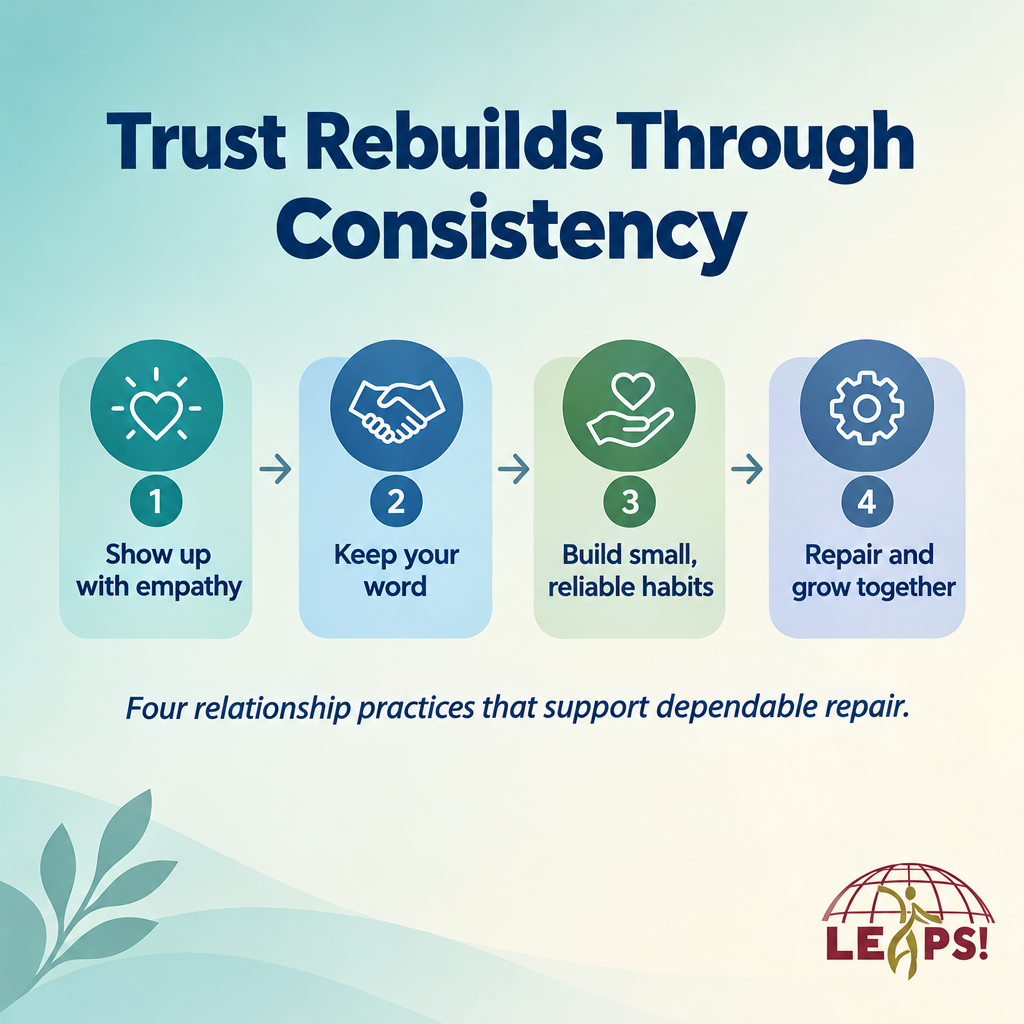
Trust rebuilds through repeated accountability and reliable behavior, not through promises made only during a crisis. Partners may discuss transparency, communication agreements, contact boundaries, privacy, expectations, and what to do when distress resurfaces. The exact agreements should fit the relationship and should be clear enough for both people to understand and evaluate.
At LEAPS Inc., trust-rebuilding therapy supports transparency, communication, boundary setting, expectation development, unresolved resentment, and intentional efforts to restore emotional safety. A practical recovery process may include these steps:
- Name the harm: Describe the betrayal and its effects without minimizing the loss, fear, anger, or confusion it caused.
- Answer questions responsibly: Discuss what can be answered honestly and identify ways to avoid evasive, defensive, or needlessly harmful exchanges.
- Agree on boundaries: Clarify contact, privacy, communication, and other expectations that support safety and reduce ambiguity.
- Follow through consistently: Match stated commitments with observable behavior over time, including during uncomfortable moments.
- Review progress with support: Revisit what is working, what remains painful, and what needs adjustment with qualified guidance.
Rebuilding trust is gradual. It depends on repeated behavior, honest communication, and each partner’s willingness to participate; therapy cannot guarantee a particular relationship outcome.
Transparency and accountability
Transparency becomes meaningful when it is specific, consistent, and connected to responsibility rather than used as a short-term performance. Partners may discuss what information is needed, how difficult questions will be handled, and how accountability will continue after the immediate crisis fades. A therapist can help distinguish responsible openness from conversations that become punishing or impossible to sustain.
Boundaries, expectations, and emotional safety
Boundaries and expectations give emotional safety a practical shape. Partners may clarify contact with another person, technology and privacy concerns, check-ins, conflict pauses, and what response is needed when anxiety returns. Agreements work best when both people understand them, can discuss changes, and recognize that safety grows through follow-through rather than control alone.
How therapy supports emotional connection instead of only resolving conflict
Relationship therapy supports emotional connection by helping partners notice the patterns that interrupt closeness, not only by settling the latest disagreement. Criticism, withdrawal, defensiveness, assumptions, and rapid escalation can become automatic after betrayal. Guided conversations and therapeutic exercises may help partners express hurt, needs, fears, and hopes with greater emotional awareness.
LEAPS Inc. also approaches meaningful relationships through relationship coaching concepts such as listening habits, perspectives, stereotypes, and assumptions. Coaching concepts can inform communication and personal growth, while therapy addresses the emotional and relational distress that brings a couple to care. Both partners can learn to listen for the concern beneath the words and respond without immediately preparing a defense.
Emotional connection may eventually mean renewed closeness, but it can also mean clearer boundaries, healthier conflict resolution, or an intentional decision about how to continue. The aim is a more honest and emotionally responsible relationship process, rather than forcing the couple to recreate what existed before the betrayal.
Recognizing recurring conversational patterns
Recurring conversational patterns often reveal where connection breaks down. One partner may pursue answers while the other withdraws, or a request for reassurance may sound like an accusation because both people are carrying unresolved fear. Therapy helps couples slow these sequences, identify triggers, and practice responses that address the underlying need instead of repeating the same conflict.
Relearning listening, empathy, and emotional responsiveness
Listening and empathy improve when partners practice reflecting what they heard, naming emotion, and responding to the concern before explaining their own position. This does not require agreement with every interpretation. It requires enough emotional responsiveness for each person to feel heard, while the therapist helps the couple address assumptions, stereotypes, and habits that have shaped their conversations.
What to ask before choosing specialized relationship therapy
The right questions can help you determine whether a relationship therapist has the experience and structure your situation requires. Ask about infidelity recovery, emotional affairs counseling, trust rebuilding, confidentiality, session format, and how individual needs are handled within couples work.
It is also reasonable to ask how the therapist addresses unresolved resentment, transparency, boundary setting, expectation development, and moments when joint sessions feel overwhelming. Couples who need compassionate structure may also ask how goals are set, how practical action planning is used, and how the process supports a decision about whether and how to continue the relationship.
Therapy costs and session details vary, so ask LEAPS Inc. directly about current fees, what each session includes, session length, intake steps, and payment or insurance details. Contacting the practice is more reliable than relying on assumptions about cost or coverage.
Questions about infidelity and emotional-affair experience
Ask whether the therapist works with betrayal, emotional affairs, accountability, transparency, boundaries, and the effects of unanswered questions. You can also ask how the therapist handles contact with an affair partner, recurring distress, and differences between the partners’ goals. Clear answers can help you judge whether the approach fits the complexity of your situation.
Questions about fit, confidentiality, cost, and individual needs
Ask how confidentiality works in couples therapy, how private concerns are handled, and what happens if one partner needs individual support alongside joint sessions. Confirm appointment format, session length, current fees, payment details, and the first-session focus. A good fit should feel compassionate, structured, collaborative, and practical without promising a guaranteed outcome.
How to begin relationship therapy in Tampa or Orlando
Begin by writing down the main concern, identifying immediate safety and communication needs, gathering questions about care, and contacting LEAPS Inc. at +1-855-885-3277 or info@leapsinc.com. LEAPS Inc. serves Tampa and Orlando with couples and marriage therapy, infidelity recovery therapy, emotional-affair counseling, and trust-rebuilding support; confirm current location and appointment availability directly.
For the first inquiry, explain whether the concern involves betrayal, an emotional affair, communication, trust, or several issues together. The first stage may focus on stabilization, goals, communication structure, and understanding the betrayal before deeper reconnection work begins. You can also review rebuilding trust after infidelity support or emotional affairs counseling before reaching out.
Preparing for the first inquiry
Prepare a short description of what happened, what feels most urgent, and what you hope therapy will help you understand or change. You do not need a perfect timeline or a fully formed decision about the relationship. Bring questions about confidentiality, fees, session structure, and how the therapist creates emotional safety when both partners feel distressed.
Knowing when additional or urgent support may be needed
Immediate local emergency or crisis support is needed if there is danger, coercion, threats, or a risk of harm. Couples therapy is not a substitute for emergency intervention, and a therapist may recommend additional individual or specialized support when joint conversations are not currently safe. If you are ready to discuss relationship therapy, contact LEAPS Inc. about the next intake step.
Frequently Asked Questions

Can relationship therapy help after an emotional affair?
Yes, relationship therapy can help partners understand the emotional impact of an affair, improve communication, establish boundaries, address transparency, and decide what repair or separation should look like. Progress depends on safety, accountability, consistent participation, and the couple’s goals.
Does relationship therapy require both partners to want reconciliation?
No, both partners do not need to want reconciliation before beginning therapy. The work can clarify needs, reduce destructive communication, create emotional safety, and support an intentional decision rather than forcing a predetermined outcome.
How much does relationship therapy cost at LEAPS Inc.?
The supplied information does not specify current fees. Ask LEAPS Inc. about session costs, what is included, session length, payment details, insurance information, and the intake process when you contact the practice.
What should we ask a therapist before starting infidelity recovery therapy?
Ask about experience with infidelity and emotional affairs, confidentiality, individual needs within couples sessions, trust-rebuilding methods, boundary work, transparency, appointment logistics, cost, and what typically happens during the first session. These questions help you assess fit before care begins.
How do we get started with relationship therapy in Tampa or Orlando?
Contact LEAPS Inc. at +1-855-885-3277 or info@leapsinc.com, describe whether the concern involves betrayal, an emotional affair, communication, or trust, and ask about current service availability in Tampa or Orlando. The team can explain the next intake step and relevant care options.