

Stepping into management can feel unsettling, especially when your former peers now look to you for decisions, direction, and support. During the first 90 days, the most useful leadership skills are the ones you can demonstrate consistently: clear communication, thoughtful delegation, timely decisions, constructive feedback, early conflict resolution, and dependable follow-through.
What should a new manager be able to do by day 90?
By day 90, a new manager should be able to set clear priorities, communicate expectations, make appropriately timed decisions, delegate with context, and build enough trust for honest conversations. Moving from individual contributor to manager requires a shift from completing your own work to helping a team perform through clarity, judgment, and relationships.
Before choosing development support, assess self-awareness, communication, delegation, conflict resolution, decision-making, feedback, strategic thinking, and accountability. These leadership skills do not develop in isolation. A manager may communicate well but avoid conflict, or delegate tasks without giving the authority and context needed to complete them.
Use five planning questions: How much time is available? How much management experience does the person have? What condition is the team in? What outcome should be visible by day 90? Is the goal individual growth or broader organizational change? The answers help you compare self-study, coaching, and structured training without assuming one option fits every new manager.
Start with a practical readiness check
A practical readiness check should identify the manager’s strongest current behavior, most urgent gap, and next observable action. Ask the manager to describe a recent decision, delegation conversation, feedback discussion, and unresolved challenge, then look for patterns in clarity, confidence, listening, and follow-through.
Identify the team and role challenges that matter most
The team’s condition should shape the first 90-day priorities. A stable team may need a focused delegation or feedback plan, while a team facing conflict, unclear accountability, or organizational change may need broader communication and decision-making support.
How can you tell whether a new manager needs self-study, coaching, or training?
Self-study may be enough when a manager has a stable team, clear responsibilities, strong self-direction, and one specific skill gap that can be practiced independently. Books, guided exercises, and reflection can help someone prepare for a difficult conversation or improve meeting structure.
Coaching is more appropriate when the manager needs confidential reflection, individualized feedback, accountability, leadership-style development, or help applying concepts to live workplace situations. Structured training is often a stronger fit when several leaders need shared language, an organization is managing change, or team performance, communication, and decision-making must improve together.
Avoid choosing support from a generic leadership checklist or job title alone. A first-time manager leading five people through routine work may need a different path from a new executive managing competing priorities across departments. The decision should reflect urgency, complexity, available time, and the level at which change is needed.
Use the manager’s role and urgency as the first filter
Start with the business situation, not the label “new manager.” If the manager has a contained challenge and enough time to practice, self-study may work; if decisions are stalled or relationships are deteriorating, individualized or group support may be more practical.
Match support intensity to the problem
Match the support to the number of people affected and the kind of practice required. One-to-one coaching can help a manager examine habits and choices, while structured leadership training can give multiple leaders a common approach to communication, negotiation, critical thinking, and consensus-based decisions.
Which leadership skills should a new manager practice first?
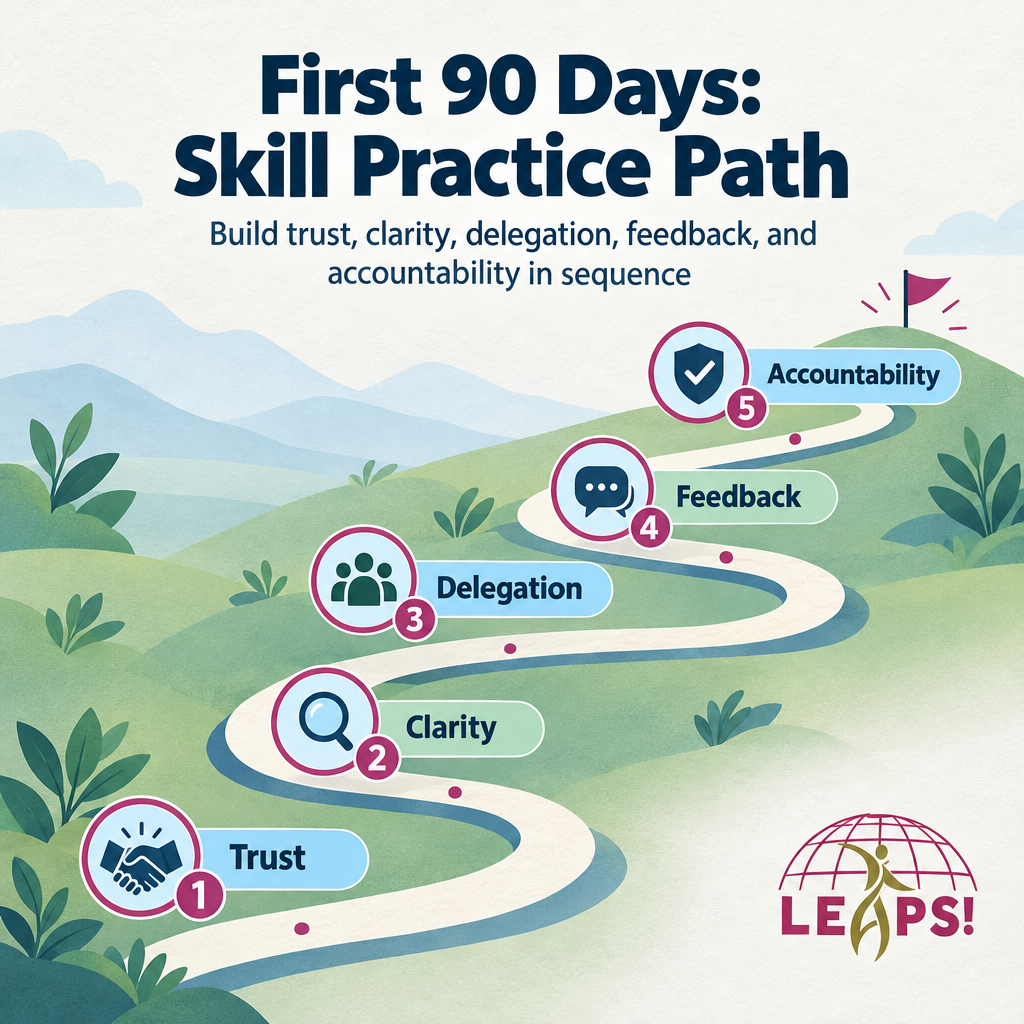
New managers should begin by listening and observing, then clarify priorities, establish communication rhythms, delegate with context, give feedback, address conflict early, and review progress. This sequence creates a foundation before the manager tries to change every process at once.
- Listen and observe: Hold one-to-one conversations and review current goals. How to know it worked: You can summarize team priorities and obstacles accurately. Pitfall: Do not treat listening as a promise to accept every request.
- Clarify priorities: State what matters now, what can wait, and how work will be evaluated. How to know it worked: Team members can explain the priorities in their own words. Pitfall: Avoid listing everything as urgent.
- Set communication rhythms: Use regular one-to-ones, team updates, and concise written follow-ups. How to know it worked: Fewer questions depend on last-minute clarification. Pitfall: Do not confuse frequent meetings with useful communication.
- Delegate with context: Define the outcome, owner, authority, deadline, and escalation rule. How to know it worked: The owner can explain both the task and decision boundaries. Pitfall: Avoid taking the work back at the first sign of difficulty.
- Give feedback and address conflict: Discuss observable behavior early and agree on a next step. How to know it worked: The conversation ends with shared understanding and a follow-up date. Pitfall: Do not delay because the conversation feels uncomfortable.
- Review progress: Revisit decisions, commitments, and team signals. How to know it worked: You can identify what changed and what still needs attention. Pitfall: Avoid relying only on personal impressions.
Build trust through clear expectations and listening
Trust grows when a manager listens carefully and then communicates what will happen next. In one-to-one meetings, ask questions that reveal obstacles without micromanaging, confirm priorities, and explain where the manager can decide independently.
Turn conversations into decisions and follow-through
Decision-making and delegation work together: define the decision, name the owner, set a deadline, agree on escalation rules, and revisit the result. A concise written summary can prevent confusion while leaving room to adjust when new information appears.
What should you compare before choosing leadership development support?
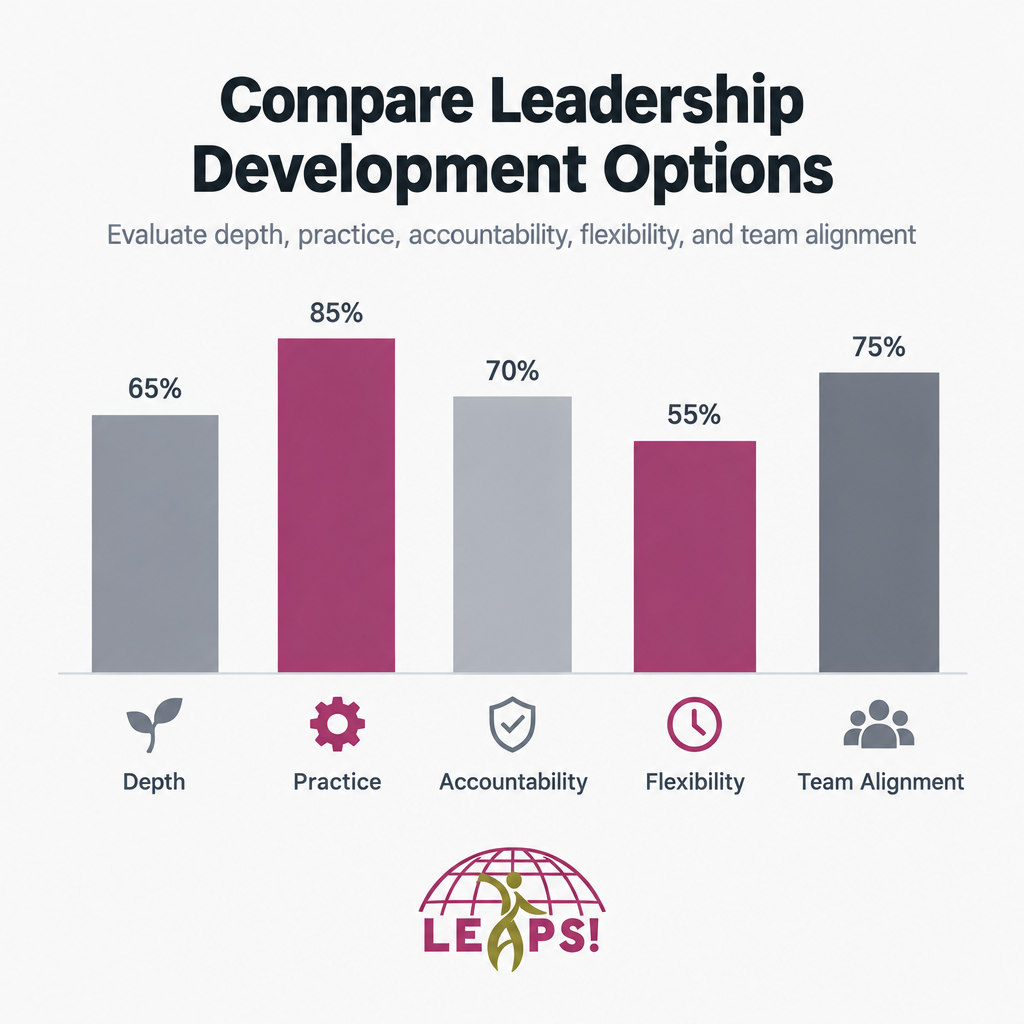
Compare development options by depth, personalization, accountability, live application, team alignment, time commitment, and organizational reach. Independent learning is accessible and flexible but depends heavily on self-direction; one-to-one coaching is more personal but centers on the participating manager; structured training creates shared language and wider alignment but requires coordination.
- Depth: Self-study may address a narrow topic, coaching can examine patterns and leadership style, and a structured program can cover connected skills over multiple sessions.
- Personalization: Coaching adapts to live challenges, while self-study and group training offer less individual adjustment.
- Accountability: Self-study requires personal discipline; coaching adds scheduled reflection; training may include group practice and review.
- Application: Coaching can connect concepts to current conversations, while training can use shared exercises and scenarios.
- Team alignment: Group training is useful when leaders need common expectations and language.
- Time commitment: Self-study is easiest to fit around a schedule, while coaching and training require protected time.
- Organizational reach: Individual work supports one leader, while structured development can support leadership-team performance and organizational change.
Leadership development coaching may help clarify leadership style, strategic plans, vision, mission, core values, and leadership-team performance. LEAPS Inc.’s Leadership Impact Intensive is a defined nine-session, high-performance leadership training program focused on leadership influence, collaboration, communication, and decision-making. It may fit organizations seeking a structured path rather than an informal collection of resources.
Evaluate the development option against shared criteria
Ask each provider how participants practice skills, receive feedback, connect learning to current work, and review progress. A clear description of session structure and expectations is more useful than a broad promise that a program will improve leadership.
Choose individual coaching, team training, or both
Choose individual coaching when one manager needs confidential reflection and tailored action planning. Choose team training when shared communication, decision-making, or change-management habits matter across the group; combining both may be appropriate when the manager needs personal support while the organization builds common practices.
How do accountability and practical application change leadership results?
Understanding leadership principles does not guarantee effective behavior during conflict, competing priorities, delegation, or organizational change. A manager may know that feedback matters and still postpone a difficult conversation when the stakes feel high.
Collaborative goal-setting, experiential learning, positive psychology, practical action planning, and scheduled accountability help connect learning with behavior. For example, a manager might choose one communication experiment for the week, apply it in a team meeting, record what happened, and review the result with a coach or trusted colleague.
During the first 90 days, review evidence such as the quality of one-to-ones, clarity of team priorities, delegation follow-through, unresolved conflicts, decision speed, and feedback from relevant stakeholders. LEAPS Inc. uses a structured, compassionate approach that combines collaborative goals, accountability, experiential learning, and practical action planning for leaders who want guided reflection tied to workplace action.
Convert leadership concepts into workplace experiments
Turn each skill into a small behavior that can be observed, such as ending one-to-ones with a documented commitment or asking a team member to propose options before you decide. Review what happened, what the manager learned, and what should change in the next experiment.
Review progress with evidence rather than impressions
Use recurring evidence instead of asking whether leadership “feels better.” Compare commitments with completion, decisions with deadlines, and stated priorities with the work the team actually discusses and delivers.
When should an organization bring in professional leadership development support?
An organization should consider professional support when communication breakdowns repeat, accountability remains unclear, decisions stall, conflict goes unresolved, team-wide performance concerns appear, or a major change initiative requires consistent leadership. These signs indicate that reading or isolated practice may not provide enough feedback or shared alignment.
Before contacting a provider, clarify the business goal, participants, available time, confidentiality expectations, current challenges, and how progress will be reviewed. LEAPS Inc. serves corporate executives, CEOs, business owners, middle managers, highly motivated employees, aspiring executives, and leaders seeking stronger organizational performance through leadership development and coaching.
To discuss leadership development coaching or the Leadership Impact Intensive for support in Tampa or Orlando, contact LEAPS Inc. at info@leapsinc.com or +18558853277 and describe the manager’s first-90-day priorities.
Recognize escalation signals
Escalate beyond self-study when the same problem appears across multiple conversations or affects the wider team. Repeated missed commitments, unclear decision ownership, avoidance of conflict, and change fatigue are practical signals that the manager may need structured accountability and support.
Prepare for a productive first conversation
Bring a short description of the manager’s role, team condition, top challenge, desired 90-day outcome, and available time. Sharing those details helps LEAPS Inc. discuss whether coaching, a structured program, or a combination better matches the situation.
Frequently Asked Questions
What leadership skills should a new manager develop before the first 90 days?
Prioritize communication, delegation, feedback, conflict resolution, decision-making, accountability, self-awareness, and strategic thinking. The order depends on the manager’s role, team condition, and immediate responsibilities.
Is self-study enough for a new manager’s first 90 days?
Self-study can work when the manager has a stable team, strong self-direction, and a specific skill gap. Coaching or structured training may be a better fit when the manager needs feedback, accountability, live-situation practice, or team-wide alignment.
How does leadership development coaching help a new manager?
Coaching provides individualized support for leadership style, strategic planning, vision and values clarification, communication, and follow-through. The goals and coaching relationship should match the manager’s needs and organizational context.
What is included in a structured leadership training program?
Program content varies, so ask about session count, learning goals, practice activities, feedback, accountability, and progress review. LEAPS Inc.’s Leadership Impact Intensive is a nine-session program focused on influence, collaboration, communication, and decision-making.
How much does leadership development coaching cost?
Pricing depends on service format, scope, session count, participants, and organizational goals. Contact LEAPS Inc. directly for current details rather than relying on a general estimate.
How do I get started with leadership development support?
Identify the manager’s top challenge, desired 90-day outcome, available time, and need for individual or team support. Then contact LEAPS Inc. at info@leapsinc.com or +18558853277 to discuss leadership development options.