

What should you bring to the first executive coaching conversation?
The first conversation should help you name the leadership issue, understand what is getting in the way, and describe the change you want to make. Many leaders arrive feeling stretched, uncertain, or frustrated because communication, decision-making, organization, executive presence, or team performance is not where they want it to be. You do not need a perfectly formed answer before you begin. A useful starting point is an honest description of what feels difficult and why it matters now.
At LEAPS Inc., the initial coaching experience focuses on clarifying what matters most, identifying barriers, recognizing leadership strengths, establishing the current and desired states, and beginning a practical plan. LEAPS Inc. works with C-suite leaders, entrepreneurs, managers, and aspiring executives. You can review the executive coaching program details and prepare questions about the format, privacy, expectations, and likely engagement length.
Clarify the leadership concern
Bring one pressing leadership concern and two or three recent examples that show how it appears at work. For example, you might describe a missed delegation opportunity, a difficult conversation you postponed, or a decision that remained unresolved because too many stakeholders were involved.
Specific examples help the coach distinguish a recurring pattern from a one-time event. They also create a practical starting point for discussing your available time, responsibilities, authority, and desired outcome.
Define the current and desired state
Describe what is happening now and what you would like to see instead. The current state might include reactive scheduling, unclear team communication, inconsistent follow-through, or difficulty communicating a strategic priority.
The desired state should be concrete enough to guide action, such as preparing more clearly for executive meetings, delegating with defined ownership, or handling feedback conversations with greater consistency. Bring questions about confidentiality, session structure, between-session work, and how the plan can change as your needs become clearer.
How does an executive coach turn a broad concern into measurable goals?
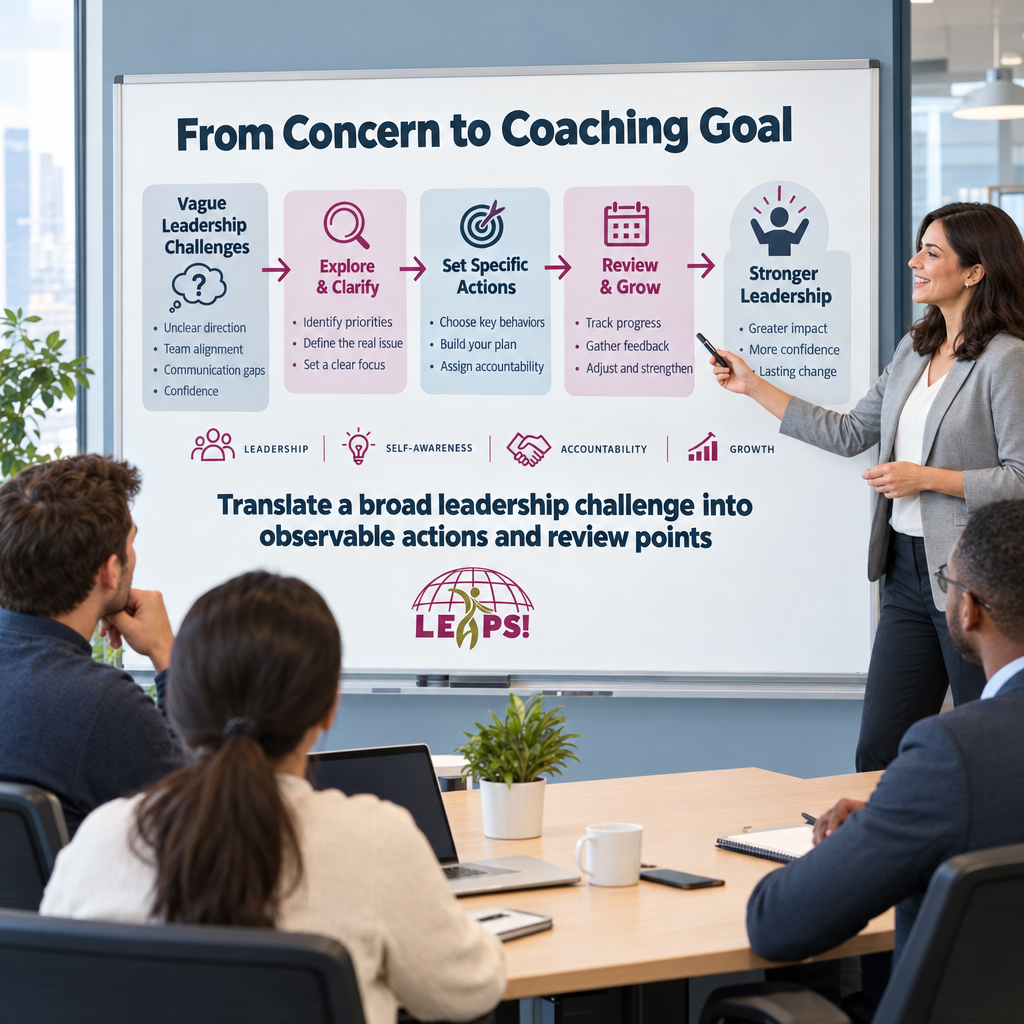
An executive coach turns a broad concern into a small set of observable leadership behaviors and review points. “I feel overwhelmed” may point toward delegation, prioritization, calendar structure, or decision-making. “My communication is not landing” may become a goal focused on concise updates, expectation-setting, listening, or preparing for difficult conversations.
At LEAPS Inc., collaborative goal-setting helps connect the goal to your role and organizational context. Choosing a few priorities usually makes practice more realistic than trying to change every leadership habit at once. A goal should fit your authority, stakeholder relationships, decision environment, and available time.
- Name the challenge: State the leadership concern in plain language.
- Describe the impact: Explain how it affects the business, team, relationships, or strategic work.
- Identify the behavior to change: Select an action you can observe and practice.
- Define evidence of progress: Decide what stronger preparation, clearer communication, or more consistent follow-through would look like.
- Agree on a review point: Set a time to examine what happened, what helped, and what needs adjustment.
Translate concerns into observable behavior
Observable behavior gives coaching something practical to examine. Instead of aiming vaguely to “be a better leader,” you might practice opening a meeting with a clear decision statement, asking a team member to summarize ownership, or using a consistent structure for executive updates.
This approach also makes setbacks useful. If a conversation does not go as planned, you and the coach can review the preparation, timing, language, and response rather than treating the experience as a personal failure.
Prioritize goals that affect leadership performance
Prioritize the behavior that has the greatest connection to your current responsibilities and desired results. A manager facing team confusion may begin with delegation and expectations, while an entrepreneur managing rapid growth may start with organization, decision-making, and strategic focus.
The right priority also respects your capacity. A goal that requires more time, authority, or organizational access than you have may need to be reframed before practice begins.
What happens during the action-planning and practice phase?
The action-planning phase connects coaching goals to real meetings, decisions, delegation tasks, feedback conversations, and strategic priorities. Rather than discussing leadership only in the abstract, you identify a next action, decide when it will happen, and determine what you will observe afterward.
LEAPS Inc. describes its approach through positive psychology, experiential learning, collaborative planning, accountability, practical action planning, and its proprietary L.E.A.P.S. coaching model. These approaches can help you recognize existing strengths while examining habits that may be limiting your effectiveness. The coach provides structure, reflection, challenge, and support, while you remain responsible for decisions and implementation.
Hypothetical examples: You might prepare a concise executive update before a leadership meeting, test a delegation plan with one project, or schedule a feedback conversation you have been postponing. The next session can examine what you tried, how others responded, and what you would change next time.
Apply leadership tools to live situations
Leadership tools become more useful when they are attached to a real situation with a clear purpose. You may prepare talking points for a strategic discussion, map stakeholders before a change initiative, or define decision criteria before choosing between competing priorities.
Practice should match the leader’s role and risk level. A sensitive conversation may require rehearsal and careful timing, while a routine delegation experiment may be appropriate for immediate testing.
Use accountability between sessions
Accountability turns an intention into a commitment that can be reviewed. Before ending a session, identify the action, timing, likely obstacle, and evidence that will show whether you completed it or learned something from the attempt.
Accountability is not punishment for an unfinished task. It gives you a structured opportunity to explain what changed, what interrupted the plan, and whether the action needs to be simplified or redesigned.
How are coaching sessions adapted for different leadership roles?
Executive coaching priorities change with the leader’s authority, stakeholders, team size, organizational change, and decision environment. A senior executive may focus on strategic alignment and executive presence, while a manager may need practical support with team communication, delegation, and feedback.
For entrepreneurs, coaching may address growth, organization, strategic decision-making, and overall business leadership capabilities. An aspiring executive may focus on readiness for expanded responsibility, communication, leadership development, and the ability to operate effectively with broader stakeholders. Prospective clients in Tampa and Orlando can ask LEAPS Inc. how its coaching format and engagement structure fit their location and work schedule.
C-suite and senior executives
C-suite and senior leaders often need coaching that accounts for competing priorities, high-consequence decisions, board or stakeholder relationships, and the effect of their communication on the wider organization. Topics may include strategic alignment, executive presence, organizational change, and communicating priorities with greater clarity.
The coaching conversation should also account for what the leader can personally control and what requires broader organizational coordination. That distinction keeps goals practical and reduces the risk of treating a system-wide issue as an individual habit alone.
Managers, entrepreneurs, and aspiring executives
Managers may focus on delegation, team expectations, conflict conversations, and consistent follow-through. Entrepreneurs may need a structure for organizing time, deciding, and building leadership capacity while the business changes.
Aspiring executives may work on communication, strategic thinking, confidence in complex decisions, and readiness for a larger scope of responsibility. In each case, the coach should connect the work to the person’s actual authority, opportunities to practice, and available time.
How long does an executive coaching engagement last, and how is progress reviewed?
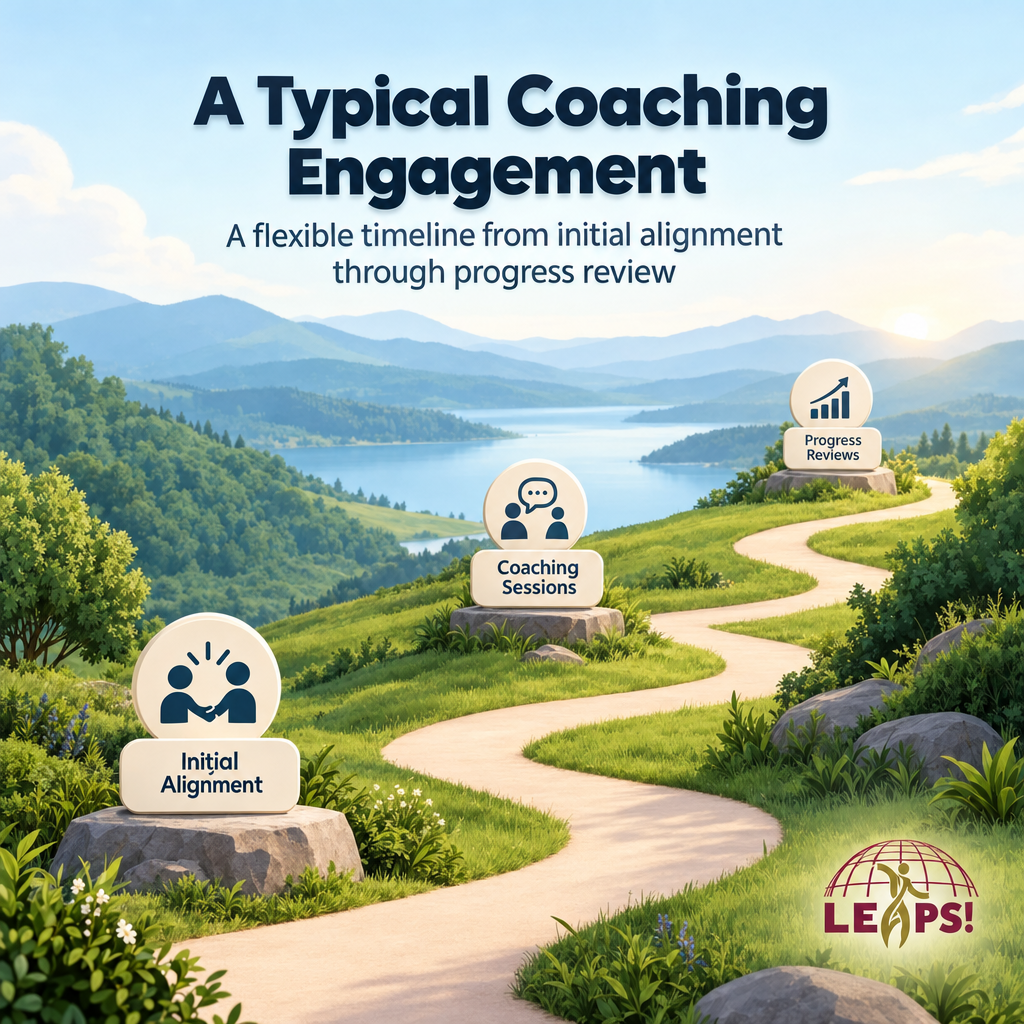
Executive coaching may last a few sessions for a focused issue or continue for six to nine months or longer when the client needs ongoing support. LEAPS Inc. states that business coaching engagement length depends on the client’s goals and situation, so the appropriate structure should be discussed rather than assumed.
Progress reviews usually return to the original goal, examine actions taken, identify evidence of change, discuss obstacles, and decide whether to continue, adjust, or close the engagement. Evidence may include stronger preparation, clearer communication, more consistent delegation, improved organization, or better alignment between leadership behavior and stated priorities. These are areas to examine, not promised outcomes.
Before starting, ask about session frequency, between-session expectations, review milestones, communication boundaries, privacy, and how the plan can change if your role or priorities shift. Clear expectations make it easier to judge whether the engagement remains useful.
Focused coaching versus ongoing support
Focused coaching can fit a defined need, such as preparing for a difficult conversation, improving delegation, or organizing a specific leadership transition. Ongoing support may be more appropriate when several connected behaviors require practice across changing business conditions.
The decision should reflect the goal, urgency, complexity, available time, and opportunities to apply new skills. A shorter engagement can still be purposeful when its scope and review point are clear.
Progress reviews and course correction
A progress review should compare the original intention with what you actually practiced and observed. Discuss which actions produced useful information, where obstacles appeared, and whether the goal still matches your role.
Course correction may mean narrowing the goal, changing the practice assignment, adding time for reflection, or closing the engagement after the focused issue has been addressed. Review points keep the process responsive rather than automatic.
How can you decide whether executive coaching is the right next step?
Executive coaching may be a good fit if you want greater accountability, clearer priorities, stronger leadership communication, better decision-making, improved organization, or support during a role or business transition. It can also help when you understand the challenge but keep repeating the same pattern without a consistent way to practice and review change.
Use this decision checklist before committing: clarify the leadership goal; confirm your willingness to practice between sessions; assess realistic availability; ask about the coach’s credentials and approach; discuss privacy expectations; understand possible engagement length; and agree on how progress will be reviewed. Coaching is not a substitute for therapy, crisis care, legal advice, or specialized organizational consulting when those services are needed. Use the initial conversation to clarify whether coaching matches the concern.
Leaders in Tampa, Orlando, and other Florida locations can contact LEAPS Inc. about executive coaching at info@leapsinc.com or +18558853277 to discuss the leadership need, preferred schedule, and next steps.
Signs the structure may fit
The structure may fit when you can name a leadership challenge, identify a meaningful reason to address it, and make time for reflection and practice. It is especially relevant when you want a partner who will help you examine strengths, barriers, decisions, communication patterns, and follow-through.
You should also be prepared to own the decisions and actions that follow from coaching. The coach can offer structure and challenge, but the work must connect to your responsibilities and real opportunities to apply it.
Questions to ask before committing
Ask how the first conversation works, what the coach expects between sessions, how confidentiality is handled, how often sessions occur, and how progress is reviewed. You can also ask how the approach changes for a C-suite leader, manager, entrepreneur, or aspiring executive.
Finally, ask what happens if your priorities change or the concern turns out to require therapy, crisis care, legal advice, or specialized consulting. A clear answer helps you choose an appropriate next step with greater confidence.
Frequently Asked Questions
What happens in the first executive coaching session?
The first conversation typically clarifies what matters most, identifies barriers and leadership strengths, establishes the current and desired states, and begins shaping practical goals. Bring a specific challenge and ask about expectations, confidentiality, format, between-session work, and timing.
Who can benefit from executive coaching at LEAPS Inc.?
LEAPS Inc. identifies C-suite leaders, entrepreneurs, managers, and aspiring executives as audiences for executive coaching. The work may address leadership development, strategy, executive presence, communication, decision-making, organization, and broader business leadership capabilities.
How long do executive coaching engagements usually last?
Duration depends on your goals and situation. LEAPS Inc. describes options ranging from a few sessions for focused issues to ongoing support lasting six to nine months or longer, with the plan shaped around priorities and progress.
How do I know whether executive coaching is right for me?
Look for a clear leadership challenge, willingness to practice between sessions, a need for accountability, and enough time to participate. Discuss the concern directly with LEAPS Inc. so you can determine whether coaching matches the need.
How do I get started with executive coaching services?
Contact LEAPS Inc. through its executive coaching information page, at info@leapsinc.com, or by calling +18558853277. Prepare your leadership issue, desired outcome, preferred schedule, and questions about engagement structure so the first conversation can be focused and useful.