

There is no single leadership style that works equally well for every team member. The strongest approach matches the person’s readiness, the task, the urgency, and the outcome you need while keeping expectations and values consistent.
How do you know which leadership challenge needs attention first?
Choosing a leadership style can feel personal because it affects trust, communication, accountability, and workplace relationships. Start by identifying the specific challenge before choosing a response: unclear expectations, low confidence, conflict, stalled decisions, inconsistent performance, or difficulty managing change.
Start with the team member, situation, and desired outcome
Begin with one recent team situation and describe what happened, who was involved, and what outcome you wanted. An emerging leader may need confidence and structure, while a middle manager may need help with delegation or conflict; an executive, business owner, or aspiring executive may need clearer strategic direction and stronger alignment across leaders.
Prerequisites, time, and difficulty
Set aside 30 to 45 minutes, a notebook or shared planning document, and any relevant feedback or observations. The difficulty is moderate because honest self-reflection is required: ask what you did, what the team needed, and whether your habitual style helped or limited progress.
Which leadership style fits a team member’s readiness and working needs?
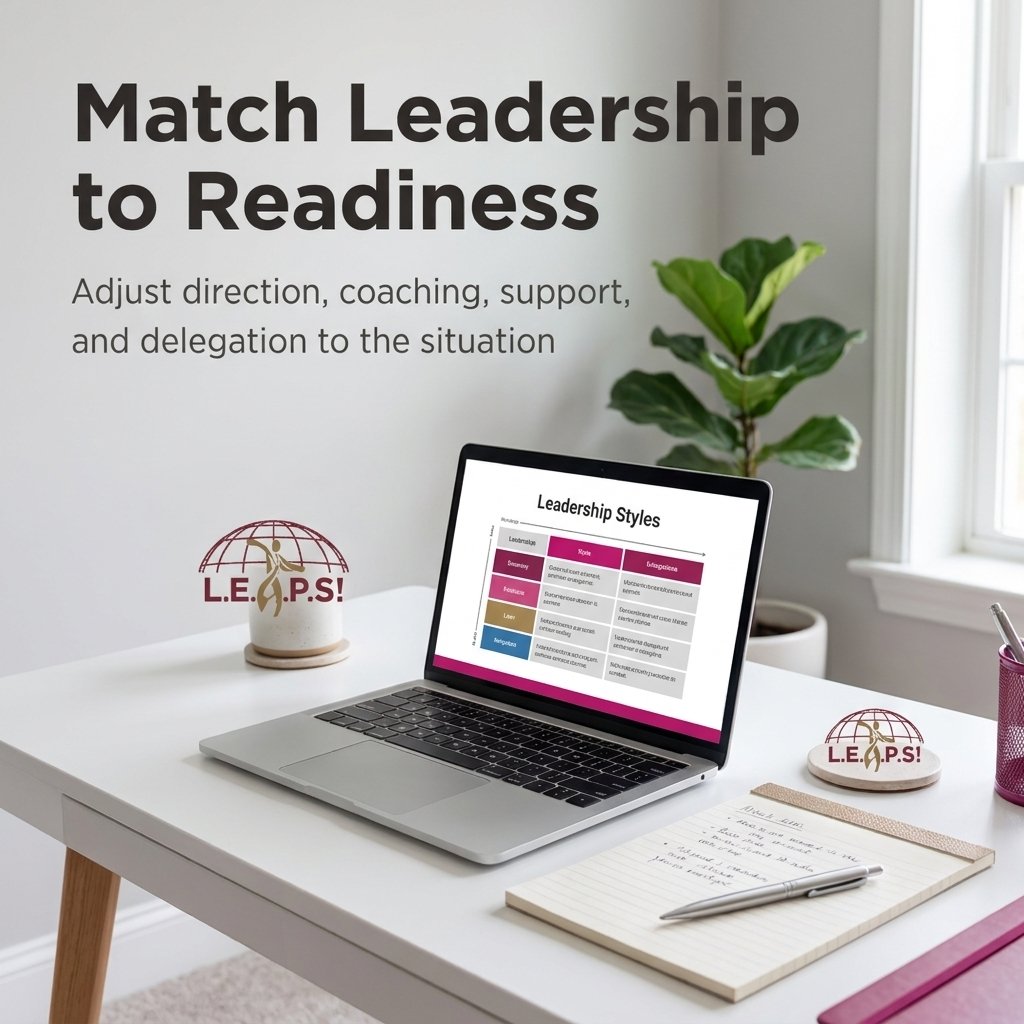
The best leadership style depends on readiness and context rather than a permanent label. Directive leadership supplies structure for new responsibilities, urgent decisions, or unclear processes; coaching develops skill and confidence; supportive leadership addresses motivation, relationships, or confidence concerns; participative leadership invites experienced team members’ judgment; and delegation gives capable employees meaningful ownership.
- Assess readiness: Review skill, confidence, motivation, and task complexity.
- Choose the response: Match structure, coaching, support, participation, or autonomy to the situation.
- Set the agreement: Define the outcome, authority, check-in point, and feedback method.
- Review the result: Ask what improved and adjust the style.
Use direction when clarity and structure are missing
Use directive leadership when a person is new to the responsibility, the process is unclear, or an urgent decision requires firm action. Explain the expected result, sequence, boundaries, and deadline, then check understanding. Direction should become less detailed as competence grows; otherwise, capable team members may wait for approval instead of thinking and acting independently.
Use coaching when capability is growing
Use coaching leadership when the team member has developing skill but benefits from questions, practice, and useful feedback. Ask how they would approach the problem, identify the gap, and agree on a small action to test. Coaching builds judgment when the situation allows learning time, but it should not replace direct intervention during an urgent safety, conduct, or performance concern.
Use delegation and support when ownership is established
Delegation fits capable employees who understand the work and need authority to deliver it, while supportive leadership remains useful when motivation, confidence, or relationships need attention. Define the outcome, decision rights, resources, and review point. Delegation is not withdrawal; leaders still provide access, feedback, and timely help when conditions change.
How can a leader turn a preferred style into consistent workplace behavior?
Consistent leadership begins with clarity about your vision, mission, core values, and personal goals. Once those are defined, translate them into behaviors such as setting expectations, asking better questions, listening before responding, giving timely feedback, negotiating priorities, and deciding criteria visible.
Translate values into observable actions
If collaboration is a core value, invite relevant input before deciding and explain how it shaped the decision. If accountability matters, document owners and follow-up dates. Strengths management helps you use your natural abilities wisely, while critical thinking helps you choose a different response when your preferred style does not fit the person or situation.
Practice communication, negotiation, and decision-making
In meetings, state the outcome, clarify who has authority, and ask each person what could block progress. During competing-priority conversations, negotiate scope, timing, and resources instead of relying on vague agreement. Consensus-based decision-making can improve commitment when the issue benefits from shared judgment, provided the group still has a clear decision process.
Check whether the behavior is helping the team
Verify progress by asking whether the team can restate priorities, whether responsibilities are understood, and whether disagreements surface earlier. Follow-up conversations should produce specific next actions. If people remain confused, silent, or dependent on you, adjust the amount of direction, support, participation, or autonomy.
What should you look for in a structured leadership development program?
A useful leadership development program should connect individual goals with organizational context, leadership communication, performance environments, negotiation, strengths management, critical thinking, and consensus-based decision-making. Reflection alone rarely changes workplace behavior; look for experiential learning, collaborative goal-setting, practical action planning, and accountability.
Assess the curriculum and coaching method
Ask whether the program addresses leadership styles, strategic planning, vision, mission, core values, interpersonal communication, and team performance. LEAPS Inc. uses its proprietary L.E.A.P.S. coaching model, combining a structured, compassionate process with positive psychology, experiential learning, collaborative goals, accountability, and practical action planning.
Confirm how goals and accountability are handled
Before enrolling, ask how goals are defined, how between-session practice works, and how feedback is reviewed. LEAPS Inc. organizes its programs into nine-session intensive journeys, giving participants a defined structure for connecting reflection with action without promising a particular result.
Check whether the format fits the leader and organization
Consider whether the support fits a corporate executive, CEO, business owner, middle manager, aspiring executive, or highly motivated employee. The right format should address the leader’s actual responsibilities and organizational setting, whether the priority is individual growth, leadership-team performance, or broader organizational development.
How do you apply leadership coaching between sessions and measure progress?
Apply one behavior at a time: select a leadership practice, use it in a real meeting or conversation, record what happened, request useful feedback, and revise the next attempt. Track progress through clearer agreements, stronger follow-through, better communication, team participation, conflict resolution, and decision speed rather than relying only on a general feeling of improvement.
Choose one behavior to practice at work
Choose a behavior that matches the challenge, such as asking two questions before offering a solution or stating decision criteria before inviting input. Write down the situation, the behavior, and the result you expect. A narrow practice is easier to repeat and evaluate than a broad goal such as “be a better leader.”
Use feedback and reflection after real interactions
After the interaction, note what the team member understood, where the conversation slowed, and what you would change. Request specific feedback about clarity, listening, support, or authority. Do not use delegation to avoid support, and do not confuse consensus with delaying every decision.
Adjust the leadership style as the team changes
Readiness can change with a new task, shifting pressure, or improved capability, so review the agreement regularly. A leader may move from direction to coaching, then to participation or delegation. Before seeking support, confirm that you have a defined challenge, willingness to receive feedback, time to practice, organizational support, and a next conversation with a qualified coach or consulting provider.
When should you seek outside leadership development support?
Outside support may be appropriate when communication problems repeat, leaders struggle to manage change, teams lack shared direction, or high-performing and average-performing workgroups need different support. External guidance can help you examine patterns with more objectivity and turn broad concerns into specific leadership behaviors and organizational actions.
Recognize recurring patterns that self-study has not changed
Consider support when the same conflicts, stalled decisions, unclear expectations, or performance problems continue despite sincere effort. LEAPS Inc. provides leadership development coaching focused on leadership styles, strategic plans, vision, mission, core values, and leadership-team performance, with attention to practical workplace application.
Match individual coaching with organizational consulting needs
Individual coaching can focus on a leader’s habits, goals, communication, and decision-making. Corporate consulting can address organizational performance, culture and climate, strategic planning, workgroup effectiveness, and broader business challenges. Contact LEAPS Inc. at info@leapsinc.com or +18558853277 to discuss whether structured leadership development fits your role and goals in Florida, including Tampa and Orlando.
Frequently Asked Questions
What leadership style works best for a new or inexperienced team member?
Clear direction usually works best at first because the person needs expectations, examples, boundaries, and regular check-ins. Add coaching and encouragement as skill and confidence develop, then reduce direction as readiness increases. The goal is guided growth, not permanent close supervision.
Should a leader use the same leadership style with every team member?
Usually, no. Keep core values, standards, and accountability consistent while adjusting the amount of direction, coaching, support, participation, or autonomy to the person’s readiness, task, and context. Fair leadership does not require identical interactions.
What does a leadership development program typically help leaders improve?
A suitable program may address leadership style, strategic planning, vision and values, interpersonal communication, negotiation, strengths management, critical thinking, consensus-based decision-making, and team performance. The exact focus should follow the participant’s goals and organizational responsibilities.
Is a structured leadership development program right for executives and middle managers?
It can be appropriate for executives, business owners, middle managers, aspiring executives, and highly motivated employees who have a defined challenge and willingness to practice new behaviors. Fit depends on goals, participation, organizational context, and the program’s coaching method.
How do I get started with leadership development through LEAPS Inc.?
Begin by identifying the leadership situation, desired team outcome, and skills you want to strengthen. Contact LEAPS Inc. to discuss fit, available structure, and whether individual leadership coaching or broader corporate consulting better matches your need.