

What if the most strategic move you make this year has nothing to do with your balance sheet and everything to do with your internal architecture? For many high-achievers, the external markers of success are present, yet a quiet sense of misalignment persists. You understand the weight of managing high-pressure environments alone, often feeling that despite your accomplishments, a deeper purpose remains just out of reach. When considering why do people go to therapy, it’s essential to look beyond the outdated stigma of repair; instead, view it as a sophisticated laboratory for personal and professional transformation.
You likely agree that true leadership requires more than just technical skill; it demands a level of self-mastery that few possess. This guide promises to reveal the diverse and transformative reasons why visionary individuals and leaders are seeking therapy to unlock their maximum potential in 2026. We’ll explore how clinical depth and strategic coaching converge to help you build emotional resilience, gain absolute clarity on your life’s mission, and refine the relationships that define your legacy. From the efficiency of therapy intensives to the power of corporate visioning, discover how to turn your inner life into your greatest competitive advantage.
Key Takeaways
- Reframe your understanding of why do people go to therapy by viewing it as a proactive strategy for mental optimization rather than just a response to crisis.
- Discover how elite leaders use emotional intelligence as a primary strategic lever to navigate high-pressure environments and resolve the “lonely at the top” phenomenon.
- Assess whether you’re merely surviving your success or truly thriving by identifying the behavioral patterns that may be stalling your professional evolution.
- Uncover the transformative power of Therapy Intensives to facilitate rapid breakthroughs and align your daily actions with your ultimate visionary purpose.
Beyond the Stigma: Why People Go to Therapy in 2026
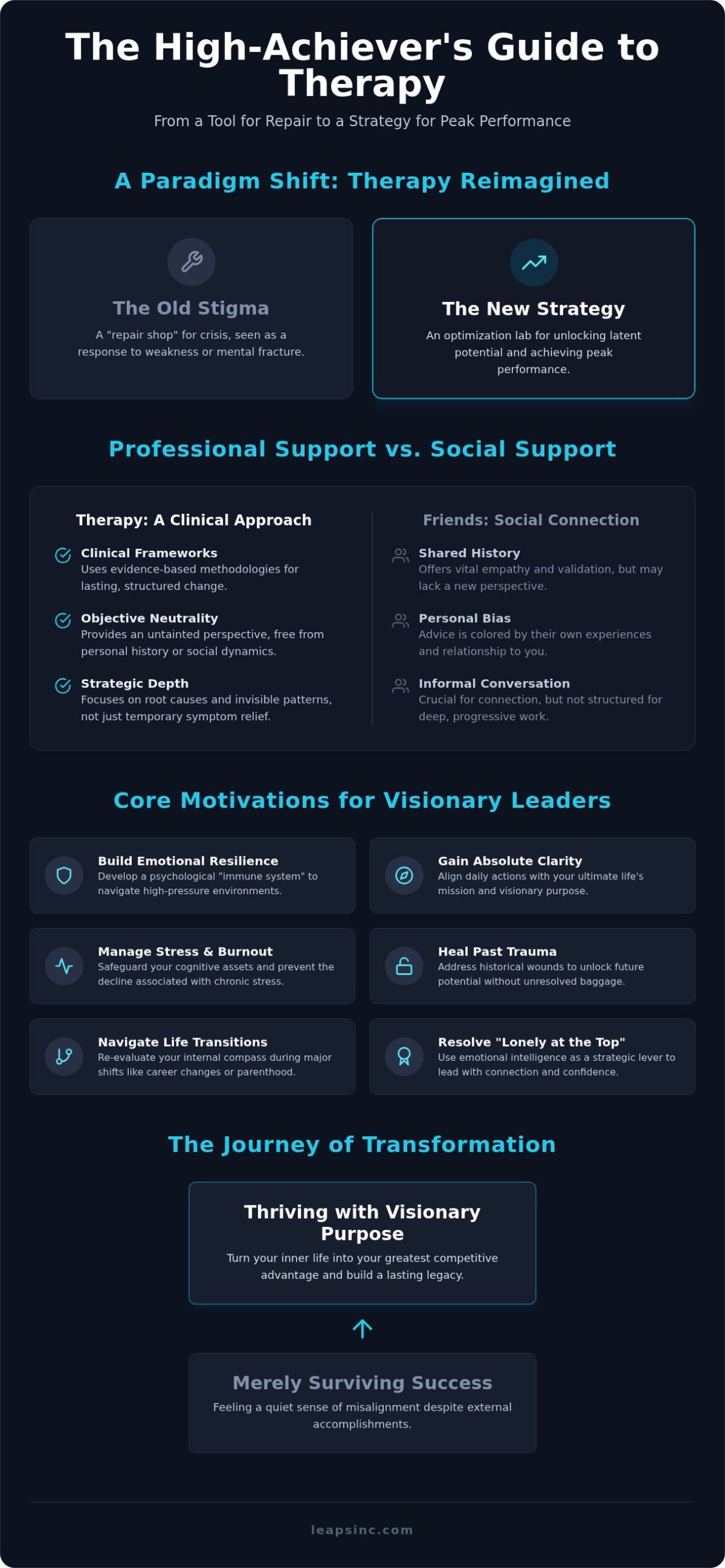
The old perception of therapy as a “repair shop” for the fractured mind is obsolete. Today, high-achieving individuals view mental health support as a sophisticated laboratory for strategic development. When we ask why do people go to therapy in 2026, the answer is rarely just “to feel better.” It’s to perform better, lead better, and live with a sense of unshakeable alignment. This shift from reactive crisis management to proactive mental wellness marks a new era where emotional intelligence is the ultimate currency.
Modern Psychotherapy has transitioned into a collaborative process designed to unlock latent potential. It’s no longer about fixing what is broken; it’s about optimizing what is already working. For the visionary leader, therapy provides a secure space to dismantle internal blocks that prevent the fulfillment of their destiny. It’s a method for reclaiming personal power in an increasingly complex world.
The Evolution of Mental Health Support
Therapy vs. Venting to Friends
While a strong social circle is vital, it cannot replace the clinical depth of professional intervention. Friends offer empathy and shared history, but they often lack the neutrality required to identify deep-seated blind spots. A professional provides a structured framework that informal conversations simply cannot replicate. Consider these distinctions:
- Clinical Frameworks: Professionals use evidence-based methodologies to track progress and facilitate lasting change.
- Objective Neutrality: An expert perspective remains untainted by personal history or social dynamics.
- Strategic Depth: Therapy focuses on the root causes of behavior rather than just offering temporary relief or “advice.”
This structured approach ensures that you aren’t just circling the same problems. You’re moving through them toward a defined goal. The expertise of a seasoned clinician allows for the identification of patterns that are invisible to the untrained eye, making the process of growth both efficient and profound.
Core Motivations: The Diverse Reasons to Seek Professional Support
The motivations for seeking professional guidance are as diverse as the individuals themselves. While symptoms like anxiety or persistent sadness are common entry points, the underlying “why” often involves a desire for structural life changes. When exploring why do people go to therapy, one finds a spectrum of needs ranging from navigating seismic life transitions to the complex processing of grief. This includes not just traditional bereavement, but the loss of a professional identity during career shifts or the profound adjustment to parenthood. These transitions require more than just resilience; they demand a re-evaluation of one’s internal compass.
High-performers often utilize therapy for successful people to manage chronic stress and prevent the cognitive decline associated with burnout. In a world that demands constant output, professional support acts as a strategic safeguard for your most valuable asset: your mind. Healing from past trauma is another core driver for many. By addressing historical wounds, you unlock the capacity to pursue your future potential without the weight of unresolved baggage. Improving relationship dynamics, whether through Individual Therapy or couples counseling, allows for a more integrated and supportive personal life that fuels professional excellence.
Emotional Regulation and Resilience
Building emotional resilience is akin to developing a “psychological immune system” for the challenges of 2026. Therapy provides the sophisticated tools required to manage intense feelings, ensuring they inform your decisions rather than dictate your actions. This process involves the clinical science of co-regulation, where the therapist’s steady, seasoned presence helps stabilize your nervous system. Over time, you internalize this stability. This enables you to navigate high-pressure environments with a grounded, calm authority that inspires those around you.
Self-Discovery and Purpose
Beyond immediate problem-solving, therapy serves as a powerful vehicle for profound self-discovery. It’s a dedicated space to define your worldview and align your daily actions with your deepest core values. Many individuals ask themselves why do people go to therapy when they already feel successful; the answer lies in uncovering latent abilities that have been obscured by subtle emotional blockages. By removing these barriers, you can finally step into your perceived destiny. This level of clarity ensures that your professional achievements are matched by an internal sense of life mission and enduring fulfillment.
The High-Achiever’s Perspective: Why Successful Leaders Go to Therapy
For the modern executive, the view from the summit often includes a surprising amount of isolation. While the world sees success, the leader often feels the “lonely at the top” phenomenon, where the weight of organizational development rests solely on their shoulders. When we analyze why do people go to therapy at this level of achievement, it’s rarely due to a lack of competence. Instead, it’s a strategic move to manage the unique anxieties that come with high-stakes decision-making and visionary leadership. Professional support provides the only confidential space where a leader can drop the mask of invulnerability and explore the internal pressures that drive their external results.
Emotional intelligence (EQ) has moved from a “soft skill” to the ultimate strategic advantage in the 2026 business environment. Leaders who understand their internal landscape can navigate complex negotiations and team dynamics with far greater precision. The American Psychological Association outlines several reasons to seek psychotherapy, including the management of chronic stress and long-term feelings of pressure. By addressing these internal factors, successful professionals ensure their mental health remains the cornerstone of their peak performance. Why do people go to therapy if they are already winning? They do it because they realize that the next level of their evolution requires a different version of themselves, one that is fully integrated and emotionally resilient.
Vulnerability as a Leadership Strength
The myth of the emotionally impenetrable leader is a relic of the past. Today’s visionary mentors recognize that authentic vulnerability is a catalyst for trust and innovation within a team. Through therapy, executives refine their approach to Corporate Visioning, ensuring that their personal values are deeply embedded in the company culture. Often, this strategic alignment is best achieved in an immersive environment, such as the bespoke leadership retreats managed by Aura Events. A leader’s emotional health directly impacts a company’s bottom line by fostering psychological safety and reducing costly turnover. This internal work allows you to lead from a place of secure authority rather than defensive reaction.
From Burnout to Visionary Momentum
Executive burnout often masquerades as a loss of passion or a “grind” mentality, but it’s actually a signal that your internal resources are depleted. Transitioning from merely managing tasks to leading with purpose requires a profound internal shift. By integrating Executive Coaching with clinical therapy, leaders can address both strategic business goals and the underlying psychological patterns that drive them. For those needing rapid transformation, a therapy intensive offers a deep, focused intervention that restores momentum and clarifies one’s ultimate mission. Entrepreneurs and founders experiencing decision fatigue or persistent insomnia may find that specialized anxiety therapy for business owners provides the targeted clinical framework needed to convert chronic tension into a strategic advantage. This structured approach moves you beyond survival and toward your maximum potential.
Identifying Your ‘Why’: Signs It Is Time to Start Therapy
Waiting for a catastrophic failure before seeking support is a strategic error that many high-performers make. While you might be surviving the demands of your position, ask yourself if you are truly thriving. Success isn’t static. It requires a constant recalibration of your internal state to ensure you aren’t sacrificing your long-term well-being for short-term gains. When we examine why do people go to therapy, we often find that the most impactful work happens when a client is already successful but feels a subtle misalignment between their daily actions and their core values. If you’re repeating the same interpersonal or professional mistakes, it’s a clear signal that your internal architecture requires a structured upgrade.
Stress doesn’t always announce itself with a panic attack. It often manifests as chronic fatigue, persistent sleep disturbances, or a general sense of being “grayed out” despite external wins. You don’t need a tragedy to justify your evolution. The “Just Because” factor is a valid reason to pursue growth, allowing you to reach your peak state before a crisis forces your hand. Understanding why do people go to therapy helps you recognize that proactive mental maintenance is the foundation of visionary leadership.
A Checklist for Self-Reflection
To assess your current state, ask yourself these practical questions: Is my motivation purely transactional? Am I avoiding social engagement or withdrawing from my social circle? Do I feel a lack of purpose despite my achievements? Recognizing these subtle shifts in sleep, mood, and engagement helps you distinguish between a temporary rut and a deeper need for intervention. If your daily life feels like a performance rather than an expression of your destiny, it’s time to seek a neutral, expert perspective.
Overcoming the First-Session Anxiety
It’s natural to feel a sense of hesitation before your first Individual Therapy or Couple Therapy session. You should expect a professional consultation that feels secure, confidential, and focused on your specific goals. Choosing a therapist who aligns with your professional aspirations is crucial for long-term success. Set realistic expectations for the journey; transformation is a methodical process, not an overnight fix. By establishing clear frameworks for growth early on, you ensure that every session moves you closer to your maximum potential. If you’re ready to align your internal life with your external success, schedule a professional consultation to begin your transformation.
The LEAPS Approach: Visionary Therapy for Transformation
LEAPS Inc. exists to bridge the gap between deep clinical psychology and the high-stakes world of executive leadership. Founded by Dr. John E. N. Daniel, our organization is dedicated to the belief that your internal health is the most critical factor in your external success. When investigating why do people go to therapy, visionary individuals recognize that standard coaching often misses the psychological roots of behavioral patterns. We provide a sophisticated blend of Individual Therapy and Entrepreneurship Coaching that addresses the whole person. Our reach extends to families and organizations nationally, ensuring that the principles of emotional resilience and strategic visioning are integrated at every level of your life.
Therapy Intensives: A Deep Dive into Growth
The high-achiever’s schedule rarely accommodates the slow burn of traditional models. This is where the power of a therapy intensive becomes indispensable. Unlike standard weekly appointments, an intensive provides a concentrated environment for deep-dive intervention. It allows you to step away from the daily noise and focus entirely on the architectural shifts required for your next level of evolution. When you consider why do people go to therapy, remember that it’s a strategic investment in your most valuable asset: your mind. This model accelerates the path to clarity, helping you resolve long-standing interpersonal or professional mistakes in a fraction of the time. It’s the preferred choice for those who demand efficiency without sacrificing clinical depth.
Your Journey Toward Peak Potential
Your transformation is a methodical process that requires both empathy and authority. At LEAPS Inc., we maintain the highest standards of confidentiality and professional credibility, ensuring that your journey toward peak potential is secure. We facilitate the transition from healing past wounds to launching corporate visioning initiatives with unshakeable confidence. By merging clinical therapy with strategic business development, we help you align your inner world with your professional destiny. This isn’t just about wellness; it’s about the strategic reclamation of your personal power and the fulfillment of your life mission. We challenge you to look beyond immediate problems and toward your maximum potential.
Ready to reclaim your power? Explore our Clinical Therapy Services.
Mastering Your Internal Architecture for Global Impact
True success requires more than technical skill; it demands a recalibrated internal state. You’ve discovered that professional support is a sophisticated laboratory for visionary leadership. By reframing why do people go to therapy, you turn a perceived vulnerability into your greatest competitive advantage. You’ve learned that emotional resilience and high-level self-mastery are the foundations of any lasting legacy, especially within the high-pressure environments of 2026.
LEAPS Inc., led by Dr. John E. N. Daniel, offers the integrated clinical and executive expertise you need to scale your impact. We specialize in Therapy Intensives for deep growth, providing a structured environment for rapid transformation. These programs are built for high-achievers who value efficiency and depth. It’s time to bridge the gap between your inner life and your professional destiny. Align your internal architecture with the magnitude of your external goals.
Take the Leap Toward Your Maximum Potential
Your future isn’t a matter of chance; it’s a matter of alignment. Step into your destiny with the clarity and resilience you deserve. We’re here to facilitate your evolution.
Frequently Asked Questions
Is it worth going to therapy if I don’t have a mental illness?
Yes, therapy is a precision tool for mental optimization and proactive wellness rather than just a response to clinical illness. When exploring why do people go to therapy, it’s essential to recognize it as a means to refine emotional intelligence and align daily actions with your ultimate destiny. It ensures your internal architecture can support your highest external ambitions.
How do I know if I need a therapist or an executive coach?
You should choose a therapist when you want to explore the internal psychological patterns and historical roots that drive your current behavior. An executive coach typically focuses on specific professional skills and strategic business outcomes. LEAPS Inc. integrates both disciplines, ensuring that your emotional health and professional success are treated as two sides of the same coin.
What is a therapy intensive and how does it differ from regular sessions?
A Therapy Intensive is a concentrated, deep-dive intervention designed for rapid breakthroughs over a few consecutive days. Unlike traditional weekly sessions that move incrementally, intensives allow for a profound immersion into complex issues. This format is ideal for busy professionals who require significant emotional or strategic clarity without the wait of a months-long process.
Can therapy actually help me become a better business leader?
Therapy is the foundation for visionary leadership because it cultivates the emotional intelligence required to manage complex organizational dynamics. By understanding your internal landscape, you can navigate high-pressure negotiations and team culture with grounded authority. This internal work directly impacts your company’s bottom line by fostering psychological safety and reducing costly turnover.
How long does it typically take to see results from therapy?
The timeline for results varies based on your specific goals and the depth of the work you’re willing to do. Some clients experience a shift in perspective after just a few sessions, while others pursue long-term growth for ongoing mastery. For those seeking accelerated results, a Therapy Intensive offers a focused framework that facilitates significant change faster than traditional models.
What should I look for when choosing a therapist for high-achievers?
Look for a provider who balances high-level clinical expertise with a deep understanding of the unique pressures of leadership. You need a visionary mentor who speaks the language of strategic advancement while maintaining a secure, confidential environment. It’s essential that they challenge you to look toward your future potential rather than just focusing on immediate problems.
Is therapy confidential for high-profile individuals or executives?
Confidentiality is the cornerstone of the therapeutic relationship, especially for high-profile leaders and entrepreneurs. Licensed professionals are bound by strict legal and ethical standards that ensure your privacy is absolute. This secure space allows you to explore vulnerabilities and strategic challenges without the risk of public exposure or any professional repercussions.
How does therapy help with relationship issues or family dynamics?
Therapy helps you identify the unconscious patterns that drive conflict in your personal and professional relationships. In exploring why do people go to therapy for family dynamics, you’ll find it provides the tools for co-regulation and clear communication. For high-achieving partners navigating the unique pressures of an executive lifestyle, couples counseling offers a strategic framework for transforming relational friction into collective momentum. This work ensures that your home life becomes a supportive foundation for your visionary goals rather than a source of chronic stress.