

What if the professional sitting across from you is not just a clinical provider, but the most vital strategic partner in your pursuit of a high-impact life? For the modern leader, the search for mental health support is often clouded by the fear of wasting precious time with an incompatible stranger. You need more than a passive listener; you require a visionary mentor who understands the unique pressures of executive responsibility. Identifying the right fit starts with the specific questions to ask a new therapist to bridge the gap between emotional healing and professional destiny.
It’s true that finding a secure, confidential environment where you can be truly vulnerable is a daunting task. You deserve a clinical partner who respects your ambitions while safeguarding your well-being. This article will show you exactly how to vet potential providers for clinical authority and strategic alignment. We will explore a rigorous checklist for 2026 that covers everything from the February HIPAA compliance updates to the therapist’s capacity for facilitating deep, accelerated transformation.
Key Takeaways
- Reframe your first session as a strategic interview to ensure your therapist functions as a visionary partner rather than a passive provider.
- Learn how to verify clinical credentials and specialized methodologies to ensure your care meets the updated 2026 ethical and regulatory standards.
- Master the specific questions to ask a new therapist that bridge the gap between your emotional well-being and your professional executive performance.
- Identify the logistical mechanics and commitment levels required to move beyond basic treatment toward a profound personal transformation.
- Synthesize therapist responses to recognize the “green flags” of a clinical mentor capable of unlocking your maximum potential.
The Strategic Partnership Audit: Why Your First Session Matters
The therapeutic alliance isn’t just a secondary benefit of treatment; it’s the primary engine of change. Research consistently identifies this bond as the most reliable predictor of clinical success. To understand what psychotherapy is at its highest level, one must view it as a collaborative architecture for the human mind. For the high-achiever, this means shifting from a passive recipient of care to a proactive strategic partner. You aren’t just seeking a solution for a symptom. You’re auditing a potential mentor for your future self.
Viewing the first session as a mutual interview changes the power dynamic. It allows you to assess whether a provider’s clinical expertise aligns with your personal and professional trajectory. This is where the right questions to ask a new therapist become your most powerful tool for vetting. You’re looking for a Visionary Mentor who sees past the immediate burnout to the latent potential beneath the struggle. They don’t just treat a patient; they empower a leader toward their ultimate destiny.
To better understand how to identify a truly effective partner, watch this helpful video:
Consultation vs. Intake: Navigating the Entry Points
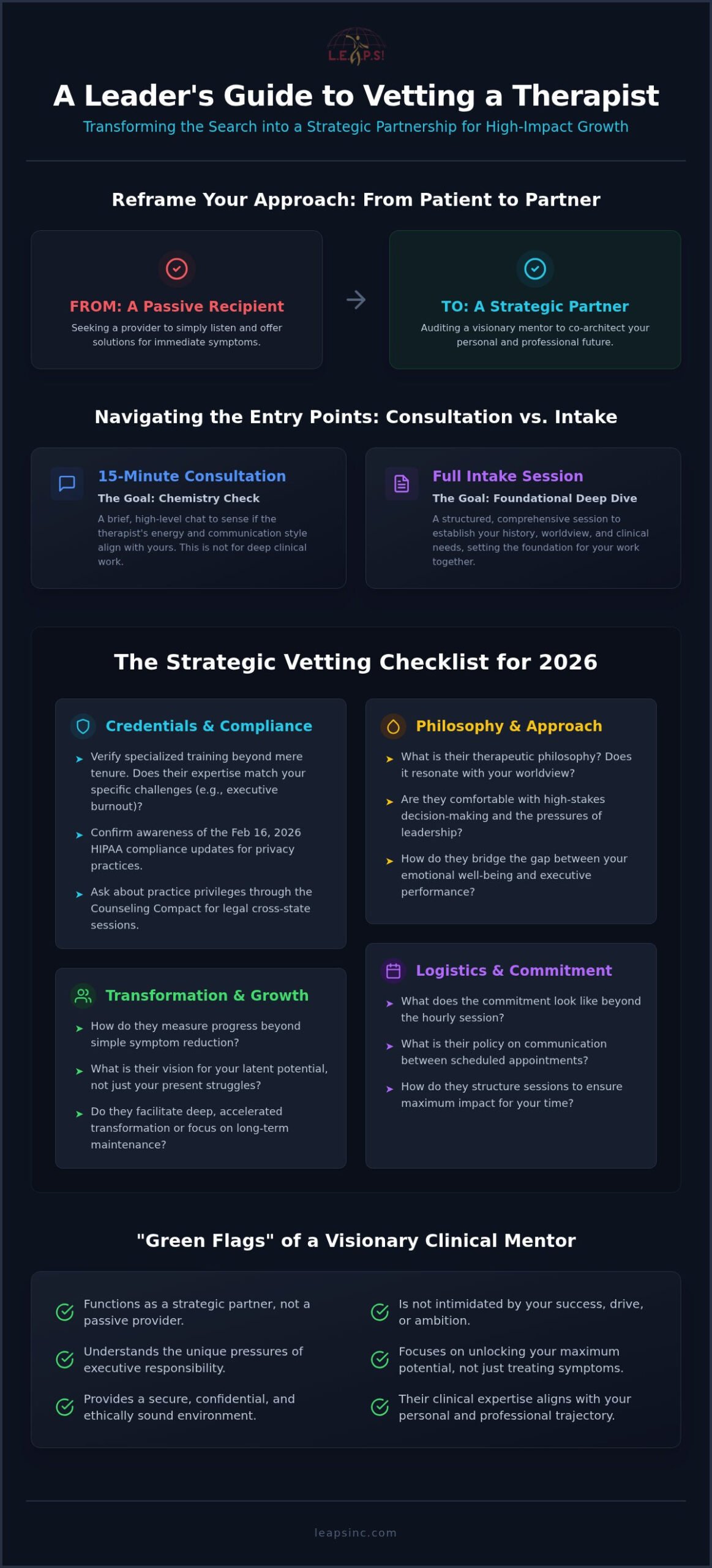
Most therapeutic journeys begin with a 15-minute consultation. Think of this as a chemistry check designed to ensure high-level alignment. It’s too brief for deep clinical work, but it’s perfect for sensing if the therapist’s energy matches your own. In contrast, the intake session is a structured deep dive into your history and worldview. While the consultation asks “can we work together?”, the intake session establishes the foundation for your clinical needs. Identifying the key differences in goals between these two initial meetings prevents frustration and sets a clear pace for your development.
The Psychology of ‘Fit’ and the Visionary Lens
Clinical fit goes beyond simply liking your therapist’s personality. It requires a deep resonance with their therapeutic philosophy and their ability to hold the complexity of your leadership role. You need a provider who isn’t intimidated by your success or your drive. When preparing your list of questions to ask a new therapist, prioritize inquiries that reveal their comfort with high-stakes decision-making. Therapeutic fit is the synergy between clinical expertise and client aspiration. When this alignment exists, the work moves from mere maintenance to a catalyst for your professional and personal transformation.
Vetting the Foundation: Questions on Credentials and Methodology
Experience is often measured in years, but clinical transformation is measured in precision. When seeking individual therapy, you must prioritize specialized training over mere tenure. A provider who has spent decades in general practice may lack the specific tools required to navigate high-stakes executive burnout or complex relational dynamics. In 2026, the clinical landscape is more nuanced than ever. You need a partner who understands the different types of therapy available and how to apply them to your specific destiny.
Verifying ethical standing is a non-negotiable step in your audit. With the February 16, 2026, HIPAA compliance deadline requiring updated Notice of Privacy Practices, your therapist should be transparent about how they handle sensitive records. Additionally, the Counseling Compact now allows many professionals to practice across state lines in participating jurisdictions like Ohio and Minnesota. Ask if they hold practice privileges through the compact to ensure your sessions are legally and ethically sound. This level of diligence ensures your growth happens within a framework of total professional integrity, much like the rigorous standards maintained by APS Compliance Consultants Inc. for organizations in the biotechnology and pharmaceutical sectors.
Essential Questions Regarding Training and Specialized Expertise
Your vetting process should focus on how a therapist’s background translates into your growth. Don’t settle for vague assurances of expertise. Use these questions to ask a new therapist to dig deeper into their clinical framework:
- “What is your experience working with my specific challenges, such as executive burnout or high-level leadership stress?”
- “Which evidence-based modalities do you lean on, and why are they effective for my goals?”
- “How do you stay current with the latest clinical research and developments in 2026?”
A visionary partner stays updated on emerging trends like the rise of intensive modalities. Understanding the “why” behind their chosen types of therapy ensures their methodology isn’t just a routine, but a tailored strategy for your advancement. If they can’t explain their methodology with clinical authority, they may not be the partner you need for deep work.
Aligning Worldview and Philosophical Frameworks
A therapist’s worldview acts as the silent architect of your sessions. It influences how they interpret your struggle and how they define “success.” For those who value spiritual alignment, seeking Christian Counseling or faith-based integration is vital. It’s about ensuring your clinical partner respects the moral and ethical foundations of your life. You can explore more on this in our guide on defining your worldview. If you’re ready to find a partner who aligns with your core values, you can schedule an appointment to begin your audit.
The Transformation Checklist: Questions for Personal and Professional Growth
For the high-achiever, emotional health is the silent engine behind organizational impact. Standard clinical vetting often stops at symptom management; however, your journey requires a deeper alignment with your professional ambitions. While foundational lists like these questions to ask before settling on a therapist provide a necessary baseline, they rarely address the unique isolation of the C-suite or the relentless pressure of entrepreneurship. You need a partner who can challenge your blind spots while respecting the scale of your vision.
Transformation in 2026 demands a proactive approach that treats your mental well-being and your career destiny as two sides of the same coin. This requires specific questions to ask a new therapist to ensure they possess the capacity to hold both your clinical needs and your leadership goals. At LEAPS Inc., we bridge this gap by integrating clinical rigor with high-level executive coaching, ensuring that your internal growth fuels your external success.
Inquiring About Synergy Between Mind and Business
Leadership performance is inextricably linked to emotional regulation and psychological resilience. If your therapist views your work life as a separate entity, they may miss the core drivers of your stress or your breakthroughs. Use these inquiries to evaluate their understanding of the executive experience:
- “How do you view the relationship between my emotional well-being and my leadership performance?”
- “Can you help me navigate the isolation often felt in high-level executive roles?”
- “Do you offer a blend of clinical therapy and strategic coaching to address my professional needs?”
A therapist who understands the weight of responsibility will not shy away from discussing your organizational impact. They should be able to articulate how unhealed patterns manifest in your decision-making and team dynamics. This synergy is what moves you from survival to a peak state of performance.
Assessing the Therapist’s View on Potential and Destiny
The right partner acts as a catalyst for your latent abilities. They should possess a philosophy that looks beyond “fixing” what is broken and instead focuses on fulfilling your ultimate purpose. When considering questions to ask a new therapist, prioritize those that reveal their stance on human potential:
- “What is your philosophy on human potential and life purpose?”
- “How do you handle ‘stuckness’ versus facilitating proactive transformation?”
- “Do you believe in helping clients reach a peak state of emotional intelligence?”
True transformation is not a passive process. It requires a mentor who can identify when you are playing small and who has the clinical authority to push you toward your maximum potential. When your therapist aligns with your visionary lens, your sessions become a strategic lab for your future self.
This strategic focus on growth often extends to the family unit, where high-achieving parents can utilize resources like firststepchilddevelopment.com to ensure their children’s psychological development is supported with the same level of intentionality.
For families seeking a comprehensive approach that covers both developmental needs and adult clinical care, you can learn more about Professional Psychology Service for evidence-based support across the lifespan.
Logistics and the Mechanics of Change: Beyond the Hourly Session
Transformation requires a stable container. While the philosophical alignment discussed previously sets the stage, the logistical framework determines whether your growth remains sustainable. For high-level leaders, the mechanics of therapy must respect the scarcity of your time and the complexity of your schedule. You aren’t just buying an hour; you’re investing in a structured process of change. This makes the logistical questions to ask a new therapist essential for preventing friction that could derail your progress.
Deep psychological work demands a specific level of commitment that often extends beyond the session itself. You need to understand how your clinical partner manages the space between meetings. Whether you’re navigating a sudden corporate crisis or an internal breakthrough, knowing the boundaries of your partnership ensures you feel supported without compromising professional ethics. Clarity in these areas allows you to focus entirely on your personal evolution and career destiny.
Practical Questions on Scheduling, Fees, and Confidentiality
Privacy is the bedrock of the therapeutic alliance, particularly for public-facing professionals. In 2026, with the updated HIPAA regulations regarding sensitive records, your therapist should provide a clear protocol for data security. Beyond digital safety, consider the practicalities of access. Use these inquiries to vet their operational excellence:
- “What is your policy on communication between sessions for high-stakes moments or urgent leadership challenges?”
- “Can you describe your privacy protocols for high-profile clients to ensure total confidentiality?”
- “How do you structure fees for specialized interventions that go beyond the standard clinical hour?”
Understanding the investment upfront prevents administrative distractions. A visionary mentor will be transparent about their fee structure and how it reflects their high-level expertise and the comprehensive support they provide.
As a client, you benefit from providers who use streamlined systems; for an example of how technology optimizes the clinical experience in regions like Latin America, you can learn more about MediCloud.me.
Exploring Therapy Intensives as an Accelerated Growth Model
The traditional 50-minute weekly session isn’t always the most effective path for rapid breakthrough. Many executives now opt for a Therapy Intensive, which allows for concentrated, deep-dive work over several hours or days. This format bypasses the “warm-up” period of weekly meetings, facilitating a peak state of insight. You can learn more about this model in our comprehensive guide to therapy intensives. When evaluating this option, consider these questions to ask a new therapist:
- “Do you offer intensives for rapid breakthrough, and what does that structure look like?”
- “How does an intensive format differ from standard weekly sessions in terms of clinical outcomes?”
- “Is a weekend intensive right for my current season of life or the specific pressures of my business?”
If you’re ready to move beyond the constraints of the hourly session and accelerate your transformation, you can schedule an appointment to discuss a tailored plan that aligns with your professional demands.
Making the Leap: Evaluating the Responses and Taking Action
Synthesizing the data from your vetting process requires more than a simple pro-con list. It’s about recognizing resonance. If you’ve utilized the strategic questions to ask a new therapist provided in this guide, you now possess a wealth of information regarding their clinical authority and visionary alignment. The final decision rests on whether this individual can serve as the catalyst for your peak state. Don’t wait for a crisis to settle the matter. Proactive transformation is a choice made in the present to secure a defined future destiny.
A common pitfall is over-analyzing the credentials while ignoring the clinical “spark.” While licensure and methodology are the bedrock, the ability of the therapist to perceive your ultimate potential is what facilitates rapid growth. You’re looking for a partner who isn’t just comfortable with your success, but who can help you navigate the psychological complexities that come with it. When you find this alignment, the fear of vulnerability is replaced by the excitement of strategic advancement.
Signs You’ve Found Your Visionary Mentor
Identifying a true Visionary Mentor involves looking for specific green flags that distinguish them from standard providers. A high-level clinical partner should exhibit these traits during your initial interactions:
- They balance deep clinical empathy with a strategic, healthy challenge to your current status quo.
- They demonstrate a nuanced understanding of your professional ecosystem and the specific pressures of your leadership role.
- They present a clear, structured framework for your future transformation rather than offering aimless, open-ended talk therapy.
If the therapist’s responses felt like a professional consultation rather than a passive interview, you’ve likely found a partner capable of handling your complexity. This synergy is the foundation of the therapeutic alliance that predicts long-term success, often bolstered by the clinician’s own commitment to professional development and training via martinhogg.co.uk.
Next Steps: Preparing for Your First Session
Once you identify this alignment, the objection of “timing” often arises. However, the most successful leaders understand that there’s no “perfect” moment to begin deep psychological work. Delaying your growth only delays your impact. Preparation is the final step in the transition from candidate to partner. Start by setting your own “Success Metrics” for the first 90 days. What does transformation look like for your emotional intelligence or your executive performance?
Prepare an “Intention Statement” for your intake session to anchor your work in a specific purpose. This ensures you and your therapist are moving toward the same peak state from day one. Finally, complete the New Client Intake Form with total clarity and purpose. This document is your first act of commitment to your new path. If you’re ready to align your internal well-being with your external ambitions, schedule your initial consultation with LEAPS Inc. today and begin the journey toward your maximum potential.
Unlocking Your Peak State through Strategic Alignment
Choosing the right clinical partner isn’t a passive act; it’s a strategic investment in your future destiny. By mastering the specific questions to ask a new therapist, you’ve moved beyond seeking simple treatment to demanding true transformation. You now understand how to vet for clinical authority, verify 2026 regulatory compliance, and ensure your mentor respects the unique pressures of high-level leadership. This rigorous vetting process ensures that your emotional well-being serves as the foundation for your professional impact, which can be further enhanced by providers who learn more about TeleDIETS to integrate AI-driven medical nutrition therapy into their holistic care models.
LEAPS Inc. embodies this multidisciplinary approach. Led by Dr. John E. N. Daniel, a seasoned visionary in clinical and executive growth, our practice specializes in high-impact Therapy Intensives for rapid transformation. We facilitate a sophisticated integration of emotional well-being and professional leadership, ensuring you don’t just recover, but excel. Your maximum potential is waiting for a framework that can hold its complexity.
Secure your strategic partnership; schedule an appointment with LEAPS Inc. today.
The path to your ultimate purpose begins with the courage to be vulnerable with the right partner. Take that first step toward your destiny today.
Frequently Asked Questions
What is the single most important question to ask a new therapist?
The most vital inquiry is “How do you define and measure clinical success for your clients?” This question forces a provider to move beyond vague promises and articulate a structured framework for your transformation. It reveals whether they possess a clear methodology or if they simply offer open ended conversation without a defined goal for your peak state.
How do I know if a therapist is truly ‘executive friendly’?
A therapist is executive friendly if they demonstrate an immediate grasp of organizational dynamics and the specific isolation inherent in high stakes leadership. They shouldn’t require you to explain basic business concepts. Instead, they should challenge your strategic blind spots while respecting the scale of your professional responsibilities and your ultimate destiny.
Is it okay to ask a therapist about their own worldview or faith?
Yes, inquiring about a therapist’s worldview or faith is essential for ensuring that your clinical partner aligns with your core ethical and spiritual foundations. A visionary mentor, such as the team at Dialogs with Life, Inc., understands that your values are inseparable from your personal growth. This alignment ensures your sessions remain a secure space where your deepest convictions are respected rather than ignored.
What should I do if a therapist’s methodology doesn’t feel like a fit after the first session?
Address your concerns directly with the provider to see if they can pivot their approach or provide a referral to someone better suited to your needs. A professional clinician values your transformation over their own ego. If the synergy isn’t there, it’s better to pivot early than to waste time with an incompatible partner who cannot facilitate your maximum potential.
How much should I share about my professional life in a clinical therapy setting?
You should share as much about your professional life as necessary to illustrate how leadership pressures and career stressors impact your internal emotional well-being. For high achievers, the office is often the primary laboratory where psychological patterns manifest. Integrating your career challenges into therapy allows for a holistic approach to your development and professional advancement.
What are the biggest red flags to look for during a therapy consultation?
The most significant red flags include defensive responses to your vetting, a lack of clear clinical structure, or a failure to maintain professional boundaries. Watch for providers who seem intimidated by your success or who offer overly soft support without any strategic challenge. These behaviors suggest they lack the authoritative energy required to lead you toward a peak state of emotional intelligence.
Can I switch from traditional weekly therapy to an intensive model later?
Yes, transitioning from standard weekly sessions to a Therapy Intensive is a common move for clients who reach a plateau or require a rapid breakthrough. This shift allows for concentrated, deep dive work that bypasses the limitations of the hourly session. It’s an effective way to accelerate your growth when a specific season of life or business demands a more rigorous intervention.
How do I bring up concerns about fees or insurance without feeling awkward?
Frame your inquiry about fees as a standard logistical audit to ensure your therapeutic partnership remains sustainable and focused on your growth. Professional therapists expect these questions to ask a new therapist and will provide transparent, structured answers. Approaching this with clarity prevents administrative friction from distracting you from your primary goal of personal and professional transformation.