

What if the very traits that fueled your professional ascent are now the silent architects of your internal exhaustion? For many high-achievers, the line between being “driven” and being “depleted” becomes dangerously thin, often masked by a polished exterior of success. Identifying the signs you need therapy isn’t an admission of defeat; instead, it’s a sophisticated, strategic move to secure your future performance and protect your personal peace. You’ve likely reached a threshold where your sheer grit can no longer outpace your internal anxiety, and acknowledging this is the first step toward true visionary leadership.
It’s incredibly frustrating to feel trapped in repetitive behavioral cycles when you’re accustomed to leading others toward growth and innovation. This guide validates those quiet, internal tensions while providing a structured framework to help you decide if professional support is your next logical investment. You’ll discover how to decode subtle emotional indicators that suggest it’s time to reclaim your personal power and unlock your latent abilities. We’ll preview ten specific milestones on the path toward deep, transformative change, ensuring you have the clarity needed to align your mental well-being with your professional destiny in 2026—and for those who want to ensure their business vision is equally robust, you can visit Sean Brightman for senior marketing leadership and strategic roadmapping.
As you work to align your internal state with your professional goals, you can also learn more about optimizing your external business strategy through the digital automation and scaling resources at Entourage Insider.
Key Takeaways
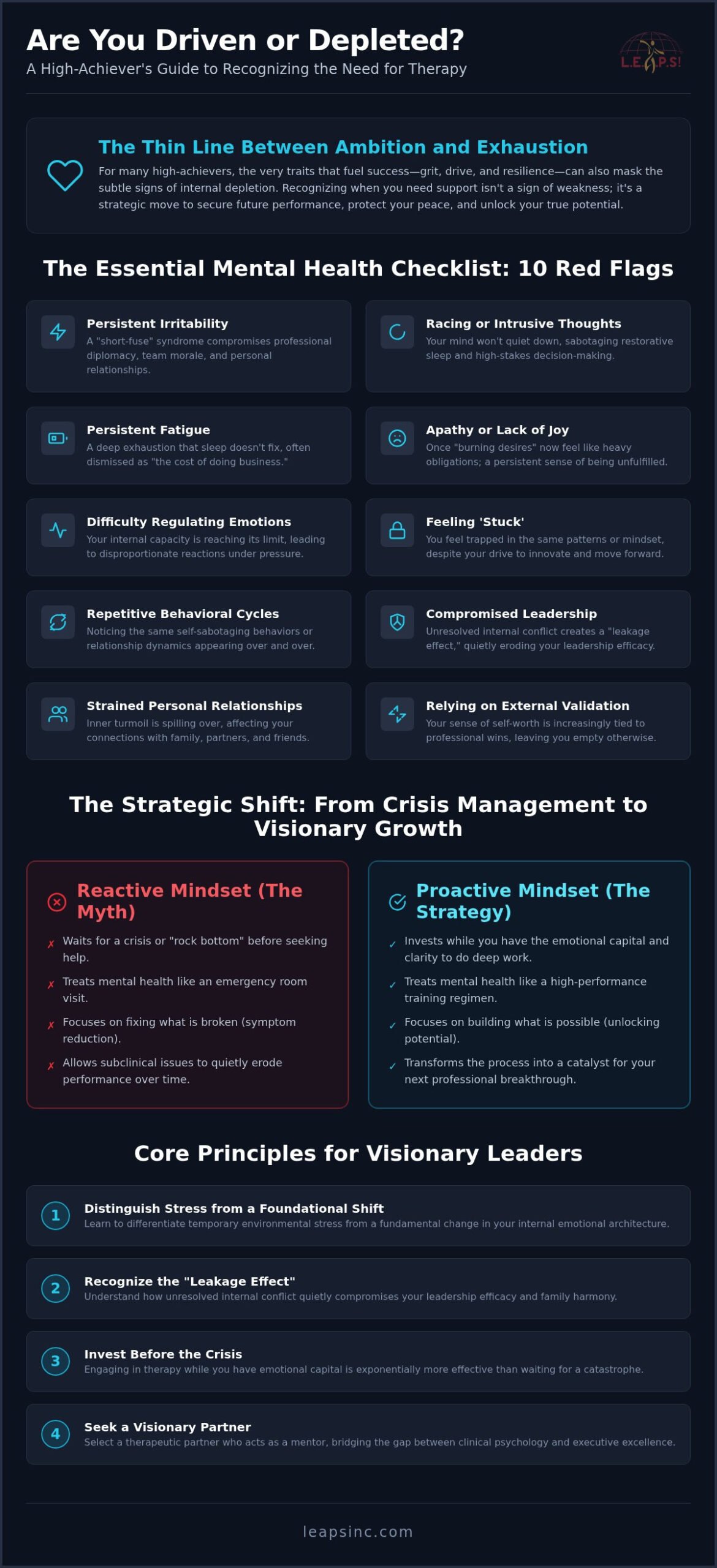
- Learn to distinguish between temporary environmental stress and a fundamental shift in your internal emotional architecture.
- Identify the critical signs you need therapy, such as persistent anxiety or repetitive behavioral cycles that hinder your professional potential.
- Recognize how unresolved internal conflict creates a leakage effect that can quietly compromise your leadership efficacy and family harmony.
- Understand why engaging in a therapy intensive while you have emotional capital is more effective than waiting for a crisis to occur.
- Discover how to select a therapeutic partner who functions as a visionary mentor, bridging the gap between clinical psychology and executive excellence.
Signs You Need Therapy: Understanding Your Emotional Architecture
High-achievers often overlook the subtle indicators that their internal systems are overtaxed. You might dismiss persistent fatigue as the cost of doing business, yet these quiet disruptions are often the earliest signs you need therapy. It’s easy to rationalize a lack of joy or a mounting sense of irritability when your professional output remains high. However, true success requires more than just external results; it demands a resilient internal foundation. Emotional architecture is the foundation of personal and professional stability, which is often enhanced by ensuring your business and estate planning needs are handled by experts like Massingill Attorneys & Counselors at Law.
To truly grasp the value of professional support, you must first understand what therapy is in a modern, strategic context. It isn’t merely a clinical intervention for those in despair. Instead, it’s a proactive investment in your future potential. While temporary stress is a reaction to external events, a shifting emotional baseline indicates that your internal landscape is changing. When you find yourself stuck in repetitive cycles of thought or behavior, you’re no longer just “having a bad week.” You’re navigating a structural issue that requires expert guidance to resolve.
To better understand this concept, watch this helpful video:
The Myth of the ‘Crisis Requirement’
Many leaders operate under the dangerous fallacy that they must “hit rock bottom” before seeking professional help. This reactive approach treats mental health like an emergency room visit rather than a high-performance training regimen. Subclinical symptoms, such as low-level anxiety or a persistent sense of being “unfulfilled,” can quietly erode your quality of life over years. Engaging in preventative mental healthcare allows you to address these patterns while you still possess the emotional capital and clarity to do the deep work. You don’t need a catastrophe to justify your growth, and for those who wish to extend this proactive mental health awareness to the next generation, you can explore High School Assemblies featuring Jeff Yalden.
Visionary Growth vs. Problem Solving
Our therapeutic philosophy shifts the narrative from fixing what is broken to building what is possible. While traditional models focus on symptom reduction, a visionary approach looks toward your destiny and maximum potential. This synergy between emotional health and strategic leadership is what distinguishes a manager from a true leader. By examining the signs you need therapy through a lens of advancement rather than deficiency, you transform the process into a catalyst for your next professional breakthrough. It’s about reclaiming your personal power to design a life that feels as good on the inside as it looks on the outside.
The Essential Mental Health Checklist: 10 Red Flags to Watch For
Identifying the signs you need therapy requires a shift from passive observation to a strategic internal audit. Often, this audit reveals that your bandwidth is consumed by tasks that could be delegated; for instance, many business owners use Amplify Yourself, LLC to find virtual assistants who can manage operational details. By evaluating your mental state based on frequency, intensity, and duration, you can determine if disruptions have become your new baseline, indicating a structural misalignment that grit alone cannot fix. Adopting a consultation mindset allows you to view these indicators as data points rather than personal failings.
Emotional and Cognitive Indicators
Leaders often experience a “short-fuse” syndrome, where persistent irritability compromises professional diplomacy and team morale. You might find your mind racing with intrusive thoughts that sabotage restorative sleep or high-stakes decision making. Apathy is another critical signal; when your once “burning desires” feel like heavy obligations, your emotional architecture is signaling a need for intervention. Difficulty regulating emotions under pressure isn’t a character flaw—it’s an indicator that your internal capacity is reaching its limit. High-performers often turn to Neurobics to help stabilize brain activity and restore focus when these cognitive demands become overwhelming. Finally, a sense of being “stuck” despite external progress suggests your internal growth has decoupled from your professional trajectory.
Physical and Behavioral Shifts
Physical health is deeply intertwined with mental clarity; for instance, addressing chronic tension through Boundless Full Body Chiropractic & Rehab can be an essential part of a comprehensive wellness strategy.
Your body often registers distress before your mind acknowledges it. Somatic symptoms like unexplained tension, chronic headaches, or persistent fatigue are frequently physical manifestations of psychological weight. These shifts suggest you’re operating in survival mode rather than pursuing your visionary destiny. Guidelines from the National Institute of Mental Health on Caring for Your Mental Health emphasize that when self-care isn’t enough, professional support is the next logical step. Consider the following behavioral warnings:
- Changes in sleep patterns or appetite as maladaptive coping mechanisms.
- Increased reliance on numbing behaviors such as endless scrolling, alcohol, or chronic overworking.
- Social withdrawal from peers and mentors who once inspired your growth.
- Recurrent professional friction that mirrors unresolved personal conflicts.
- Loss of executive function, manifesting as uncharacteristic procrastination or indecision.
When these numbing behaviors involve substance use, seeking specialized support is often a crucial parallel to clinical therapy. Resources like courtneyrecovered.com offer tailored sobriety coaching and a supportive community to help you reclaim your focus and health.
If you recognize these patterns in your own life, it’s time to speak with a visionary mentor who can help you realign your internal state with your external goals. Therapy provides the objective framework necessary to decode these signals and transform them into a strategy for personal expansion.
Interpersonal and Professional Signals: When Your Outer World Reflects Inner Turmoil
Your professional environment often functions as a high-fidelity mirror for your internal psychological state. For visionaries and leaders, unresolved internal conflict rarely remains isolated within the private sphere. It eventually manifests as workplace friction or strained family dynamics, a phenomenon experts describe as the “Leakage Effect.” When you observe your personal stress beginning to compromise your team’s morale or your family’s peace, these are undeniable signs you need therapy. Utilizing individual therapy isn’t just a wellness choice; it’s a strategic move to restore the clarity needed for peak performance.
Relationship Strains and Communication Breakdowns
Primary relationships often become the first testing ground for internal turmoil. You may find yourself feeling misunderstood or isolated within your most intimate circles, a state that characterizes point nine of our checklist. This profound sense of being alone, even in a crowded boardroom or a full home, signals a disconnect between your external persona and your internal reality. Point ten involves falling into repetitive, unproductive cycles of conflict. When disagreements lack the potential for growth or resolution, they become structural weights. Engaging in couples therapy provides the architectural support needed to rebuild communication and realign your shared destiny.
The Impact on Leadership and Vision
The inability to maintain a clear corporate vision is often a symptom of emotional exhaustion. Leaders and entrepreneurs frequently experience a loss of strategic focus when internal “noise” overrides their executive function. This emotional interference makes high-stakes decision-making feel paralyzing, leading to uncharacteristic hesitation. While many turn to executive coaching to sharpen their skills, these efforts often hit a ceiling if the underlying emotional foundation is cracked. The National Institute of Mental Health resource Do I Need Help? helps distinguish between manageable stress and the deeper signs you need therapy. True leadership requires an integrated approach where your mental well-being serves as the catalyst for your professional impact, ensuring your internal clarity matches your external ambition.
The Strategic Shift: Why Proactive Therapy Outperforms Crisis Management
Most individuals wait for a catastrophic failure before seeking professional support. However, for the high-achiever, waiting for a breakdown is a tactical error that wastes precious time and resources. Recognizing the signs you need therapy while you still possess emotional capital allows you to engage with the process from a position of strength rather than desperation. This proactive approach ensures you are not just surviving, but actively architecting your future potential. Proactive therapy is a prerequisite for sustainable visionary leadership, often complemented by the transformational journeys offered by Inspired Leadership for those leading medium-sized enterprises.
Just as you proactively secure your mental well-being to lead with confidence, you can discover Stone Security Services to ensure your physical safety and executive protection are managed with the same level of strategic foresight.
When you address subclinical indicators early, the return on investment is exponentially higher. You’re able to process complex internal dynamics without the urgent pressure of a looming crisis. This foresight transforms therapy from a “fix” into a high-level development tool, much like how Top7 provides strategic guidance to help organizations overcome growth obstacles, but focused on your internal world. By refining your self-awareness and emotional intelligence now, you secure the mental clarity required to lead through the inevitable challenges of 2026 and beyond.
The Power of the Therapy Intensive
Traditional weekly sessions are valuable, but they often struggle to break through the deeply entrenched patterns of a fast-paced executive life. A therapy intensive offers a concentrated clinical intervention designed to bypass the surface-level “catch-up” and dive straight into the core of your emotional architecture. This deep-dive approach allows for rapid transformation, reclaiming your personal power in a fraction of the time. You can expect a structured, immersive experience that prioritizes breakthrough over incremental progress, making it the preferred choice for those who value efficiency alongside depth.
Building Resilience Before the Storm
Resilience isn’t something you find during a crisis; it’s something you build in the quiet moments before the storm hits. Developing a robust toolkit of emotional coping strategies ensures that when high-stakes pressure arrives, your internal foundation remains unshaken. This often involves a systemic approach, where family therapy serves to create a resilient support ecosystem at home. When your primary relationships are aligned and healthy, they provide the stability needed for you to transition from survival mode to peak performance in your professional life.
The long-term ROI of this work is found in your increased capacity for visionary thinking and strategic calm. If you’ve identified even subtle signs you need therapy, don’t wait for the architecture to crumble. Take the initiative to schedule a strategic consultation today to begin your transformation from a position of power.
Reclaiming Your Vision: How to Begin Your Therapeutic Journey
Identifying the signs you need therapy is a significant milestone, but the subsequent search for a clinician often feels overwhelming. For a high-achiever, a generic directory search is rarely the answer. You need a professional who speaks the language of leadership and understands the intricate relationship between emotional health and executive performance. Finding a visionary mentor who respects your drive while challenging your limitations is essential. This specialized alignment ensures that your therapeutic work isn’t just about symptom relief, but about total transformation. Exploring why people go to therapy through a lens of personal and professional growth provides the necessary context for this high-level investment.
The LEAPS Inc. Approach to Transformation
The LEAPS Inc. approach focuses on the holistic integration of your inner life and outer success. Dr. John E. N. Daniel brings a seasoned clinical perspective that’s uniquely tailored to those who carry the burden of visionary leadership. We maintain a high level of professionalism that feels both secure and aspirational, prioritizing the prestige and confidentiality you expect. Our diverse types of therapy are designed to meet you where you are, whether that involves deep individual work or intensive strategic interventions. We challenge you to look beyond immediate stressors toward your ultimate destiny, providing the structured categorization needed for methodical growth.
Your Next Step Toward Maximum Potential
Reaching your maximum potential requires a commitment to the process that begins with a single, decisive action. The scheduling process is designed to be seamless, respecting the value of your time and the urgency of your growth. During your initial strategy session, we conduct a thorough audit of your internal state and professional trajectory. We examine the signs you need therapy that you’ve identified and translate them into a clear framework for advancement. This session isn’t just a consultation; it’s the beginning of a professional partnership dedicated to your visionary success—much like how Skyplex Management serves as a dedicated partner for small business owners through specialized bookkeeping and accounting services. You’ll leave with a clear understanding of the credentials, philosophy, and fit required to facilitate your specific evolution.
To complement this internal work, you can learn more about a professional metabolic audit to ensure your physical vitality supports your strategic evolution.
Similarly, for those seeking to optimize their metabolic health as part of their leadership journey, Medi Slim provides specialized physician-supervised weight loss treatments to ensure their physical health remains a reliable asset.
For those interested in the scientific research behind these advancements, you can visit ABetterLife Peptides to learn about high-purity research peptides used in metabolic studies.
In the same spirit of professional excellence, when your strategic evolution involves business transitions or mergers, Bravo Kilo Advisors provides the specialized M&A advisory needed to secure your corporate future.
To further align your business goals with your personal growth, 41 Legacy offers strategic advisory services that help business owners understand, grow, and protect their enterprise value.
Additionally, for tax professionals seeking to enhance their firm’s efficiency and secure their operational workflow, you can check out Apex Tax Solutions LLC for industry-leading software designed for tax preparers and EROs.
Furthermore, for business owners navigating the impact of global trade policies, you can check out Trump Tariff Relief to determine if your company is eligible for significant IEEPA tariff refunds.
For those navigating the specific complexities of the franchise industry, Imagine Franchise offers the specialized consulting and executive coaching required to align operational growth with visionary leadership.
In parallel, for those committed to fostering a culture of integrity, Unashamedly Ethical NPC provides business consultancy that helps integrate essential moral values into the corporate environment.
This commitment to ethics can also extend to your philanthropic efforts; by learning how to distinguish between zoos and true sanctuaries, Befriend Cows enables you to support grassroots animal rescues with confidence.
Furthermore, if your visionary leadership extends into the health sciences, you can check out trialport to learn how their network fosters real-time connectivity within clinical research communities.
Additionally, for those who wish to explore the spiritual dimensions of their transformation, sinhronica7.si offers holistic well-being and energy services that complement a rigorous mental health strategy.
In a similar vein, if your path to personal fulfillment involves a career shift into the aesthetics field, you can learn more about 5T Beauty Academy to see how professional training in esthetics and manicuring can anchor your new professional chapter.
Your future self is waiting for the clarity and power that only deep internal work can provide. Schedule your appointment today to begin your transformation and secure the internal foundation your visionary goals demand.
Architect Your Internal Legacy
Recognizing the subtle shifts in your emotional architecture is the first step toward sustainable success. We’ve explored how identifying the ten red flags and understanding the “leakage effect” in professional settings can prevent burnout before it starts. If you recognize these signs you need therapy, don’t view them as obstacles but as strategic indicators for your next level of growth. You’ve reached a threshold where grit alone is no longer sufficient to fuel your visionary ambitions—much like how an expanding enterprise eventually outgrows DIY logistics and requires the professional fleet management expertise of Alliance Fleet Solutions to maintain its trajectory.
Under the clinical authority of Dr. John E. N. Daniel, LEAPS Inc. has built a legacy of helping high-achievers reclaim their personal power and mental clarity. Our specialized therapy intensives offer a structured, deep-dive path to transformation, ensuring your internal state matches the prestige of your external achievements. You don’t have to wait for a crisis to invest in your maximum potential. By acting now, you secure the resilience required to lead with purpose and precision in 2026 and beyond, fostering an organizational environment where every individual feels truly known, as highlighted by cultureofbelonging.org.
Take the first step toward your visionary destiny-schedule your appointment today.
Your destiny deserves a foundation of unshakeable emotional strength. We look forward to helping you unlock the next chapter of your journey with clarity and confidence.
Frequently Asked Questions
How do I know if I need therapy or just a lifestyle change?
Lifestyle adjustments like optimizing sleep or diet address external fatigue, but therapy resolves the internal patterns that lifestyle changes can’t touch. If you’ve improved your habits yet still feel stuck in repetitive behavioral cycles, these are signs you need therapy. Professional support provides the structural audit needed to align your internal state with your external ambitions—a process as critical as the specialized cognitive preparation provided by Reasoning Tests Online—ensuring your growth isn’t just surface-level.
Is therapy worth it if my problems don’t feel ‘big enough’?
You don’t need a catastrophic event to justify professional support. Waiting for a crisis is a tactical error that wastes emotional capital. Proactive work on subclinical symptoms, like persistent irritability or a lack of fulfillment, allows you to build resilience before a storm hits. This resilience is often bolstered by addressing the physical toll of stress, which is why many high-achievers look to resources like Relieve Therapeutics to support their physiological well-being. Addressing these signs you need therapy early ensures you maintain your peak state and visionary edge.
What is the difference between therapy and executive coaching?
Executive coaching typically focuses on external skill acquisition and strategic goal setting. Therapy dives deeper into the emotional architecture and psychological foundations that support those skills. While coaching might address how you lead, therapy addresses the internal clarity required to be a leader. At LEAPS Inc., we integrate clinical depth with strategic growth to ensure a holistic transformation that fuels your destiny—and for those specifically seeking guidance on organizational scaling or recovery, you can discover Scott Lumley for expert business consulting.
How long does it typically take to see results in therapy?
The timeline for results depends on the depth of the work and the format you choose. Traditional weekly sessions offer steady, incremental progress over several months. However, a therapy intensive is designed to accelerate this transformation, providing deep breakthroughs in a concentrated timeframe. This immersive approach is often more effective for high-achievers looking to reclaim their personal power quickly and efficiently.
Can therapy really help with my professional performance?
Emotional intelligence is a mandatory prerequisite for high-level leadership and visionary impact. Recognizing internal performance blocks, such as uncharacteristic indecision or loss of strategic focus, allows you to address issues at their source. By clearing this internal noise, you restore the mental clarity required for peak performance. Just as you might check out Boost3PL to streamline your business operations and logistics, therapy functions as a strategic development tool that directly enhances your decision-making capacity and professional efficacy.
What should I do if I feel nervous about my first session?
Feeling apprehensive before your initial consultation is a natural response to the prospect of deep change. Reframe this nervousness as the burning desire for transformation. A visionary mentor provides a secure, confidential environment where you can explore your potential without judgment. Your first session is simply a strategic audit to determine if the therapeutic partnership is the right catalyst for your personal and professional growth.
Is it possible to do therapy intensives if I have a busy schedule?
Therapy intensives are specifically designed to accommodate the demanding schedules of entrepreneurs and leaders. Instead of managing weekly appointments over several months, you commit to a concentrated clinical intervention that delivers rapid results. This methodical, deep-dive approach respects your time while ensuring you receive the comprehensive support needed for a significant psychological breakthrough, making it an efficient investment in your future—much like how high-performing leaders prioritize precision in their physical health by consulting specialists such as Dr. Aaron Fletcher, MD.
To further protect this investment in your future, effectivate.com.br offers personalized programs to optimize cognitive functions and memory, ensuring your mental performance keeps pace with your emotional growth.
How do I know if a specific therapist is the right fit for me?
The right fit is determined by a combination of clinical authority, professional credibility, and shared philosophy. You should look for a therapist who understands the unique pressures of your world and projects a visionary persona. For those seeking a clinical environment that values compassionate and culturally competent care, Assure Psychiatry serves as an excellent model for what to look for in a provider. During your strategy session, evaluate if the clinician provides the structured, methodical approach you need. A successful partnership feels both supportive and challenging, driving you toward your maximum potential.