

What if the friction within your family isn’t a sign of failure, but the very catalyst required to unlock your collective maximum potential? It’s deeply draining to navigate the same circular arguments, especially when the “revertigo” effect causes a seasoned leader to feel like a misunderstood child the moment they enter a family setting. You’ve likely felt that this instability acts as a silent anchor, dragging against your professional momentum and hindering your sense of purpose.
We understand that a fractured home life can obscure your vision for the future and stifle your destiny. This guide provides a sophisticated blueprint to master family conflict resolution techniques that go beyond mere compromise. You’ll learn to utilize clinical frameworks to transform domestic tension into a strategic asset for emotional resilience and personal growth. We’ll explore the mechanics of emotional co-regulation, the psychology of the family ecosystem, and the structured steps needed to turn every disagreement into an intentional moment of repair. By the end, you’ll possess the tools to lead your family toward a harmonious, high-functioning future where every member can thrive.
Key Takeaways
- Reframe family friction as a strategic catalyst for growth, recognizing that tension often signals a necessary evolutionary shift within your family ecosystem.
- Leverage the biological mechanism of co-regulation to stabilize your own nervous system, allowing you to anchor the emotional climate of your home during disagreements.
- Implement sophisticated family conflict resolution techniques, such as the structured Repair Cycle, to transform repetitive arguments into opportunities for deeper connection.
- Dismantle the “revertigo” effect by identifying the specific triggers that cause adult regression, ensuring your professional identity remains secure in family settings.
- Determine when to transition from self-guided efforts to professional family therapy or specialized intensives to resolve deep-seated generational blocks.
The Visionary Perspective on Family Conflict: Friction as a Catalyst
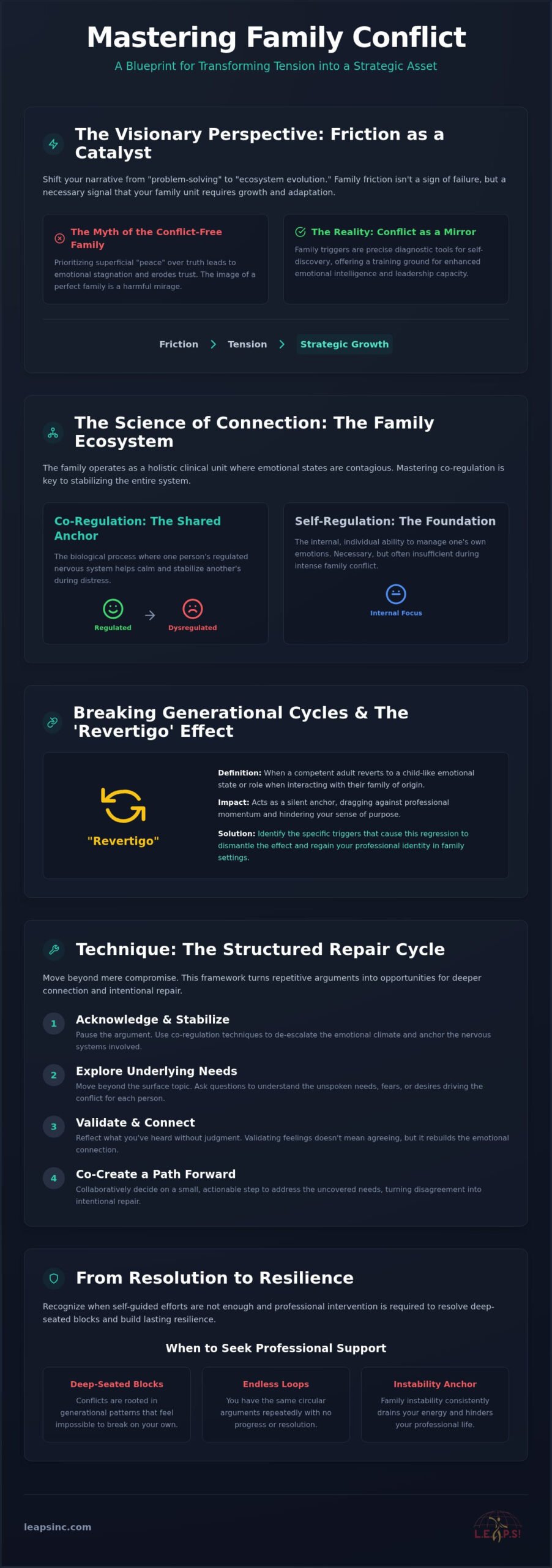
Family conflict isn’t a sign of dysfunction. Instead, it’s a natural byproduct of a Family Ecosystem in transition. As individuals grow, the system must recalibrate to accommodate new boundaries, identities, and desires. For high-achievers, this friction often feels more taxing than professional stress because you can’t outsource your emotional history. You might lead a corporation with precision, yet feel completely unequipped when a holiday dinner descends into a repetitive argument. This happens because family dynamics tap into our most primal needs for belonging and validation, making the stakes feel soul-deep.
We invite you to shift your narrative from “problem-solving” to “ecosystem evolution.” In this visionary framework, conflict serves as the tension required for your family to reach its maximum potential. By applying sophisticated family conflict resolution techniques, you aren’t just silencing a disagreement; you’re facilitating a strategic upgrade to your collective emotional intelligence. This process requires moving beyond the surface level of the argument to understand the underlying shifts the ecosystem is demanding.
The Myth of the Conflict-Free Family
The image of the perfect, conflict-free family is a harmful mirage that encourages suppression rather than expression. When we prioritize “peace” over truth, we invite emotional stagnation that eventually erodes trust. Healthy conflict is a vital signal that the family system requires growth or adaptation to remain functional. Without this friction, there is no catalyst for change, leaving the family unit stuck in outdated patterns that no longer serve its members’ evolving destinies. Embracing this reality allows you to view disagreements as necessary milestones on the path to a more resilient bond.
Conflict as a Mirror for Personal Transformation
Your family triggers are precise diagnostic tools. They reveal latent emotional needs and offer a unique training ground for self-discovery. When you master family therapy techniques within your own home, you directly enhance your leadership capacity. The same emotional intelligence required to navigate a sibling’s resentment or a parent’s expectation is the foundation of visionary executive influence. By utilizing the home as a laboratory for growth, you can apply family conflict resolution techniques that transform domestic friction into a powerful asset for personal and professional transformation. This family therapy approach ensures that your personal evolution and your family’s growth move in tandem toward a shared vision of success.
The Science of Connection: Co-Regulation and the Family Ecosystem
In our therapeutic philosophy, we view the family as a holistic, interconnected clinical unit where the health of one individual dictates the vitality of the entire system. This Family Ecosystem operates on the biological mechanism of co-regulation. It’s the silent, physiological dialogue between nervous systems that determines whether a home feels like a battleground or a sanctuary. In high-pressure households, emotional contagion is a constant reality. If an executive returns home vibrating with the cortisol of a high-stakes deal, that energy ripples through the ecosystem, often triggering dormant conflicts. Understanding this biological tether is the first step in mastering sophisticated family conflict resolution techniques.
The LEAPS Inc. approach merges clinical depth with professional well-being, recognizing that your domestic stability is the foundation of your executive performance. When the ecosystem is dysregulated, it’s nearly impossible to maintain the clarity needed for visionary leadership. By treating the family as a single clinical unit, we can identify where the “circuitry” is failing and implement strategic interventions that restore balance to every member of the home.
Defining Co-Regulation in the Modern Home
Co-regulation is the collaborative process where one person’s regulated nervous system helps settle another’s dysregulation. While self-regulation is the internal ability to manage one’s own emotions, co-regulation is an external, shared responsibility. For example, when a parent remains calm and grounded during a teenager’s outburst, they provide a physiological “anchor” for the child. This isn’t about being passive; it’s about utilizing clinical presence to stabilize the environment so that productive dialogue can occur. In practice, this might look like taking three deep breaths before responding to a provocative comment, effectively signaling safety to everyone in the room.
The Impact of High-Stress Environments
High-achievers often struggle with professional leakage, where the intensity of the boardroom bleeds into the living room. This creates a volatile ecosystem where everyone is perpetually on edge. Visionary leaders must prioritize creating a psychological sanctuary at home by establishing clear boundaries between their professional and personal lives. Using family conflict resolution techniques that prioritize emotional safety allows the home to become a place of recovery rather than another source of stress. By protecting the domestic emotional climate, you ensure that your family remains a source of strength rather than a drain on your potential. If you feel your family ecosystem is currently out of balance, you may wish to schedule an appointment to begin a structured recalibration.
Breaking Generational Cycles: Addressing Revertigo and Maladaptive Loops
Revertigo is a powerful psychological phenomenon. It’s the sudden, often involuntary regression successful adults experience when they return to their family of origin. You might lead hundreds of employees with absolute authority at 2 PM, yet find yourself slamming doors or feeling deeply wounded by a parent’s comment by 6 PM. This regression occurs because the family ecosystem often operates on a “Worldview” that hasn’t updated in decades. Your family members may still see you through the lens of your childhood self, ignoring your professional evolution and personal growth. To move forward, you must apply advanced family conflict resolution techniques that address these historical echoes rather than just the surface-level disagreement.
These maladaptive loops are repetitive, circular arguments that never reach a meaningful conclusion. They are scripts that every family member knows by heart, leading to the same exhausted silence every time. Breaking these cycles requires more than just willpower; it requires a clinical understanding of how your past is dictating your present. Many high-achieving families find that family therapy is the most effective way to map these loops and create a new, visionary language for connection that honors who you are today.
Recognizing Your Role in the Pattern
Awareness is the first step toward disruption. During a family encounter, practice “spectator-mode” self-observation to see which role you are playing. Are you the Hero, constantly achieving to prove your worth? Or perhaps the Scapegoat, absorbing the family’s collective stress? Maybe you’re the Caretaker, sacrificing your own needs to maintain a fragile peace. Recognizing these archetypes allows you to maintain your “Adult Self,” keeping your professional composure even when the environment feels regressive. When you stop playing the assigned part, the entire loop begins to lose its power.
Disrupting Generational Communication Loops
Every loop has an entry point, a specific phrase or tone that signals the start of the script. Once you identify this trigger, you can choose a different path. Strategic vulnerability is a powerful tool for de-escalation; instead of defending your position, express the underlying emotion. Saying, “I feel dismissed when we talk about my career this way,” is far more effective than an angry rebuttal. This approach allows you to implement family conflict resolution techniques that set visionary boundaries. These boundaries protect the future of the relationship, ensuring that your family interactions support your destiny rather than draining your potential. Understanding your attachment styles in relationships can further illuminate why certain communication loops feel so deeply entrenched and difficult to break.
Advanced Conflict Resolution Techniques for Lasting Harmony
Mastering family conflict resolution techniques requires a fundamental transition from reactive emotion to strategic intervention. In high-achieving families, disagreements are often fueled by a misalignment between intent and impact. You may intend to offer helpful guidance, but the impact on your spouse or child is one of micromanagement or dismissal. Recognizing this gap is a high-level clinical skill that prevents resentment from taking root. When a conversation begins to spiral, the “Take Two” method serves as an immediate course correction. It allows any member to pause, acknowledge that the current trajectory is unproductive, and literally “start over” with a more regulated tone and clearer objective.
This tactical approach ensures that the family ecosystem remains a place of growth rather than a theater for repetitive power struggles. By treating communication as a precision skill, you can navigate even the most complex domestic challenges with the same composure you bring to executive negotiations. If you find that these cycles are too deeply entrenched for self-correction, you can schedule an appointment for family therapy to begin a guided transformation.
The Four-Step Authentic Repair Process
Resolution is incomplete without a structured repair. Most families stop once the shouting ends, but true harmony requires an intentional “Repair Cycle” to prevent the same issue from resurfacing. This process involves four distinct clinical steps:
- Acknowledgement without defensiveness: State clearly what happened without making excuses or shifting blame to the other person’s triggers.
- Validation of the other person’s emotional reality: Confirm that their feelings make sense from their perspective, even if you disagree with their interpretation of the facts.
- Expression of regret and ownership: Take full responsibility for your part in the friction, focusing on your actions rather than their reaction.
- Collaborative planning for future prevention: Discuss specific ways to handle similar situations differently next time, creating a new protocol for the ecosystem. For a structured walkthrough of each stage, the visionary checklist for emotional repair offers a clinical framework to guide your family through every step of this process.
Active Listening as a Strategic Tool
Active listening is not a passive act; it’s a proactive act of leadership. In a high-pressure home, the “Speaker-Listener Technique” ensures that every voice is heard and understood before a solution is proposed. This involves “Reflective Mirroring,” where the listener repeats back what they heard the speaker say before responding. This simple clinical intervention stops the “revertigo” effect by forcing both parties to remain in their Adult Selves. Applying your executive communication skills to the dining room table transforms these moments from exhausting chores into strategic investments in your family’s collective resilience.
From Resolution to Resilience: The Role of Professional Intervention
While the family conflict resolution techniques discussed previously provide a robust foundation for change, certain generational patterns require the precision of a professional intervention. There comes a point where self-guided efforts reach their limit, especially when the family ecosystem is entangled in deep-seated blocks that defy simple logic. In these instances, transitioning to a “Visionary Mentor” model of therapy is the most strategic path forward. Traditional counseling, often limited to brief weekly sessions, may prove insufficient for families navigating high-stakes dynamics or complex emotional histories that require more intensive focus.
Seeking professional guidance isn’t an admission of failure. It’s a demonstration of strategic foresight. It acknowledges that your family’s emotional health is a critical asset worthy of expert investment. A neutral, clinical perspective provides the clarity needed to dismantle “dead-end” loops that have persisted for years, ensuring that your domestic environment supports rather than stifles your collective destiny.
When to Seek Professional Guidance
You’ll know it’s time for professional intervention when the same circular arguments recur regardless of the family conflict resolution techniques you’ve applied. If the “revertigo” effect feels insurmountable or if family friction is actively hindering your professional potential, the ecosystem is stuck. A seasoned clinician can identify the underlying structural failures that are invisible to those inside the system. This level of support allows every member to move toward their maximum potential without the weight of unresolved trauma anchoring their progress. It’s about protecting the future of the lineage by resolving the frictions of the past.
Specialized Family Intensives for Deep Transformation
For families requiring rapid, profound change, a therapy intensive offers a strategic alternative to months of standard treatment. These focused interventions act as a “deep dive,” allowing for the concentrated repair of the family ecosystem over a few consecutive days. This model is particularly effective for high-achievers who value efficiency and clinical depth. It aligns perfectly with the synergy between emotional healing and executive coaching, treating personal and professional success as two sides of the same coin. To understand the full scope of this transformative approach, explore The Deep Dive: A Comprehensive Guide to Therapy Intensives in 2026. By choosing this path, you reclaim your personal and family power, ensuring that your domestic life becomes the launchpad for your ultimate destiny.
Reclaiming Your Legacy through Intentional Growth
Transforming family friction into a source of collective strength requires a fundamental shift from reactive survival to visionary strategy. You’ve explored how biological co-regulation stabilizes the home and how identifying “revertigo” protects your hard-won professional identity during family gatherings. These sophisticated family conflict resolution techniques aren’t just about ending arguments; they’re about evolving the very circuitry of your family ecosystem to support your highest ambitions.
At LEAPS Inc., led by visionary expert Dr. John E. N. Daniel, we specialize in the integration of clinical health and executive success. We understand that your domestic stability is the foundation of your leadership capacity. Whether you require our specialized Family Therapy Intensives for rapid, deep-dive transformation or structured strategic guidance, we provide the clinical depth needed to unlock your family’s maximum potential. Your destiny is inextricably linked to your domestic harmony, and the tools for repair are now within your reach.
Don’t allow generational cycles to dictate your future. Schedule a consultation to evolve your family ecosystem today. By choosing to lead your family with clinical authority and empathetic intent, you ensure that every member can thrive in a resilient, high-functioning home.
Frequently Asked Questions
What is the most effective way to handle a recurring family argument?
The most effective way to handle a recurring family argument is to identify the “entry point” or trigger that signals the start of the script. Once you recognize this pattern, you can utilize the “Take Two” method for immediate course correction. Instead of repeating the same rebuttals, express the underlying emotion using strategic vulnerability. This shifts the conversation from a power struggle to a moment of repair, allowing the family ecosystem to evolve.
How can I stop feeling like a child when I visit my parents (revertigo)?
You can stop the revertigo effect by practicing “spectator-mode” self-observation during family interactions. Recognize that your family’s worldview may be stuck in the past, but your professional identity is secure. When you feel the urge to regress, anchor yourself in your current executive reality. Take three deep breaths to stabilize your nervous system. By consciously maintaining your “Adult Self,” you disrupt the old patterns and force the system to acknowledge your current evolution.
Can family therapy help if only one person is willing to change?
Family Therapy is highly effective even if only one person is initially willing to change. Since the family is an interconnected ecosystem, a significant shift in one member’s behavior forces the entire system to recalibrate. By mastering family conflict resolution techniques on your own, you change the “input” into the family circuit. This often reduces the intensity of conflicts and eventually invites other members to participate in the new, healthier dynamic you’ve established.
What is the difference between family counseling and a Therapy Intensive?
Traditional family counseling typically involves weekly one-hour sessions focused on incremental progress. In contrast, a Therapy Intensive is a strategic “deep dive” occurring over several consecutive days. This format allows for the rapid resolution of deep-seated blocks that weekly sessions might never reach. Intensives are particularly suited for high-achieving families who require an efficient, concentrated environment to achieve a profound transformation and reclaim their collective visionary power in a shorter timeframe.
How do I set boundaries with family members without causing more conflict?
Setting boundaries without causing more conflict requires framing your needs as a strategic investment in the relationship’s future. Use “I” statements to express how a specific behavior impacts your emotional well-being rather than criticizing the other person. For example, say, “I need our visits to remain focused on the present so I can feel fully connected to you.” This approach positions the boundary as a tool for deeper connection rather than a wall of separation. Clarifying how to find your core values can provide the internal compass needed to set boundaries that are authentic, consistent, and aligned with your true identity rather than reactive to the moment.
What should I do if my family refuses to participate in conflict resolution?
If your family refuses to participate, the most proactive step is to focus on your own emotional resilience through Individual Therapy. You cannot control their participation, but you can control your response to the ecosystem’s friction. Strengthening your own nervous system through co-regulation skills ensures that their refusal doesn’t derail your personal or professional destiny. Often, when one person becomes unshakable, the rest of the family eventually feels the shift and adapts to your new strength.
How does family conflict affect my professional performance as a leader?
Family conflict acts as a silent drain on your cognitive and emotional resources, often leading to professional leakage. When your domestic ecosystem is in turmoil, your ability to maintain the clarity required for visionary leadership is significantly compromised. Unresolved family stress can manifest as irritability in the boardroom or a lack of focus during strategic planning. Resolving these domestic blocks is a strategic necessity for any leader aiming to reach their maximum potential and protect their legacy. Understanding the benefits of individual therapy for personal and professional growth can provide a powerful complement to family-focused work, helping you build the internal resilience needed to lead with clarity both at home and in the boardroom.
Is co-regulation something that can be learned as an adult?
Co-regulation is absolutely a skill that can be mastered as an adult through intentional practice. It involves learning to utilize your own regulated nervous system to stabilize others during high-pressure moments. Through clinical family conflict resolution techniques, you can train your body to remain calm and grounded even when those around you are dysregulated. This ability is a hallmark of high-level leadership, allowing you to anchor the emotional climate of both your home and your organization. Exploring how your attachment styles in relationships shape your capacity for co-regulation can provide an additional layer of insight as you develop this critical skill. Leaders who have taken the time to understand how to find your core values often discover that this clarity accelerates their ability to co-regulate, as a secure sense of identity provides a stable foundation from which to anchor others during moments of emotional turbulence.