

What if the ceiling you’ve hit in your career isn’t a lack of strategy, but an unhealed emotional pattern? Many high achievers reach a plateau where they can’t tell if they’re suffering from clinical burnout or simply a lack of professional direction. You’ve likely felt the frustration of seeking growth only to find yourself caught between the unregulated coaching industry and the sometimes passive nature of traditional clinical practice. Understanding the nuances of therapy vs coaching is no longer just about choosing a service; it’s about architecting your future.
We agree that your time and mental energy are your most precious assets. You deserve a clear framework that honors your internal depth while aggressively pursuing your destiny. This visionary guide will empower you to distinguish between emotional healing and strategic execution, ensuring you never settle for a fragmented approach to your development. We will examine the shifting landscape of 2026, from new licensing compacts to the rise of integrated models, providing you with the structured insights needed to bridge the gap between psychological well-being and executive mastery.
Key Takeaways
- Distinguish between clinical interventions designed for emotional well-being and strategic partnerships focused on scaling your organizational impact.
- Navigate the nuanced landscape of therapy vs coaching to identify whether your current plateau requires deep psychological healing or tactical executive execution.
- Explore the 2026 trend toward holistic integration, where high achievers leverage multi-disciplinary expertise to align their internal depth with their external vision.
- Quantify the synergistic ROI of integrated growth, connecting emotional resilience and clarity of purpose to measurable gains in leadership efficiency.
- Utilize a structured decision framework to determine if your path forward requires stabilizing your psychological foundation or accelerating your strategic momentum.
Clinical Foundations vs. Strategic Momentum: Defining the Core Differences
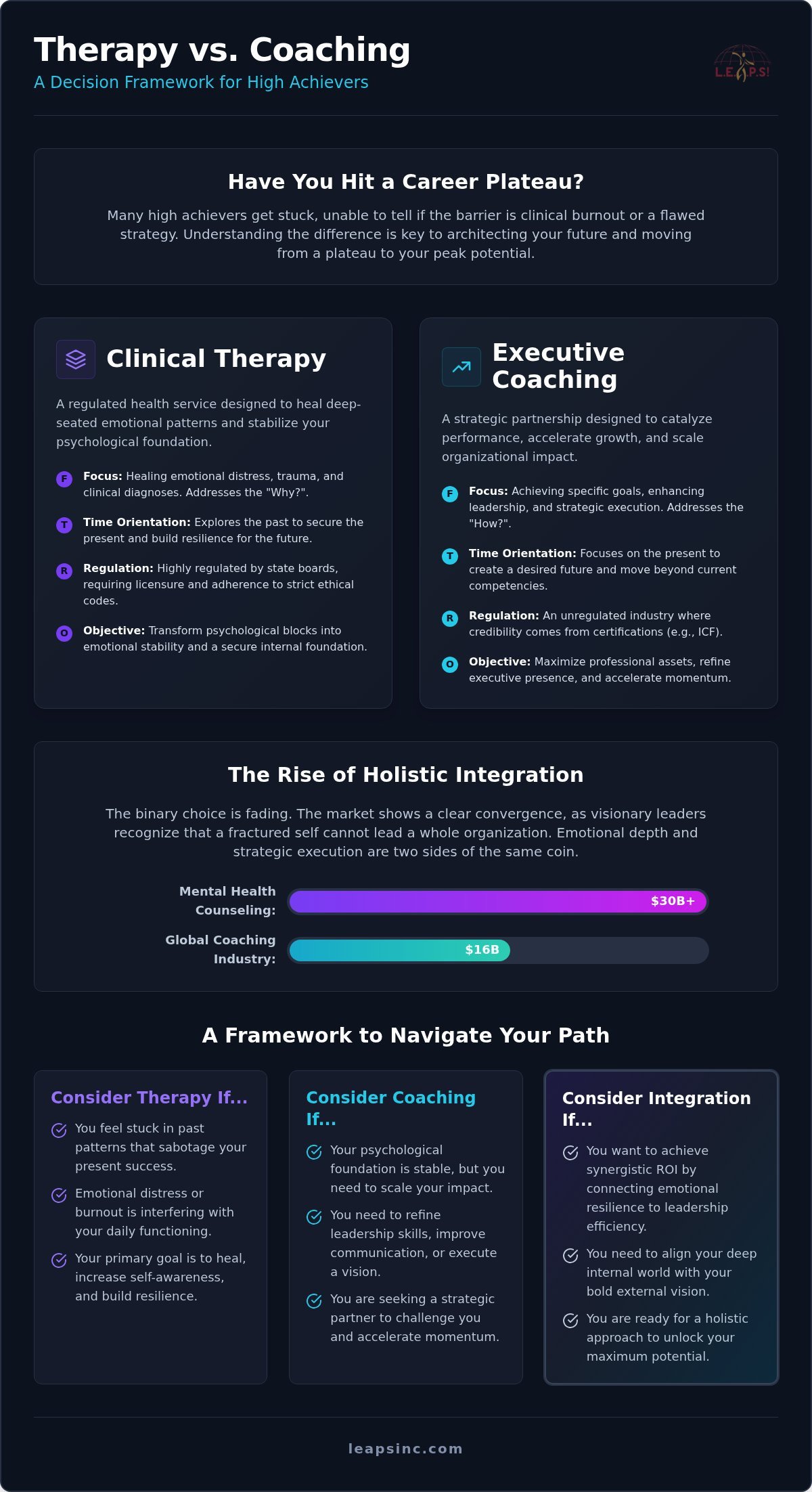
The choice between professional interventions often feels like a binary decision between looking back or moving forward. Clinical therapy operates as a highly regulated health service, requiring state licensure to treat mental health conditions and emotional distress. It provides the essential stabilization needed when internal patterns interfere with daily functioning. Professional coaching, conversely, functions as a strategic partnership designed to catalyze performance and organizational development. While the debate of therapy vs coaching often centers on “healing” versus “achieving,” the reality in 2026 is far more integrated.
Understanding these distinct roles requires a look at the regulatory landscape. Therapists are bound by strict state boards and ethical codes focused on patient safety and clinical efficacy. Coaches operate in an unregulated space where prestige is defined by rigorous certifications from bodies like the International Coaching Federation. Both paths offer profound transformation, but they utilize different engines to drive change. To better understand the specific boundaries and overlaps between these two disciplines, watch this helpful video:
The Scope of Individual Therapy
At its core, individual therapy addresses clinical diagnoses, complex trauma, and deep-seated emotional patterns that govern your subconscious. A seasoned clinician creates a secure, confidential environment where you can safely explore vulnerability without judgment. Competitors often claim therapy is strictly about the past, but true clinical work utilizes the past to secure your present foundation. It transforms psychological blocks into emotional resilience, ensuring that your internal engine is capable of sustaining the high-pressure demands of your destiny.
The Scope of Executive and Business Coaching
The discipline of executive coaching shifts the lens toward corporate visioning, leadership impact, and the strategic scaling of your professional life. This field draws heavily from coaching psychology to unlock latent abilities and refine your strategic execution. The coach acts as a visionary mentor, challenging you to move beyond current competencies toward a peak state of influence. It is less about treating a deficit and more about maximizing an asset, focusing on specific outcomes such as:
- Refining executive presence and high-stakes communication.
- Aligning organizational culture with a bold corporate vision.
- Identifying and executing strategic advancements for revenue growth.
- Developing the mental agility required for entrepreneurship.
The goal is professional transformation, turning a successful leader into a visionary catalyst for their entire organization. By understanding the nuances of therapy vs coaching, you can determine whether you need to repair the foundation or accelerate the build.
The Rise of Holistic Integration: Why the Binary Choice is Fading
High performers often view their lives in silos. They treat their emotional well-being as a private medical matter and their career growth as a public strategic pursuit. This separation is artificial. In 2026, the global coaching industry has reached a valuation of $16 billion, while the mental health counseling market has climbed to over $30 billion. These numbers don’t just reflect growth; they represent a convergence. The binary debate of therapy vs coaching is dissolving because the modern visionary understands that a fractured self cannot lead a whole organization.
Integrating clinical depth with executive strategy isn’t just a luxury. It’s a necessity for those navigating the complexities of 2026. While traditional models highlight the differences between a life coach and a therapist, navigating the nuances of therapy vs coaching allows you to identify where your psychological blocks act as a ceiling on your revenue growth. Emotional health is the ultimate strategic advantage, providing the clarity required to make high-stakes decisions and develop authentic brands that resonate with a discerning market.
Merging Clinical Depth with Strategic Advancement
A leader’s internal landscape directly mirrors their external impact. When clinical insights inform leadership decisions, the result is an executive presence that is both grounded and magnetic. This “Visionary” lens treats emotional vulnerability and professional success as two sides of the same coin, acknowledging that the courage to face one’s past is the same courage required to design a bold future. Holistic mental health is the seamless integration of internal psychological depth with external strategic execution.
The Evolution of the Visionary Mentor
The role of the professional support figure is shifting from a passive clinical observer to a proactive, mission-oriented mentor. This evolution moves beyond simple problem-solving toward a potential-unlocking model that facilitates rapid transformation. It requires a “burning desire” to see the client reach their maximum potential, rather than just returning to a baseline of functioning. LEAPS Inc. embodies this shift through a unique Therapeutic Philosophy that looks toward destiny rather than just immediate relief. If you are ready to explore how this integrated approach can accelerate your own trajectory, you may schedule a consultation to begin your journey.
Navigating Your Destiny: A Decision Framework for Professional Support
Choosing the right professional support requires an honest assessment of your current psychological and professional terrain. Are you seeking to stabilize a foundation that feels cracked, or are you ready to scale a vision that is already secure? This distinction is the cornerstone of the therapy vs coaching decision. If you are battling persistent anxiety, unresolved trauma, or self-sabotaging patterns that feel outside your conscious control, you are likely facing a psychological block rather than a simple skill gap. Determining the required level of clinical oversight is a strategic move that honors your internal depth and protects your professional reputation.
The framework for this decision rests on the depth of the obstacle. A skill gap can be bridged with new information and tactical execution. A psychological block, however, requires the clinical expertise of a licensed professional who can navigate the complexities of the human psyche. According to experts at Psychology Today, the primary distinction in Therapy vs. Coaching is that one treats clinical conditions while the other optimizes performance. Identifying where you sit on this spectrum ensures you don’t misapply a strategic solution to a clinical problem.
When Therapy is the Essential Foundation
You cannot build a visionary future on a volatile foundation. Signs that emotional vulnerability or past trauma are hindering your performance include chronic burnout, difficulty regulating emotions during high-stakes negotiations, or a persistent sense of “imposter syndrome” that logic cannot fix. For those requiring a rapid clinical breakthrough, Therapy Intensives offer a concentrated space to address these patterns in days rather than months. Understanding why people go to therapy reveals that it’s often the most courageous step toward long-term executive sustainability.
When Coaching is the Strategic Next Step
Once your emotional foundation is secure, the focus shifts toward visionary leadership and corporate strategy. This is the realm of strategic mentorship. You are no longer repairing; you are creating. Utilizing high-level Business Coaching is essential for entrepreneurs and leaders who are ready to fulfill their destiny and scale their impact. This partnership focuses on organizational alignment, revenue growth, and the execution of a bold corporate vision. For those in the highest tiers of leadership, Executive Coaching for C-Suite professionals provides the structured environment needed to refine executive presence and drive systemic change.
Your path forward might require immediate, deep intervention or ongoing strategic mentorship. By applying this framework, you ensure that every investment in your growth is aligned with your ultimate potential.
Beyond Problem-Solving: The Synergistic ROI of Therapy and Coaching
Investing in your professional and personal development is often viewed through the lens of cost, but the visionary leader recognizes it as essential capital. The synergistic ROI of therapy vs coaching manifests in both the intangible strength of the psyche and the tangible growth of the organization. While traditional business models focus solely on quarterly reports, the 2026 landscape demands a dual-lens approach that calculates both “soft” and “hard” returns on investment. You cannot separate the health of the leader from the health of the enterprise.
Calculating the soft ROI involves measuring improvements in emotional resilience, clarity of purpose, and the quality of professional relationships. When a leader possesses deep internal awareness, they navigate high-stakes crises with a steady hand rather than a reactive impulse. This emotional stability acts as a force multiplier for the hard ROI, which is seen in increased leadership efficiency, organizational alignment, and direct revenue growth. With the U.S. professional coaching market projected to grow at 9.3% annually through 2030, the market has clearly signaled that strategic mentorship is a primary driver of corporate success.
Your personal life often serves as the silent engine of your professional output. Friction in family or couples dynamics can leak into the boardroom, draining the cognitive resources required for visionary thinking. Addressing these internal depths isn’t a distraction from business; it’s a strategic move to protect your most valuable asset. To sustain professional talent across your entire organization, a robust Employee Assistance Program (EAP) ensures that your team remains high-functioning and aligned with your mission, reducing the 44% burnout rate currently seen in the global workforce.
The Executive Advantage: Vulnerability as Strength
The modern leader must integrate clinical self-awareness with strategic execution to maintain a peak state. Scaling a business while maintaining personal sanity requires more than just a better calendar; it requires a transformation of the self. By embracing vulnerability as a clinical strength, you unlock the ability to lead with authenticity. This integration allows you to build a prestige brand that is grounded in truth rather than just marketing tactics. Working with a strategic marketing coach who understands the intersection of psychological depth and brand presence can ensure your external market position authentically reflects your internal clarity. If you’re ready to quantify your own growth, you can schedule a leadership impact consultation to begin the process.
Aligning Culture and Strategy
Visionary health scales from the individual to the organization through the process of corporate visioning. This discipline impacts everything from team health to strategic marketing, ensuring that your internal values are reflected in your external market position. When you align your team’s psychological well-being with your strategic goals, you create an environment where maximum potential isn’t just a goal, but a daily reality. This holistic integration is the ultimate strategic advantage in a competitive market.
Unlocking Maximum Potential: The LEAPS Inc. Model
Dr. John E. N. Daniel leads LEAPS Inc. with a unique vantage point that bridges the gap between clinical psychology and high-level business development. He understands that your destiny isn’t found in a standard textbook but in the intentional integration of your internal depth and external strategy. This model respects the distinct boundaries of therapy vs coaching while leveraging their combined power to fuel your transformation. Whether you’re seeking individual healing or corporate visioning, our commitment to security and confidentiality ensures a prestige experience tailored to the high-stakes world of executive leadership.
Our commitment to prestige professional care means that your journey is protected by the highest standards of discretion. We recognize that for C-suite executives and entrepreneurs, the stakes of personal growth are exceptionally high. We provide a structured environment where you can explore emotional vulnerability without risking your professional standing. This methodical transition from clinical support to strategic development ensures that your growth is both sustainable and impactful, allowing you to scale your influence without sacrificing your well-being.
For those whose purpose is anchored in spiritual convictions, we offer specialized faith-based perspectives to ensure spiritual alignment. We believe that a leader’s moral compass is a critical component of their maximum potential. By integrating these perspectives, we provide a holistic framework for strategic advancement that honors your deepest values while pursuing your visionary goals.
A Methodical Approach to Growth
Transformation is rarely accidental; it’s the result of a structured, deliberate process. Our model moves you through specific phases, starting with a comprehensive clinical intake to secure your emotional foundation. Once stable, we transition into visionary leadership development and strategic execution. LEAPS Inc. acts as the catalyst for those ready to move beyond a baseline of functioning and reach their true peak state. We challenge you to look past immediate problems and toward the life purpose you were designed to fulfill.
Your Next Strategic Move
Your current trajectory is the result of your previous decisions. If you feel a plateau or a sense of untapped ability, it’s time to challenge the status quo and architect a new future. True growth requires the courage to invite expert-centric mentorship into your life. This isn’t just about choosing between therapy vs coaching; it’s about choosing the most direct path to your destiny. Are you ready to bridge the gap between where you are and where you are meant to be? Your next strategic move is to Schedule an Appointment to begin your transformation.
Architecting Your Future Potential
The journey toward your peak state requires more than a simple choice between healing and achieving. It demands a sophisticated integration of both. You’ve learned that while clinical therapy secures your psychological foundation, strategic coaching provides the momentum needed to scale your corporate vision. Navigating the nuances of therapy vs coaching is the first step in reclaiming your cognitive resources and aligning your internal life with your professional destiny.
Led by Dr. John E. N. Daniel, LEAPS Inc. provides the multi-disciplinary expertise required to bridge clinical psychology and corporate strategy. We don’t just solve problems; we facilitate a transformation that honors your life purpose and maximizes your organizational impact. It’s time to stop settling for a fragmented approach to your development and start architecting a life of integrated success. We challenge you to look beyond immediate relief and toward the visionary potential you were designed to reach.
Begin your journey toward visionary growth; schedule a consultation with LEAPS Inc. today. Your path to alignment and executive mastery is waiting for you to take the first strategic step.
Frequently Asked Questions
Is it better to start with therapy or coaching if I feel stuck in my career?
You should start with therapy if your feeling of being stuck is accompanied by persistent emotional distress, chronic burnout, or repetitive patterns of self-sabotage. If your psychological foundation is secure but you lack tactical direction or executive presence, coaching is the appropriate entry point. An integrated approach often begins with a clinical intake to ensure your internal health can sustain the rapid growth that high-level therapy vs coaching models demand.
Can a therapist also be my executive coach?
Yes, provided the practitioner possesses multi-disciplinary expertise and maintains clear ethical boundaries. While some professionals separate these roles, others utilize an integrated model where clinical insights directly inform strategic development. This dual-lens approach allows you to address internal depth and external strategy simultaneously. You should verify that your practitioner has both the clinical licensure and the business development experience required for high-level corporate visioning and leadership mastery.
What is the main difference in training between a therapist and a coach?
Therapists must complete a master’s or doctoral degree and thousands of supervised hours to obtain state licensure. This training focuses on diagnosing and treating mental health conditions. Coaching is an unregulated field, though prestige coaches often hold certifications from bodies like the ICF. The 2026 Counseling Compact allows therapists to practice across state lines, reflecting the rigorous nature of clinical training compared to the varied landscape of therapy vs coaching credentials.
How do I know if my professional challenges are actually rooted in clinical anxiety?
Professional challenges are likely rooted in clinical anxiety if you experience persistent physical symptoms, racing thoughts, or an inability to disconnect from work. While 44% of employees report feeling burned out according to 2026 data, clinical anxiety involves a deeper sense of dread that logic cannot resolve. A clinical assessment is the only way to determine if you need therapeutic intervention to stabilize your foundation before pursuing aggressive professional transformation.
Are coaching sessions confidential in the same way therapy sessions are?
No, the legal protections differ significantly between these disciplines. Therapy is protected by HIPAA and state laws governing privileged communication between patient and provider. Coaching confidentiality is primarily contractual rather than statutory. While a prestige coach will maintain a high level of professional discretion, they aren’t legally mandated to protect your information in the same way a licensed clinician is. This distinction is critical when discussing sensitive high-stakes corporate visioning or leadership vulnerabilities.
Can I utilize an Employee Assistance Program (EAP) for executive coaching?
Most EAPs are designed for short-term clinical support rather than high-level executive coaching. However, modern corporate structures are increasingly integrating strategic mentorship into their employee assistant programs to sustain professional talent. You should check your specific plan to see if it covers performance-based interventions. Often, businesses provide separate budgets for executive development that fall outside traditional clinical benefits, allowing you to pursue specialized entrepreneurship or leadership impact intensives separately.
How long does it typically take to see results in an integrated therapy and coaching model?
Most clients report initial clarity within the first 30 to 60 days of an integrated model. Clinical breakthroughs regarding emotional resilience often happen quickly during a concentrated intensive, while strategic advancement and revenue growth develop over several months of consistent execution. The rhythm is deliberate and thorough, moving from establishing a secure psychological foundation to achieving your maximum potential. It’s a journey that prioritizes long-term executive sustainability over temporary fixes.
What is a therapy intensive, and is it more effective than weekly coaching?
A therapy intensive is a concentrated clinical experience, often lasting several days, designed to facilitate rapid breakthroughs in emotional healing or trauma processing. It isn’t “more effective” than coaching; it serves a different purpose. While coaching provides ongoing strategic momentum and accountability, an intensive acts as a high-energy catalyst for deep psychological change. Integrating an intensive into your growth plan can accelerate your path to visionary leadership by removing long-standing emotional blocks quickly.