

What if the recurring friction in your relationship isn’t a symptom of failure, but a catalyst for your shared destiny? You’ve likely achieved success through precision and clarity in your professional life, yet you still face the exhaustion of cyclical arguments that never reach a resolution. It’s frustrating to feel unheard despite being articulate; it’s even more painful when emotional distance begins to threaten the very vision of your family unit. Understanding how to improve communication in a marriage requires more than just better words. It demands a strategic shift in how you perceive your partnership as a unified, visionary entity.
This guide provides an elevated framework for transforming your marital dialogue, moving you past mere survival into a state of purposeful growth. We will examine how to convert reactive conflict into a structured dialogue that honors both individual depth and collective ambition. By the end of this exploration, you’ll possess the practical tools to restore emotional intimacy, navigate difficult conversations, and synchronize your long term life goals. Prepare to lead your relationship toward its maximum potential through intentional, visionary communication that secures your shared future.
Key Takeaways
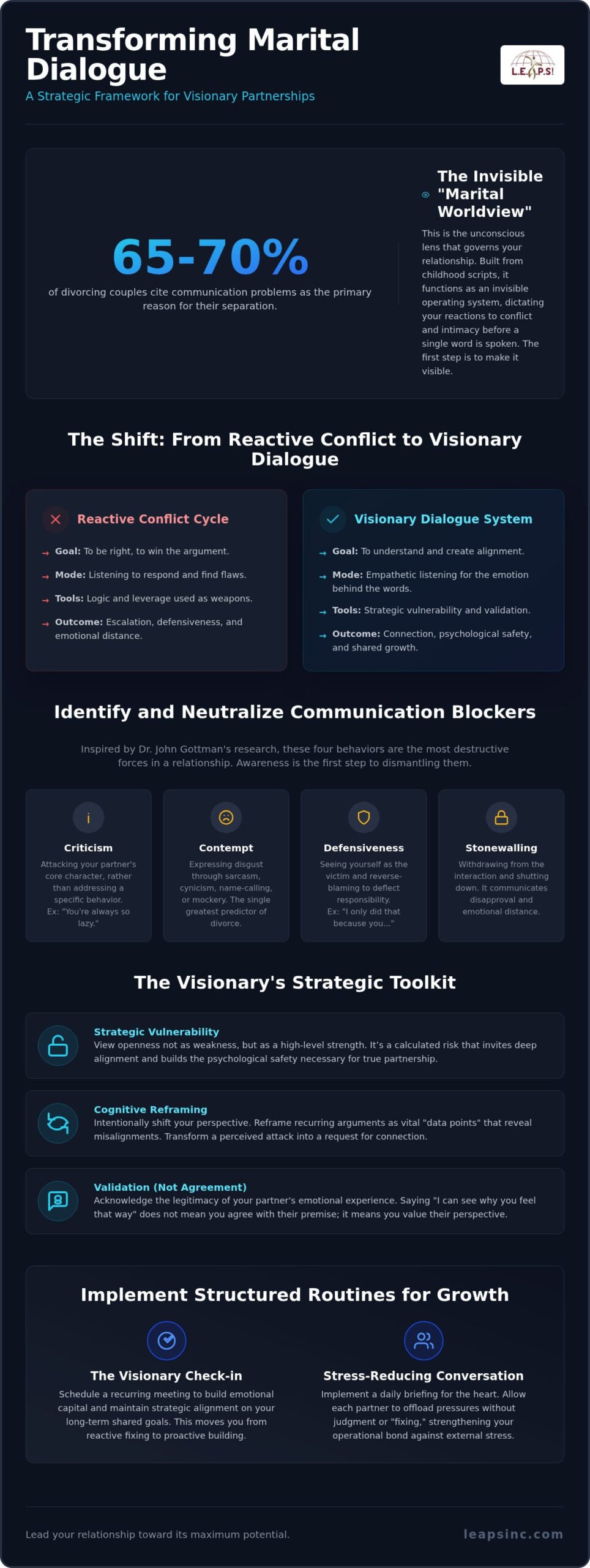
- Identify the invisible “marital worldview” and childhood scripts that govern your reactions, giving you the power to rewrite your relationship’s operating system.
- Discover how to improve communication in a marriage by transitioning from reactive listening to strategic, empathetic engagement that prioritizes understanding over being right.
- Reframe recurring arguments as vital “data points” that reveal where your partnership’s misaligned, using softened start-ups to prevent defensive escalations.
- Implement structured routines like the “Visionary Check-in” to build emotional capital and maintain strategic alignment on your long-term life goals.
- Understand how to utilize high-impact Therapy Intensives as a “strategic offsite” for your marriage when you’re seeking rapid transformation and deep-seated healing.
The Architecture of Connection: Understanding Your Marital Worldview
Effective partnership is rarely about the words spoken; it’s about the internal framework through which those words are filtered. We define your Marital Worldview as the complex psychological lens through which you and your partner interpret every gesture, silence, and statement. This lens isn’t accidental; it’s often built upon childhood scripts that function as an invisible operating system, dictating how you handle conflict and intimacy before a single word is uttered. To truly grasp defining your worldview is to recognize these personal biases that color your reality.
Many couples struggle with how to improve communication in a marriage because they focus on surface level tactics while ignoring this foundational architecture. Research indicates that 65-70% of divorcing couples cite communication problems as the primary reason for their separation. By integrating theories of interpersonal communication, we can see that relational control is often established through these subconscious patterns. You must adopt Strategic Vulnerability, viewing openness not as a liability or a sign of weakness, but as a high level strength that invites deep alignment and psychological safety.
Why ‘Good’ Communication Often Fails
There’s a striking paradox among high achievers: individuals who are masterful negotiators in the boardroom often find themselves paralyzed at the dinner table. Success in professional environments often relies on logic and leverage, yet these tools can become destructive in a marriage. Dr. John Gottman’s “Four Horsemen,” consisting of criticism, contempt, defensiveness, and stonewalling, act as strategic blockers that stall your shared destiny. Cognitive Reframing is the essential tool for marital success, allowing you to transform a perceived attack into a request for connection. It’s about seeing the obstacle as the path to a more resilient union.
The Visionary Lens: Marriage as a Purpose-Driven Entity
Transformation begins when you shift your focus from reactive problem solving to proactive vision building. Instead of asking how to fix a flaw, ask how to build a legacy. Participating in individual therapy is a critical step in this process; it prepares you to be a more conscious communicator by resolving internal conflicts that project onto your partner. Every interaction should be filtered through a single, powerful inquiry: “Does this conversation serve our shared future?” When you view your marriage as a purpose driven entity, communication becomes the primary vehicle for reaching your maximum potential together.
Strategic Listening: Moving Beyond ‘Active’ to ‘Empathetic’ Engagement
If the architecture of connection provides the blueprint, then listening is the operational execution of your partnership. In the high pressure world of executive leadership, we often listen to respond, seeking the most efficient solution to a presented problem. However, discovering how to improve communication in a marriage requires a shift toward empathetic listening, where the objective is understanding rather than immediate resolution. This is the difference between a transactional exchange and a visionary alignment that honors the internal depth of your spouse.
To lead your relationship effectively, you must embrace the concept of being the CEO of the Self. This framework demands that you take full emotional responsibility for your internal state before you engage in dialogue. When your partner shares a grievance, your primary strategic tool is validation. Validation doesn’t imply agreement with their specific perspective; instead, it acknowledges the legitimacy of their emotional experience. Implementing a daily “Stress-Reducing Conversation” acts as an executive briefing for the heart, allowing both partners to offload the day’s pressures without the fear of being judged or prematurely “fixed.”
The Art of Mirroring with Depth
Mirroring is frequently taught as a mechanical repetition of words, but a visionary mentor understands it requires true emotional reflection. You aren’t just a parrot; you’re a mirror reflecting the underlying sentiment of the speaker. Use a structured script to anchor this practice: “What I’m hearing you say is… and it makes sense because…” This demonstrates that you’ve truly processed their worldview. Much like Corporate Visioning, the principle of proper timing is critical. You wouldn’t pitch a merger in a hallway; don’t attempt high stakes emotional conversations when either partner is depleted or distracted.
Managing Reactivity in Real-Time
Communication often breaks down due to biological flooding, a state where the nervous system is too overwhelmed to process information rationally. This is a biological blocker to progress. When you detect this in yourself or your partner, utilize a Tactical Timeout. This isn’t an act of abandonment; it’s a strategic pause to allow for physiological cooling. Agree to revisit the topic in twenty minutes once regulation is restored. Emotional regulation is the prerequisite for strategic marital alignment. If you’re ready to master these high level dynamics, consider how a professional consultation can refine your relational strategy and restore intimacy.
Conflict as a Catalyst for Growth: Reframing Arguments
In a visionary partnership, conflict is not a sign of failure but a source of high-value data. It serves as a diagnostic tool, revealing exactly where the strategic alignment of the family unit has begun to drift. Statistics from 2026 indicate that 65-70% of divorcing couples cite communication problems as their primary reason for separation; therefore, reframing these moments is essential for long-term survival. Rather than viewing an argument as a threat, we must see it as an opportunity to recalibrate our shared destiny. To avoid a defensive “market crash,” leaders within a marriage utilize a softened start-up. This technique involves initiating a conversation with a neutral tone, focusing on a specific feeling and a positive need. It’s a fundamental shift in how to improve communication in a marriage, ensuring that the dialogue remains productive rather than destructive.
Strategic planning within a relationship requires distinguishing between solvable problems and perpetual issues. Research suggests that the majority of marital conflicts are perpetual, meaning they’re rooted in fundamental differences in personality or lifestyle. You don’t “fix” these issues; you manage them through ongoing dialogue and mutual respect. This approach is central to mastering family conflict resolution techniques that prioritize growth over short-term wins. By accepting that some friction is a permanent part of the landscape, you can focus your energy on transformation rather than endless, circular attempts at change.
The Principle of First Response
The course of any conflict is often determined not by the person who starts it, but by the person who responds. Adopting a “Generous Interpretation” is a high-level psychological skill where you assume your partner is an ally with a valid perspective, even in moments of tension. This maintains psychological safety and prevents the escalation into contempt. Pivot your language from accusatory “You” statements to vulnerable “I” statements. For instance, stating “I feel disconnected when we don’t spend time together” is far more strategic than saying “You always ignore me.” This subtle shift preserves the dignity of both partners while keeping the focus on the desired outcome of restored intimacy.
Repair Attempts: The Strategic Pivot
Resilient marriages are characterized by the frequency and success of “Repair Attempts.” These are the secret weapons of a visionary partnership, consisting of any statement or action, be it humor, a gentle touch, or a simple admission like “I’m sorry, I worded that poorly,” that de-escalates a tense situation. They are the strategic pivots that prevent a minor disagreement from becoming a relational crisis. While these maneuvers can be practiced at home, couples counseling offers a structured laboratory where you can refine these skills under professional mentorship. Learning to repair in real time ensures that your partnership remains a high-energy catalyst for personal and collective growth.
Practical Exercises for Enhancing Dialogue
To move from theoretical understanding to lived reality, you must implement structured routines that facilitate consistent growth. Understanding how to improve communication in a marriage is a skill refined through repetition and intentionality. These five steps function as a strategic toolkit for couples seeking to fortify their bond and secure their shared future.
- The Visionary Check-in: Dedicate 20 minutes each week to a formal alignment session. Discuss upcoming logistical challenges, emotional states, and progress toward your shared long-term goals.
- The Appreciation Audit: Build emotional capital by expressing three specific gratitudes to your partner daily. Focus on character traits and actions that often go unnoticed in the rush of daily life.
- The Worldview Inquiry: Once a week, ask one deep, open-ended question about your partner’s inner life. This practice prevents the “roommate syndrome” by maintaining a high level of curiosity about their evolving perspective.
- The Physical Connection Ritual: Utilize the principle of physical touch as a grounding technique. A six-second hug or holding hands during a difficult talk can lower cortisol levels and foster a sense of security.
- The Digital Sunset: Create a sanctuary for communication by removing all digital distractions after a specific hour. This ensures your most valuable attention is reserved for your partner rather than a screen.
The ‘Dream Within Conflict’ Exercise
Many recurring arguments are actually about unexpressed values or hidden dreams. To break the cycle, you must move from “Positions”—the specific thing you want—to “Interests”—the underlying reason why it matters to you. Uncovering the dream behind the conflict requires a safe space where both partners can disclose their deepest aspirations without fear of judgment. When you understand the “why” behind your partner’s stance, the “what” becomes much easier to negotiate through a visionary lens.
Rituals of Connection
Rituals are the recurring heartbeat of a healthy marriage, providing a predictable rhythm of intimacy and support. These can range from simple morning coffee briefings to elaborate annual “Vision Retreats” where you recalibrate your family’s direction. It is vital to find your core values to ensure these rituals align with your personal truth and collective mission. When your daily habits reflect your highest principles, your relationship becomes a powerful catalyst for individual and partnership transformation. If you’re ready to design a custom roadmap for your relationship, schedule a consultation to begin your strategic journey today.
When Strategy Requires a Specialist: The LEAPS Inc. Approach
While daily habits and structured exercises are vital for relational health, some dynamics require a more specialized intervention to break through long-standing barriers. At LEAPS Inc., we distinguish between “Maintenance”—the steady, incremental progress found in weekly sessions—and “Transformation”—the radical shifts achieved through a Therapy Intensive. While weekly therapy provides excellent ongoing support, an intensive functions as a strategic deep-dive for couples in crisis or those seeking rapid growth. Our methodology merges seasoned clinical expertise with a future-oriented, visionary framework that treats your relationship as a high-stakes partnership. Understanding how to improve communication in a marriage often requires this level of dedicated, professional focus to move from reactive conflict to purposeful alignment.
For many, a shared destiny is anchored in spiritual truth. Integrating faith into your relational strategy provides a unique perspective on how to improve communication in a marriage, as it anchors your dialogue in shared values and eternal purpose. We offer Christian marriage counseling for couples who seek a faith-integrated worldview. This ensures your growth is not only psychologically sound but also aligned with your core beliefs, providing a holistic foundation for lasting unity.
The Power of the Intensive Format
For high-achievers accustomed to executive “sprints,” the traditional marathon of weekly therapy can feel frustratingly slow. A Therapy Intensive compresses six months of work into 2-3 focused days. This format is designed to reduce the “noise” of daily life; the emails, the school runs, and the household management disappear to focus exclusively on the “signal” of the relationship. It’s the strategic offsite your marriage deserves. By removing distractions, you create the psychological space required for profound breakthroughs and the restoration of emotional intimacy.
Taking the Next LEAP
Choosing to seek professional intervention isn’t an admission of defeat; it’s a high-level leadership decision. It reflects a commitment to your maximum potential and the protection of your family’s destiny. The consultation process at LEAPS Inc. is designed to determine the precise level of support your partnership requires to thrive. Whether you need the steady guidance of weekly sessions or the high-energy catalyst of an intensive, the goal remains the same: a purposeful alignment of your shared future. Reclaim your marital power today and align your visionary destiny by scheduling your consultation.
Securing Your Shared Future
Mastering how to improve communication in a marriage is more than a set of conversational tactics; it’s a high level leadership commitment to your partnership’s shared destiny. By reframing conflict as essential data and shifting from reactive responses to empathetic engagement, you transform your household into a purpose driven entity. You’ve learned that connection requires a structured architecture, built through intentional rituals and the profound breakthroughs possible through specialized intervention.
At LEAPS Inc., led by Dr. John E. N. Daniel, we integrate clinical depth with executive coaching to facilitate rapid transformation. Our specialized Therapy Intensives serve as the ultimate strategic offsite for your relationship, providing the focused environment needed to resolve deep seated friction and restore emotional intimacy. Don’t settle for mere survival when peak relational health is within reach. It’s time to align your visionary future and reclaim your marital power. Schedule a Visionary Consultation with LEAPS Inc. today to begin the journey toward your maximum potential together.
Frequently Asked Questions
How can I improve communication if my spouse refuses to go to therapy?
You can initiate transformation by focusing on your own internal architecture first. Engaging in individual therapy at LEAPS Inc. allows you to resolve personal scripts and biases that often cloud marital dialogue. When you step into your role as the “CEO of the Self,” you change the relational dynamic through your own emotional regulation. This leadership decision often creates a ripple effect, inviting your partner into a more visionary way of connecting.
What are the most common barriers to effective communication in marriage?
Barriers often manifest as “The Four Horsemen”: criticism, contempt, defensiveness, and stonewalling. Beyond these psychological blockers, modern technology introduces significant friction. For instance, a Baylor University study found that 46% of people have been “phubbed” or phone snubbed by their partner. These distractions act as strategic blockers that prevent you from reaching your maximum potential as a unified couple, creating emotional distance that threatens your shared destiny.
Is it possible to fix a marriage when communication has completely broken down?
Restoration is possible when both partners are willing to engage in a structured, strategic reset. Complete breakdowns usually indicate that the “operating system” of the relationship is overwhelmed by unresolved data and childhood scripts. Utilizing a Therapy Intensive can act as a high energy catalyst for change. By removing the noise of daily life, you can focus on the signal of your connection and rebuild the architecture of your partnership from the ground up.
How do I bring up difficult topics without starting a fight?
Start with a “Softened Start-up” by focusing on a specific feeling and a positive need. This is a core strategy for how to improve communication in a marriage without triggering a defensive reaction. Instead of using accusatory “You” statements, pivot to “I” statements that express your internal depth. For example, say “I feel lonely when we don’t talk” rather than “You never listen.” This preserves psychological safety and maintains alignment on your shared goals.
What is the difference between active listening and empathetic listening?
Active listening focuses on the mechanics of repeating words to show you’ve heard them, but empathetic listening goes deeper into the partner’s worldview. It requires you to reflect the emotion behind the statement, acknowledging the legitimacy of their experience. This shift moves your dialogue from a transactional exchange to a visionary alignment. It honors the internal life of your spouse, which is essential for discovering how to improve communication in a marriage at a peak level.
How often should a couple have a ‘visionary check-in’?
We recommend conducting a 20 minute alignment session once a week. Think of this as an executive briefing for your partnership. During this time, discuss your logistical needs, emotional states, and progress toward long term life goals. Regular check-ins build emotional capital and ensure that you aren’t just reacting to immediate problems. This ritual serves as the recurring heartbeat of a healthy marriage, keeping you both synchronized on your shared purpose and destiny.
Can a therapy intensive really fix years of poor communication in one weekend?
A Therapy Intensive provides a powerful “sprint” that can achieve breakthroughs equivalent to six months of weekly sessions. Led by experts like Dr. John E. N. Daniel, these intensives remove daily distractions to focus entirely on deep clinical intervention. While years of habits require ongoing practice, an intensive provides the strategic pivot needed to break circular arguments and establish a new, visionary framework for your future. It’s a high level investment in your relationship’s potential.
What should I do if my partner uses ‘stonewalling’ during every argument?
Recognize that stonewalling is often a biological response to “flooding,” where the nervous system becomes too overwhelmed to process dialogue. When this happens, implement a “Tactical Timeout.” Agree to pause the conversation for at least 20 minutes to allow for physiological cooling. This isn’t an act of abandonment; it’s a strategic move to ensure that when you return to the table, you are both regulated and capable of purposeful, visionary communication.