

What if your most potent leadership tool isn’t a strategic framework, but the invisible resonance of your own nervous system? You’ve likely felt the suffocating pressure of a team member’s burnout or the sharp sting of isolation during a high-stakes conflict with a partner. It’s common to feel overwhelmed by the emotional turbulence of those around you, leaving you drained and searching for a way to stay grounded while others lose their footing.
To truly master these volatile moments, we must define co regulation not just as a clinical term, but as the fundamental biological architecture of human connection and visionary influence. This guide will empower you to move beyond reactive emotional fusion and toward a state of intentional synergy. We’ll explore the clinical mechanics of how our bodies influence one another and provide structured steps to stabilize the high-pressure environments you inhabit. By mastering this biological art, you’ll possess the tools to unlock your highest leadership potential and cultivate deep emotional resilience in every relationship that matters to your destiny.
Key Takeaways
- Understand the biological foundations of human connection by learning how to define co regulation as a reciprocal exchange of nervous system signals.
- Discover why the “Regulated Leader” is the ultimate catalyst for organizational innovation and how your physiological state dictates team performance.
- Reframe recurring communication breakdowns in your intimate life as physiological mismatches that can be healed through intentional somatic attunement.
- Master a strategic five-step framework to transition from reactive emotional overwhelm to proactive, grounded presence in high-stakes environments.
- Unlock your highest leadership potential by integrating clinical psychology with executive strategy to foster deep resilience across all areas of your life.
What is Co-Regulation? Defining the Physiological Partnership
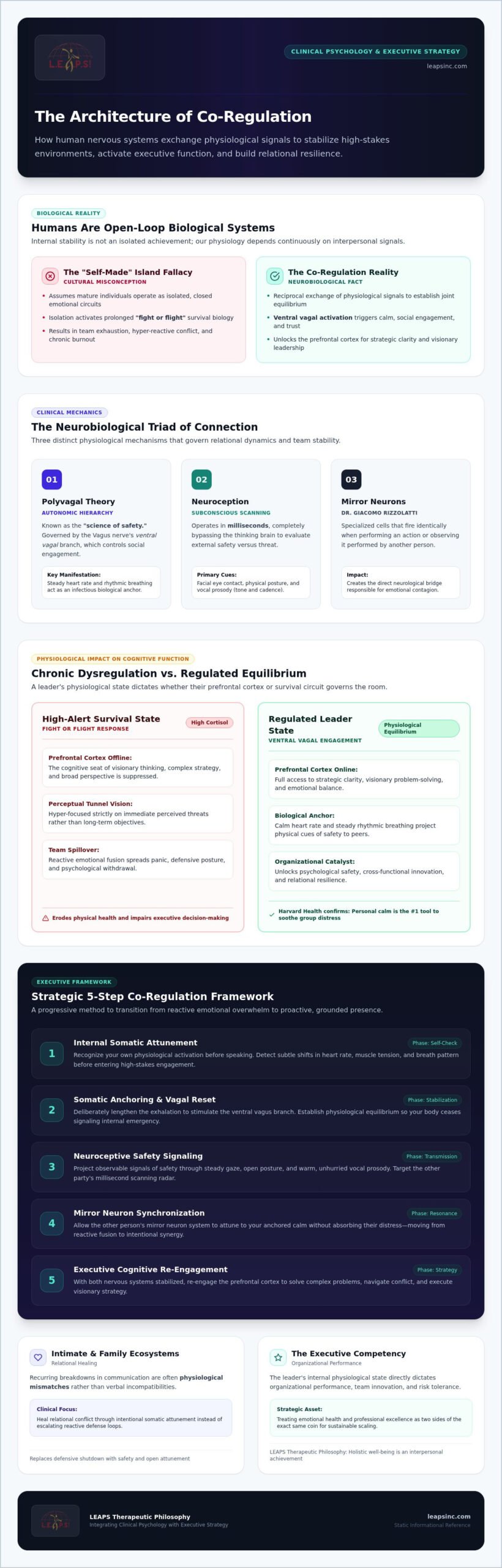
Humans are not closed circuits. We are biologically designed as open-loop systems, meaning our internal stability depends heavily on our interactions with others. To define co regulation accurately, we must view it as the reciprocal exchange of physiological signals that allow two nervous systems to reach a state of equilibrium. While self-regulation involves the internal tools we use to manage our own emotions, this psychological concept of co-regulation focuses on the interpersonal dance of safety. It’s the silent language of a steady gaze, a calm voice, or a grounded presence that tells another person’s brain it’s safe to relax.
This partnership is the prerequisite for high-level cognitive function. When your nervous system is stuck in a state of high alert, your prefrontal cortex, the seat of visionary thinking and strategic decision-making, effectively goes offline. You can’t lead others toward a grand destiny if your biology is screaming for survival. At LEAPS, we view co-regulation as a strategic asset for growth, treating emotional health and professional excellence as two sides of the same coin.
To better understand this concept, watch this helpful video:
The Biology of Shared Safety
The architecture of this connection is found in the Vagus nerve, specifically the “ventral vagal” branch. This system governs social engagement, allowing us to feel calm and connected rather than guarded or aggressive. When a leader or partner operates from this state, it becomes contagious. Their calm heart rate and rhythmic breathing act as a biological anchor for everyone in the room. Co-regulation is a biological imperative for human flourishing.
Beyond Self-Help: Why We Need Others to Regulate
Western culture often prizes the myth of the “self-made” emotional island, suggesting that mature adults should never need others to stay balanced. This is a neurobiological fallacy. In professional settings, isolation often triggers a “fight or flight” response, leading to burnout and fractured teams. True resilience isn’t found in isolation but in the strength of our relational bonds. This perspective is central to the LEAPS Therapeutic Philosophy, which emphasizes that holistic well-being is an integrated, interpersonal achievement. By mastering this shared regulation, you unlock the ability to stay grounded during high-stakes conflict and lead your organization toward its maximum potential.
The Science of Connection: Mirror Neurons and Polyvagal Theory
The science of human connection is anchored in Polyvagal Theory, often described as the “science of safety.” While we previously touched on the Vagus nerve, we must define co regulation through the lens of the autonomic hierarchy to understand its impact on leadership and intimacy. This biological framework explains why your body reacts to a partner’s tone before your conscious mind even registers the words. Through a process called neuroception, our nervous systems constantly scan the environment for cues of threat or safety in others’ posture, eye contact, and vocal prosody. This subconscious scanning happens in milliseconds, bypasses the thinking brain, and determines whether we lean in with curiosity or pull back in defense.
Mirror neurons, discovered by Dr. Giacomo Rizzolatti, provide the neurobiological machinery for this attunement. These specialized cells fire both when we perform an action and when we observe someone else doing it, effectively creating a bridge for emotional contagion. This is why Harvard Health on practicing co-regulation emphasizes that our own calm is the most effective tool for soothing another’s distress. Chronic dysregulation, however, impairs executive decision-making and erodes physical health by keeping the body trapped in a state of high-cortisol survival. When a leader is chronically dysregulated, they lose the ability to see the “big picture,” instead becoming hyper-focused on immediate perceived threats, which inevitably leads to reactive, short-sighted choices.
The Autonomic Hierarchy in Real Time
Our biology moves through three distinct states. First is Social Engagement, where we are calm, creative, and connected. Below that is Mobilization, the fight-or-flight response characterized by anxiety or anger. At the bottom lies Immobilization, a state of shutdown or “freeze.” A dysregulated leader can inadvertently trigger this freeze response in a team, stifling innovation and creating a culture of fear. Conversely, a regulated partner can pull a spouse out of an emotional spiral simply by offering a steady, grounded presence that signals the world is safe once again.
Mirroring Destiny: The Power of Intentional Presence
Visionary mentors use their own autonomic stability to catalyze growth in others. When we define co regulation as a leadership competency, we recognize that your presence is your most powerful strategic asset. By maintaining open eye contact and warm vocal prosody, you signal safety to those you lead, allowing them to access their highest potential. Mastering this requires deep internal work; many leaders utilize Individual Therapy to first stabilize their own nervous systems before attempting to lead others. If you’re ready to transform your relational impact, you can schedule an appointment to begin your own journey of somatic mastery.
Co-Regulation in Intimate Relationships and Family Ecosystems
Many couples enter therapy believing they have a “communication problem,” but the reality is often a physiological mismatch. When one partner’s nervous system enters a state of mobilization, the other’s system frequently mirrors that distress, creating a feedback loop of perceived threat. You can’t use sophisticated communication skills if your brain is convinced you’re in a survival situation. To truly transform these dynamics, we must define co regulation as the prerequisite for any meaningful dialogue. It’s the process of using your own grounded presence to signal safety to your partner, effectively down-regulating their stress response so that connection becomes possible again.
This dynamic is vividly illustrated by the “still face” experiment, which demonstrates the profound distress caused when a primary attachment figure becomes emotionally unresponsive. In adult intimacy, this manifests as stonewalling or emotional withdrawal, triggering a “dorsal vagal” shutdown in the other partner. According to Harvard Health’s overview of co-regulation, maintaining an empathetic and regulated presence is the most effective way to navigate these big emotions. Without this shared stability, families often fall into patterns of emotional contagion, where the anxiety of one member quickly becomes the burnout of the entire household.
Stabilizing the Marital Bond
Intimacy requires a “secure base” where both individuals feel safe enough to be vulnerable. You can de-escalate high-stakes conflicts by intentionally using somatic tools like synchronized breathing or gentle physical touch, which send immediate safety signals to the brain’s limbic system. The goal isn’t to avoid dysregulation entirely but to master the art of “repair” after a mismatch occurs. For those seeking to deepen this mastery, our resource on Modern Connection: The Visionary Guide to Couples Counseling provides a structured path toward relational synergy.
Building Resilient Family Dynamics
In a family system, the parent serves as the primary “external regulator” for the children. By maintaining a non-anxious presence during household chaos, you provide the biological scaffolding your children need to eventually develop their own self-regulation skills. This isn’t about being perfect; it’s about being the steady anchor in the storm. When family patterns become stuck in reactive loops, Family Therapy can provide the clinical framework necessary to restore ecosystem health. When we define co regulation as a family practice, we empower every member to contribute to a culture of resilience and mutual support.
The Executive Edge: Co-Regulation as a Leadership Competency
While many resources focus on developmental psychology, we must define co regulation as a critical executive competency. In the high-pressure environment of the C-suite, leadership is often reduced to IQ and strategic maneuvering, yet the most effective leaders are those who master their own biological resonance. A “Regulated Leader” acts as the emotional thermostat for the entire organization, setting a tone of grounded stability that allows others to perform at their peak. This isn’t just about soft skills; it’s about the physiological architecture of high performance. When a leader remains calm under pressure, they provide the biological scaffolding that enables their team to access complex problem-solving and creative risk-taking.
The ROI of this psychological safety is measurable and significant. Research from Gallup and Harvard Business School indicates that teams with high psychological safety see a 27% reduction in turnover and a 12% increase in productivity. By fostering an environment where nervous systems aren’t constantly in survival mode, you unlock latent innovation that fear-based cultures inadvertently stifle. Integrating co-regulation into Strategic Mentorship ensures that leaders don’t just manage tasks, but actively stabilize the human systems that drive the bottom line. This shared emotional load also prevents executive burnout, as the leader is no longer an isolated island attempting to carry the organization’s stress alone.
Emotional Contagion in the C-Suite
Anxiety is highly contagious, especially when it originates from the top. A CEO’s unresolved stress trickles down through the hierarchy, triggering “fight or flight” responses in middle management and eventually paralyzing the front line. During market volatility or corporate restructuring, your ability to stay grounded is your most valuable strategic asset. A leader’s primary job is to manage their own nervous system so they can stabilize their team’s. By consciously utilizing co-regulation, you prevent the panic that leads to reactive, short-sighted decision-making.
Visionary Culture and Organizational Health
Transforming a culture of fear into one of high-performance safety requires a deliberate shift in how we approach Corporate Visioning. Instead of focusing solely on metrics, visionary leaders prioritize the relational health of their teams. This creates an ecosystem where employees feel safe enough to voice divergent opinions, which is the bedrock of innovation. For those ready to master this level of influence, our guide on Executive Coaching for C-Suite: Unlocking Visionary Leadership offers a path to profound professional transformation. If you’re prepared to lead from a state of grounded power, schedule an appointment to begin your executive development journey.
How to Practice Co-Regulation: A Strategic 5-Step Framework
Practicing this biological art requires moving beyond abstract concepts to a structured, somatic discipline. To define co regulation in action is to describe a deliberate series of physiological interventions designed to shift a relational system from threat to safety. This framework provides the specific steps needed to stabilize those you lead or love.
- Step 1: Self-Awareness. You must identify your own autonomic state before attempting to influence another’s. If you’re in a sympathetic “fight” state, you’ll only amplify the tension.
- Step 2: Attunement. Observe the other person’s non-verbal cues without judgment. Look for the tightening of the jaw, the shallow breath, or the averted gaze.
- Step 3: Stabilization. Consciously deploy safety signals. Use a calm, melodic voice, a soft gaze, and an open, relaxed posture to invite their nervous system back to equilibrium.
- Step 4: Validation. Acknowledge the emotional reality of the moment. Naming the distress lowers the brain’s threat response and builds the bridge toward reconnection.
- Step 5: Integration. Once both nervous systems are regulated, move toward collaborative problem-solving. Visionary thinking only happens when the biology is at rest.
Practical Tools for High-Stakes Moments
In the heat of a boardroom conflict or a marital disagreement, simple somatic tools can prevent a total relational rupture. Use the Square Breathing technique, which involves inhaling, holding, exhaling, and holding for four seconds each, to synchronize your physiology with those around you. Vocal softening is another potent tool; lowering your volume and slowing your cadence signals that the situation is under control. If a partner or employee is too dysregulated for these cues to land, practice safe disengagement. Stepping away to self-regulate preserves the relationship and allows for a more productive repair later.
Deepening the Practice with Professional Support
Mastering these steps in isolation is difficult, especially when dealing with deep-seated trauma or chronic executive stress. Therapy Intensives are the most effective way to reset a dysregulated system, providing the deep intervention needed to break long-standing patterns of friction. This clinical work creates a powerful synergy with executive development, allowing you to lead with a grounded authority that others naturally follow. If you’re ready to master this synergy and fulfill your highest potential, schedule a consultation to begin your journey toward visionary synergy.
Mastering the Architecture of Human Connection
Your journey toward emotional synergy begins with the realization that your nervous system is your most influential leadership tool. We have explored how to define co regulation as a profound biological partnership that dictates the success of your most vital relationships. By moving through the strategic steps of self-awareness and attunement, you shift from reactive survival to intentional influence. This mastery allows you to stabilize turbulent environments and foster a culture of deep resilience in both your executive and intimate life.
At LEAPS Inc., led by Dr. John E. N. Daniel, we specialize in reaching your maximum human potential by integrating clinical therapy with executive coaching. Our multi-disciplinary approach ensures that your professional growth and emotional depth advance in unison. You possess the capacity to transform your legacy through the power of regulated presence. Elevate your emotional and professional synergy; schedule your LEAPS consultation today. Step into the future you were designed to lead with a grounded, visionary heart.
Frequently Asked Questions
What is the difference between co-regulation and enabling?
Co-regulation involves providing the biological scaffolding to help another person find their own equilibrium, whereas enabling involves removing the consequences of their behavior. When we define co regulation, we focus on physiological support that builds autonomy and resilience. Enabling often creates dependency and erodes the other person’s growth. True co-regulation empowers the individual to access their own self-regulation skills, while enabling keeps them stuck in a cycle of reactive dysfunction.
Can co-regulation happen in a remote or virtual work environment?
Co-regulation can absolutely occur in virtual environments, though it requires greater intentionality with non-verbal cues. Your vocal prosody, facial expressions, and focused presence on screen still send safety signals to a colleague’s nervous system. While you lack physical touch, the mirror neuron system still responds to the warmth in your voice and the calmness of your posture. Leaders who master virtual attunement can stabilize their teams even across significant geographical distances.
How long does it take to see the effects of co-regulation in a relationship?
You’ll often feel the physiological shifts of co-regulation within seconds or minutes of an attuned interaction. Heart rates begin to synchronize and cortisol levels drop almost immediately when safety is established. However, building lasting emotional resilience within a relationship or team requires consistent practice over several months. This repeated experience of shared safety rewires the nervous system for long-term stability, eventually making regulated states the default during high-stakes moments.
Is co-regulation possible if one person is unwilling to participate?
It’s possible to influence a situation even if the other person isn’t consciously participating in the process. Your own grounded, ventral vagal state acts as a powerful anchor that can invite the other person’s nervous system toward safety. While true bidirectional synergy requires mutual engagement, a leader or partner who maintains their own regulation can often de-escalate a conflict and prevent the other person from spiraling further into a state of threat.
What are the first signs of emotional dysregulation in a professional setting?
The first signs of dysregulation in a professional environment often include a sudden loss of perspective, defensive communication, or cognitive “fog.” You might notice a colleague becoming hyper-critical, withdrawing from collaboration, or displaying physical signs like shallow breathing and restless movement. These are biological indicators that the individual has moved from a state of social engagement into a survival mode, where their ability to access visionary thinking is severely compromised.
How does co-regulation impact physical health and stress levels?
Co-regulation has a profound impact on physical health by actively down-regulating the body’s stress response. Consistent attunement lowers blood pressure, stabilizes heart rate variability, and reduces the chronic inflammation associated with high cortisol levels. By fostering these safe connections, individuals experience improved sleep quality and a stronger immune system. This physiological foundation is essential for anyone seeking to reach their maximum potential in both their personal and professional lives.
Can a leader co-regulate an entire team at once?
A leader can influence an entire team by setting the “autonomic tone” of the room. Through the process of emotional contagion, your own calm and grounded presence spreads to those around you, effectively stabilizing the group’s collective nervous system. This is why executive presence is more than just charisma; it’s a biological signal of safety that allows a team to move from a culture of fear to one of high-performance innovation and shared success.
Why is co-regulation considered a ‘visionary’ leadership skill?
This skill is considered visionary because it recognizes that human potential is unlocked through relational safety rather than just IQ or strategy. Leaders who master this understand that their team’s biological state is the ultimate driver of innovation and long-term retention. By prioritizing the nervous system’s health, you build an organization that is resilient enough to navigate market volatility and corporate restructuring while maintaining a clear focus on its higher destiny.