

What if an employee assistance program could do more than respond when someone is struggling? The right employee assistance program services can support individual well-being while helping employers consider the workplace conditions that shape it. Programs vary, and counseling is only one part of the support an organization may need.
If you’re unsure what an EAP can cover, how work-life resources differ from counseling, or whether a program fits your team, start by identifying your employees’ needs, your organization’s priorities, and the support the program is designed to provide.
This guide explains the range and purpose of EAP services, offers a framework for assessing organizational fit, and considers how individual support can connect with workplace well-being. LEAPS Inc. provides Employee Assistance Program services and consultation, alongside business services that support organizational development. Use the guidance here to clarify what matters to your organization and identify a purposeful next step.
Key Takeaways
- Employee assistance program services can extend beyond counseling, but the scope depends on the employer’s arrangement and provider.
- Distinguish emotional support from practical work-life resources and referrals to understand which needs a program is designed to address.
- Assess organizational fit by identifying workforce needs, clarifying goals, mapping service categories, and setting review questions.
- Plan how employees will access the program and communicate its terms accurately, including its privacy practices.
- LEAPS Inc.’s EAP and consultation services can support conversations about employee well-being and organizational priorities.
What Are Employee Assistance Program Services, and What Are They For?
Employee assistance program services are employer-supported resources that help employees navigate personal or work-related concerns. They provide a defined way to seek support when a challenge affects daily life or work. The program’s scope depends on the employer’s arrangement and the services its provider delivers, so the label alone doesn’t explain what’s included.
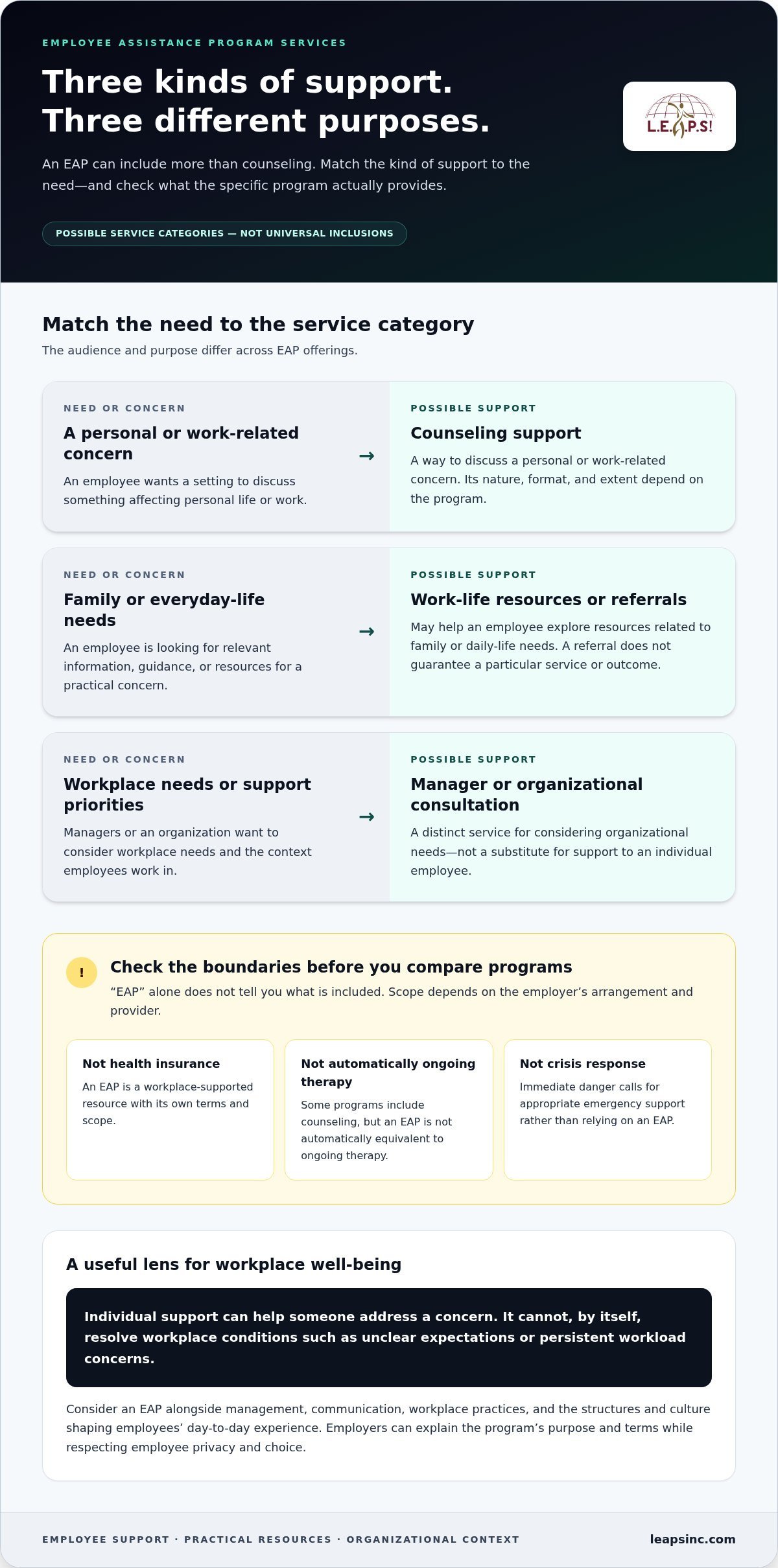
An EAP is distinct from health insurance, ongoing therapy, and crisis response. Health insurance is coverage for eligible care, while an EAP is a workplace-supported resource with its own terms and scope. Some programs include counseling, but an EAP isn’t automatically equivalent to ongoing therapy. It also shouldn’t be treated as an emergency or crisis response service. Someone facing immediate danger needs appropriate emergency support rather than relying on an EAP. For historical background and a broad overview of the category, see the Employee Assistance Program Wikipedia entry.
How can employee assistance support employees and employers?
For employees, an EAP can offer a way to address concerns such as relationship strain, stress, or a difficult change at work. The support available depends on the program. Its value is in providing a defined avenue to seek assistance, not in promising that every concern will be resolved or that a particular outcome will follow.
Employers establish and communicate the resource. They aren’t responsible for diagnosing employees or deciding what an individual is experiencing. A thoughtful approach makes support accessible while respecting employees’ privacy and choice about whether to use it. Employers can explain the program’s purpose and terms without intervening in an employee’s personal life.
Where does an EAP fit within workplace well-being?
An EAP is one part of workplace well-being, not a substitute for thoughtful management, clear communication, or sound workplace practices. A support resource can’t, by itself, resolve organizational conditions such as unclear expectations or persistent workload concerns. Consider the EAP alongside the structures and culture that shape employees’ day-to-day experience.
This wider perspective connects individual support with organizational priorities. Exploring corporate wellness solutions can help frame well-being as an organization-wide consideration rather than a standalone benefit. LEAPS Inc. provides EAP services and consultation for organizations. Learn more about LEAPS Inc.’s Employee Assistance Program and consider how employee support relates to your broader organizational priorities.
What Services Can an Employee Assistance Program Include?
The phrase employee assistance program services can describe a range of support, not a standard package that every employer receives. To compare programs meaningfully, separate support for individual employees from resources focused on practical concerns or organizational needs. The scope depends on the employer’s arrangement and provider.
The examples below illustrate possible categories, not universal inclusions. Consider the audience and purpose of each service to understand what it is designed to address and where its boundaries lie.
| Service category | Intended audience | Example purpose |
|---|---|---|
| Counseling support | Employees | Discuss a personal or work-related concern |
| Work-life resources or referrals | Employees | Explore resources related to family or daily-life needs |
| Manager or organizational consultation | Managers or organizations | Consider workplace needs or support priorities |
Counseling, referrals, and practical work-life resources
Counseling can give an employee a setting to discuss concerns affecting personal life or work. For example, an employee navigating family strain or a challenging workplace transition may want support thinking through the situation. The nature, format, and extent of counseling depend on the specific program.
Some arrangements also include referrals or practical work-life resources. A referral can connect someone with another resource, but it doesn’t guarantee that a particular service, solution, or outcome will follow. Family-related concerns, for example, may lead an employee to seek guidance or identify relevant resources. Distinguish these possibilities from counseling rather than assuming one category automatically includes the others.
Support for managers and organizational needs
Employee support and organizational consultation serve different purposes. Support for an individual can help them address a concern; consultation can help an organization or its managers consider workplace needs and the context in which employees work. Neither should be confused with diagnosing employees or disclosing details of private interactions.
LEAPS Inc. provides EAP services and consultation, alongside business services that support organizational development. Keep the focus on your organization’s goals and the type of support you need. Learn about LEAPS Inc.’s organizational EAP services as you consider which priorities matter to your workplace.
As you review service categories, identify the audience for each, the need it addresses, and the boundaries of the support. To discuss how employee support relates to your organization’s priorities, schedule a conversation with LEAPS Inc.
How to Assess Whether EAP Services Fit Your Organization
An EAP is more likely to feel relevant when its scope reflects workforce needs rather than assumptions about what employees need. A practical assessment helps leaders distinguish individual support priorities from organizational consultation goals, then compare those priorities with the program’s services, access process, and terms.
Start with employee and organizational needs
Build your understanding from appropriate, non-identifying input, such as recurring workplace themes, general feedback, and barriers employees say make it harder to seek support. Consider workforce context, communication barriers, and concerns people may hesitate to raise. Don’t use informal surveys or conversations to solicit personal health details. The goal is to identify broad needs, not investigate individuals.
Use this framework to connect those needs to a program:
- Identify workforce needs. Look for general patterns that may shape demand for support, such as work-life pressures, communication challenges, or difficulty understanding available resources. Consider whether different teams or work arrangements face distinct access barriers. Keep the discussion at a group level and avoid collecting identifiable personal health information.
- Clarify goals. Separate employee support priorities from organizational consultation goals. Employees may need a clear path to seek help with personal concerns, while leadership may want guidance in considering workplace well-being. Define what the program should make accessible, not a result it can guarantee.
- Map service categories. Compare each priority with the categories included in the proposed arrangement, such as counseling, practical resources, referrals, or organizational consultation. Note which categories address a stated need and where there may be a gap. This makes the comparison specific instead of labeling an EAP “generic” without examining its scope.
- Define review questions. Decide what leaders need to understand about access, communication, and general program use. Clarify which information should remain confidential and what, if anything, may be available in aggregate. Review questions should reflect the program’s design and applicable requirements.
Define goals and a useful review approach
Choose realistic objectives that describe the support employees can learn about or access, rather than promising lower stress, improved performance, or a particular level of use. Compare the program’s scope and access information with those objectives. Clear, accurate communication helps employees understand what the EAP is for and how to begin, without overstating what it provides.
Before choosing measures, determine what information leadership needs to assess the program and what must remain private. Available reporting and suitable review measures depend on the program’s design and applicable requirements. A careful assessment preserves the distinction between organizational learning and an individual employee’s experience. LEAPS Inc.’s Employee Assistance Program services can be part of this broader organizational conversation.
How to Plan Access, Confidentiality, and Program Communication
Even a thoughtfully selected EAP can be difficult to use if employees aren’t sure who it’s for, how to access it, or what support it includes. Access channels, eligibility, and service terms depend on the employer’s arrangement. Build communications from the actual program details, not assumptions based on another organization’s experience.
Before sharing an announcement, gather the current program information and turn it into a clear, consistent explanation. Employees should find the same accurate guidance whether they hear about the EAP from a manager, an onboarding resource, or an internal benefits page.
Communicate the program clearly to employees
Use plain language to explain who the program is for, what the employer has arranged, and where employees can find current access instructions and applicable terms. Don’t suggest that access is anonymous, unlimited, immediate, or available to particular family members unless those details are documented for the program. Clear boundaries build trust; overpromising can undermine it.
A useful communication plan should make these points easy to locate:
- Who is eligible under the employer’s arrangement
- Which access route employees should use and where to find it
- What kinds of support the program includes, as described in its terms
- Where employees can review current details or get help understanding access steps
Keep this information easy to revisit. If the program’s terms or access process change, update the places employees rely on instead of leaving outdated instructions in circulation.
Set responsible expectations for employers and managers
Managers can make employees aware of the program and direct them to its official information without asking why someone might use it or seeking personal counseling details. A manager’s role is to share the resource, not investigate an employee’s circumstances or act as a counselor. Consistent boundaries help preserve the distinction between workplace support and an individual’s private conversations.
Organizational review is a separate process. Leadership may consider program-level information when available and appropriate, but shouldn’t treat it as a window into individual employee interactions. Whether aggregate information can be shared, and what it may contain, depends on the program’s design and applicable requirements. Don’t promise employers access to reports or specific data unless those terms are established.
Before publishing statements about confidentiality or privacy, compare the wording with the actual program arrangement and applicable requirements. Explain what the employer has arranged, identify where the official terms are available, and avoid broad assurances that aren’t supported by those terms. Apply the same standard to managers’ conversations, internal FAQs, and onboarding materials.
Thoughtful communication turns access from an abstract benefit into a resource employees can understand and consider using. To discuss how an EAP can fit within your organization’s support approach, schedule a conversation with LEAPS Inc.
How LEAPS Inc. Connects EAP Services With Organizational Growth
Employee support and organizational development belong in the same strategic conversation, even though they address different needs. An EAP can offer employees a resource for navigating concerns, while leaders consider the workplace priorities, culture, and direction that shape the broader employee experience. Connecting these perspectives doesn’t mean promising that one service will produce a particular business result. It means considering well-being with care for both individuals and the organization.
Bring employee support into a wider organizational vision
LEAPS Inc. provides Employee Assistance Program services and consultation for organizations considering how to support employees. This work can be considered alongside organizational priorities, rather than as an isolated benefit. For example, leaders can reflect on how the organization’s stated values, communication, and approach to employee well-being align. The aim is thoughtful alignment, not assuming that an EAP alone can resolve workplace challenges or deliver a specific outcome.
Broader organizational services may also be relevant when they match a distinct goal. Business development, strategic marketing, brand development, and corporate visioning address different organizational considerations; they aren’t automatic parts of an EAP. Employers exploring a larger well-being strategy can use the discussion of corporate wellness solutions to consider how employee support fits within organization-wide health and purpose.
Start by naming the questions your organization is working through. Are you clarifying what employee support should mean in practice? Do you want to align a support resource with your organization’s direction? Or are you considering employee well-being as part of a wider organizational-development conversation? Defining the question keeps the EAP discussion grounded in your priorities, without assuming what the program includes or what results it will produce.
Take a clear next step with LEAPS Inc.
Bring your organization’s priorities and questions about EAP support into a conversation with LEAPS Inc. Outline the needs you’ve identified, the purpose you want the program to serve, and how employee well-being relates to your broader vision. LEAPS Inc.’s Employee Assistance Program and consultation services provide a basis for that discussion, with the scope and details shaped by the specific arrangement.
You don’t need to arrive with every decision made. A considered conversation can help you articulate what matters, separate employee support needs from organizational goals, and identify the questions that will guide your next steps. If you’re ready to explore that fit, Schedule an appointment with LEAPS Inc. to begin a purposeful discussion about employee support and organizational growth.
Shape a More Intentional Path Forward
The next step isn’t to adopt a program simply because it’s familiar. Decide what meaningful support should look like for your people and how that intention fits the organization you’re building. Let that vision guide the questions you ask, the priorities you set, and the way you approach employee assistance program services.
LEAPS Inc. brings an organizational perspective to this conversation, providing Employee Assistance Program services alongside business development, strategic marketing, brand development, and corporate visioning. These services address distinct goals while keeping employee well-being and organizational direction in thoughtful conversation.
Bring your questions, priorities, and hopes for the workplace you want to create. Schedule an appointment to discuss your organization’s goals and explore a purposeful next step with LEAPS Inc.
Frequently Asked Questions
What services are typically included in an employee assistance program?
An EAP may include counseling, referrals, or practical resources, but there isn’t one package that applies to every employer. An employee dealing with caregiving responsibilities, for example, may need a different kind of support than someone facing a work-related concern. Review the program’s written scope and compare it with the needs you want to address. The name “EAP” alone doesn’t tell you which services are available.
Are employee assistance program services confidential?
Privacy terms depend on the specific program and applicable requirements, so don’t assume every arrangement handles information in the same way. Before using an EAP, employees can review its written privacy information to understand how individual interactions are handled and whether program-level information may be shared with the employer. Employers should communicate only what those terms support, rather than offering broad assurances about anonymity or confidentiality.
Can family members use employee assistance program services?
Family eligibility depends on the employer’s arrangement and the program’s terms. An employee considering support for a spouse, partner, or dependent should review the official eligibility information rather than assume household members are included. Employers can help by ensuring that program materials explain who may access services and how eligible participants can find the relevant instructions.
How can an employer measure whether an EAP is useful?
Start by reviewing whether employees can find and understand the program, then compare available program-level information with the goals set for it. Depending on the arrangement, useful indicators might include awareness, access patterns, or non-identifying feedback about the process. These measures don’t establish an individual employee’s experience or prove a particular outcome. Use only information the program is designed to provide, and gather feedback without requesting personal counseling details.
Is an employee assistance program the same as health insurance?
No. An EAP is an employer-arranged support resource, while health insurance is coverage governed by its own plan terms. The two may relate to an employee’s broader support options, but one shouldn’t be assumed to replace or duplicate the other. An employee may need to review each program’s terms to understand whether a concern should be addressed through the EAP, their health plan, or another appropriate resource.
Do employees have to participate in an employee assistance program?
Participation expectations depend on the employer’s policies and the specific circumstances; there isn’t one assumption that fits every workplace. Employees can review written program information or workplace guidance to understand whether access is optional and what participation involves. Employers and managers should communicate expectations accurately and avoid treating a person’s use of a support resource as permission to seek details about their personal conversations.
How is an EAP different from a workplace wellness program?
An EAP generally refers to a defined support resource employees may access under an employer’s arrangement. A workplace wellness program can describe a broader set of organizational efforts focused on well-being, such as examining workplace practices, communication, or shared priorities. The two may complement one another, but they aren’t interchangeable by definition. Employers can decide how each fits their goals and explain clearly what employees can expect from each resource.