

What if you don’t need to feel completely certain before taking a thoughtful step toward a new career? Coping with career change anxiety can be difficult when financial security, professional identity, and an unclear future all seem tied to one decision. Feeling unsettled doesn’t mean you’re making the wrong choice, and dissatisfaction alone doesn’t mean it’s time to leave.
It makes sense to want solid answers before risking what you’ve built. But anxiety can turn practical questions into predictions of failure, making every option feel overwhelming. You can take your concerns seriously without treating them as a diagnosis or letting fear make the decision for you.
This guide explores why career transitions can stir up anxiety and how to separate concrete risks from worst-case assumptions. You’ll find manageable ways to clarify what matters, gather information, and test possible directions without forcing an immediate leap. We’ll also consider when individual therapy may help you explore emotional patterns and how professional coaching can support goals related to leadership and business. Seeking support isn’t a sign that you can’t decide; it can be an intentional way to move forward with greater clarity.
Key Takeaways
- Hope, grief, fear, and excitement can coexist during a career transition. Feeling unsettled doesn’t automatically mean you’re making the wrong choice.
- When coping with career change anxiety, separate evidence-based concerns from absolute predictions, then identify what you still need to learn.
- Use a paced approach: steady yourself, clarify your concerns, gather information, and test possible directions through manageable experiments.
- When worry persists or stalls decisions, individual therapy can help you explore emotional well-being. Professional coaching can support leadership and business goals.
- Seeking support can be an intentional part of making a career decision, not proof that you can’t decide independently.
Coping with career change anxiety starts with understanding what feels uncertain
A career transition can bring hope and curiosity alongside grief, fear, or excitement. You might feel energized by the possibility of work that better fits your values, yet miss familiar routines, trusted colleagues, or a role that helped you understand who you are. These feelings can coexist. They don’t prove that changing careers is either the right decision or a mistake.
Career-change anxiety is worry or unease linked to uncertainty about work and the transition ahead. It may arise while you’re considering a change, preparing for one, or adjusting to a new direction. Coping with career change anxiety doesn’t require eliminating every doubt before you act. It means understanding what your unease may be signaling and how much it is affecting your life.
For another perspective on how unexpected work events can affect a person’s career path, see this overview of career shock.
To explore practical ways to respond to work-related anxiety, watch this video from BBC:
Why a career transition can unsettle identity and security
Work often provides more than income. It can shape daily rhythms, relationships, social standing, and your sense of how you contribute. Leaving a familiar role may raise questions: Will your skills transfer? Will you feel competent while learning? Will you belong in a different professional environment? These are possibilities to consider, not experiences everyone has.
Security can feel uncertain, too. You may be weighing changes in income, responsibilities, or status while wondering what you’ll miss about the work you know. Grief for a familiar chapter doesn’t cancel curiosity about what could come next. Naming both can help you see the transition more clearly.
How to recognize anxiety without diagnosing yourself
Notice what happens in ordinary moments. You might replay the same decision late at night, postpone a small research task, feel tense when someone asks about your plans, or repeatedly picture the most difficult outcome. These reactions can occur during periods of change; by themselves, they don’t establish a mental health diagnosis.
Temporary discomfort may rise around a decision and ease as you rest, talk it through, or learn more. Pay closer attention if worry feels persistent, intense, or difficult to manage, or begins interfering with sleep, work, or relationships. Uncertainty is common; distress that repeatedly disrupts daily life deserves attention. An assessment with a mental health professional can help you understand what’s happening. Individual therapy can offer space to explore emotional patterns and concerns affecting a career decision, even if you haven’t reached a conclusion.
What fuels career-change anxiety, and how uncertainty affects decisions
A transition can feel difficult not because you lack courage, but because several unknowns arrive at once. You may be weighing what you could gain against what you might lose while feeling pressure to make a choice you’ll never regret. Caution has a purpose: it can direct attention to real risks. The challenge is separating a question that needs investigation from a frightening prediction that hasn’t been tested.
Uncertainty invites the mind to fill in missing details. If you don’t know whether your skills will transfer, for example, you might imagine that no employer will value your experience. Rehearsing that possibility can make it feel increasingly certain, even though it remains a forecast. Coping with career change anxiety includes noticing whether repeated thinking is generating new evidence or simply repeating the same fear.
Fear of failure, regret, and losing professional identity
Career decisions can seem irreversible, especially when you believe one choice will determine your entire future. That pressure can make researching options feel safer than taking any next step. Seeing peers advance, change fields, or appear confident may sharpen self-doubt, but their timelines and circumstances don’t determine what’s right for you. A transition may involve trade-offs, such as a learning curve or changed responsibilities, while also creating possibilities for growth.
Try replacing “I have to get this exactly right” with a more workable question: “What can I learn before I commit further?” This shifts your attention from predicting your whole future to identifying information you can gather now. It doesn’t dismiss the stakes; it makes them easier to examine.
When practical pressures amplify emotional uncertainty
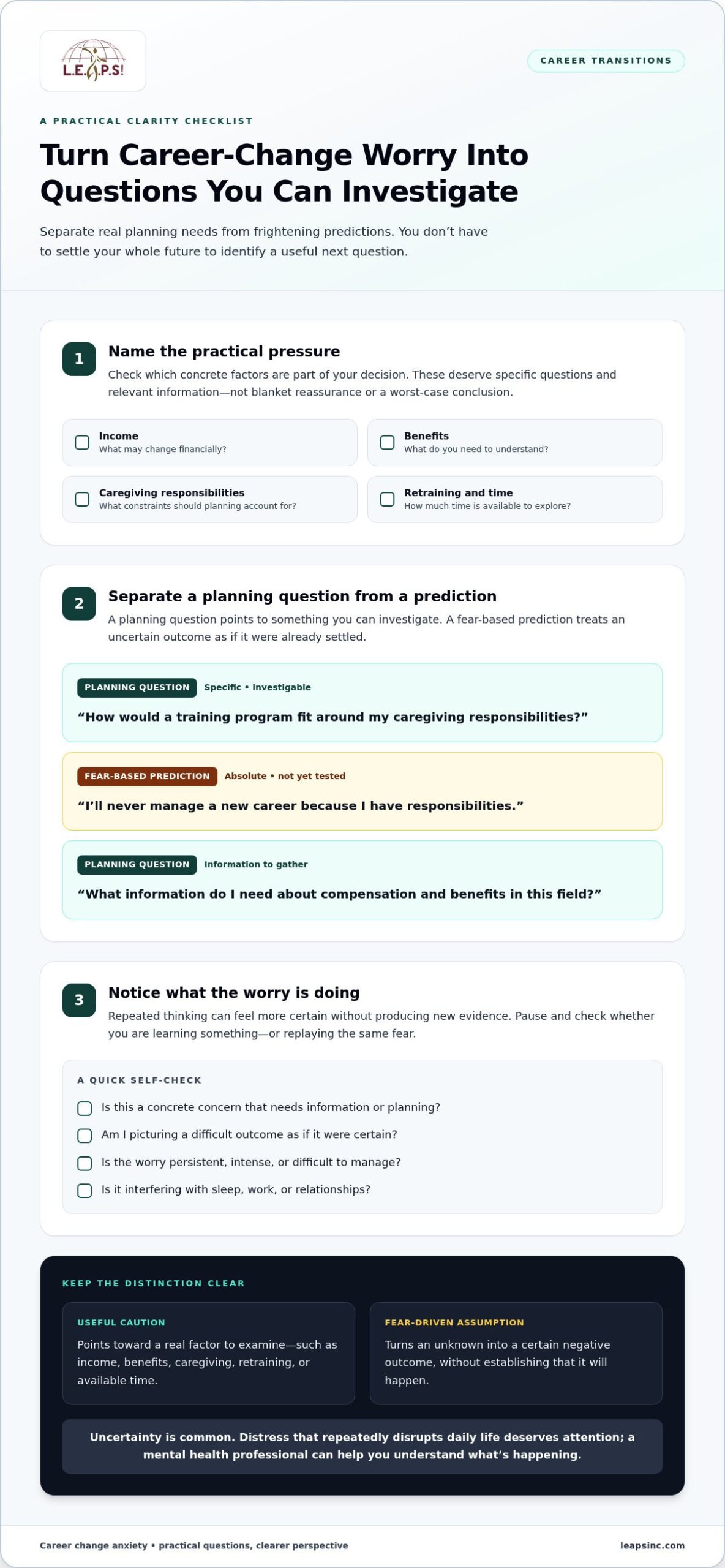
Some concerns call for concrete planning. Depending on your situation, you may need to consider income, benefits, caregiving responsibilities, retraining, or the time available to explore a new direction. These aren’t signs that you’re overthinking. They’re real factors that deserve specific questions and relevant information, not blanket reassurance or a worst-case conclusion.
- Planning question: “How would a training program fit around my caregiving responsibilities?”
- Fear-based prediction: “I’ll never manage a new career because I have responsibilities.”
- Planning question: “What information do I need about compensation and benefits in this field?”
- Fear-based prediction: “Changing fields will inevitably leave me worse off.”
To investigate, identify the unknown and find a source that can help answer it: a program’s published requirements, a conversation with someone in the field, or a careful review of your current commitments. You don’t need to solve every issue at once or follow a financial rule that may not fit your life. Start with the question that most affects your decision.
If worry makes it hard to separate emotional patterns from practical choices, individual therapy can provide space to explore what is weighing on you. You can schedule an appointment as an intentional step toward understanding your concerns, not as a substitute for your own judgment.
Career change anxiety: distinguish a useful warning from a fear-driven assumption
Anxiety can draw attention to something that deserves care, such as income security or a need to feel competent. But it can’t predict with certainty what a future role will bring. A feeling deserves attention, but it doesn’t establish a future outcome. Treat it as a signal to examine, not a verdict on whether you should stay or go.
Make that examination more concrete by setting out a concern alongside the evidence, unanswered questions, and one small way to learn more. For example:
- Concern: “I might not be qualified for this field.” Evidence: I meet some role requirements but haven’t used one key tool. Unknowns: How essential is that tool, and can I build the skill? Small way to learn: Review several job descriptions and try a relevant introductory exercise.
- Concern: “I’ll lose stability if I change.” Evidence: The new path may involve a different income structure. Unknowns: What do comparable roles offer, and what transition options exist? Small way to learn: Research compensation and speak with someone familiar with the work.
This format separates a specific concern from an absolute prediction such as “I will never succeed.” The concern points to a question you can investigate; the prediction treats an uncertain future as settled fact. If you find a genuine obstacle, you can plan around it. If the evidence is incomplete, seek information instead of letting fear fill in every blank.
Questions that turn vague worry into a clearer decision
Pause and ask: What feels most at risk: stability, identity, competence, relationships, or another priority? What do I know firsthand, what am I assuming, and what remains unanswered? Consider both directions: what might changing cost, and what might staying cost in energy, growth, or alignment with what matters? These questions don’t force a choice. They reveal what the decision needs to account for.
Avoiding all-or-nothing thinking about the next role
A career decision doesn’t have to be permanent or perfectly certain to be thoughtful. Exploring a field can mean gathering information, not resigning tomorrow. You might learn about its daily work, practice a relevant skill, or compare roles before deciding whether to take another step. Naming your decision criteria can also help. For example, identifying your core values may clarify what you want your next move to support.
When coping with career change anxiety, aim for a decision process that respects both evidence and emotion. A useful warning becomes more actionable when you can state what it concerns and what could help you assess it. A fear-driven assumption often speaks in absolutes without accounting for new information or alternative paths. You don’t need to silence the anxious thought. Listen, test what it claims, and choose a next step that fits what you learn.
How to cope with career change anxiety: a paced, practical plan
You don’t have to resolve every career question before taking a useful step. A flexible process can help you settle enough to think, clarify what you need to know, gather information, test an option, and review what you learn. Adjust the pace to your circumstances. The aim isn’t to force a decision by a deadline, but to create movement without treating each step as an irreversible commitment.
- Steady yourself. Before researching or deciding, take a brief pause. Place both feet on the floor, notice the support beneath you, and slowly name what you can see and hear. Then write down the concern on your mind and one thing you know for certain. This grounding and journaling exercise may help you organize the moment; it isn’t treatment or a substitute for professional support.
- Name the concern. Turn “I don’t know what to do” into one focused question, such as “Would this role use my existing communication skills?”
- Gather facts. Identify what information could help answer that question, then choose a relevant source instead of searching without a clear purpose.
- Test an option. Try a manageable experiment, such as an informational conversation, a short skills-practice task, or a closer look at the role’s daily responsibilities.
- Review what you learned. Record what the experiment clarified, what surprised you, and what remains uncertain. Use that learning to choose a next step, or decide that pausing is appropriate.
Create a small-step exploration plan
Keep the experiment proportionate to the question. If you’re unsure whether a field suits your strengths, speak with someone who does that work or try a relevant task before making a major commitment. Choose a review point that fits the experiment rather than imposing a universal timeline. A few written observations can help you distinguish new information from anxiety that has simply returned.
Build emotional support while you make practical plans
Identify one or two trusted people who can listen without taking over the decision. You might ask them to help you think through options rather than tell you what to choose. Protect routines that support steadiness, including time for rest, meals, movement, and relationships. A career transition draws on attention and energy; taking care of those foundations is part of the plan, not a distraction from it.
Professional support can be another intentional resource. Individual therapy can provide space to explore emotional well-being and patterns affecting a career decision. If your priority is professional development, LEAPS Inc. offers business and executive coaching focused on leadership and organizational development. These forms of support have different emphases, and choosing either doesn’t mean you’re unable to decide independently.
For support as you clarify your concerns and next steps, you can schedule an appointment. Coping with career change anxiety is often less about achieving certainty all at once and more about building enough steadiness to learn, reflect, and move forward deliberately.
When support can help you move through career change anxiety
You don’t have to wait until you feel overwhelmed to seek support. It may be useful if worry keeps returning, you feel unable to make or act on decisions, or distress begins affecting sleep, work, relationships, or daily routines. Support can create room to understand what’s happening and consider your options. It doesn’t mean you’re incapable of making a career decision, and it can’t guarantee a particular professional outcome.
As you cope with career change anxiety, consider what kind of help would serve you best. Is the main challenge emotional strain and uncertainty, or are you seeking structure for professional development and action? Your needs may overlap. For individuals navigating deeper anxiety, stress, or fear surrounding change, specialized approaches such as hypnotherapy—highlighted at lilianechibly.com.br—can offer focused relief. You remain the decision-maker; a supportive professional can help you examine your priorities without choosing your future for you.
How therapy and career coaching can serve different needs
Therapy focuses on emotional well-being. It can offer space to explore stress, emotional patterns, and personal concerns that influence how you experience a career decision. Coaching is oriented toward professional development, such as leadership, business goals, and organizing action. LEAPS offers business and executive coaching for entrepreneurs and corporate leaders. The distinction is the focus of the work, not a judgment about which kind of support is more valuable.
For instance, you might want to understand why uncertainty brings up intense self-doubt, or you might need help clarifying business or leadership goals and planning how to pursue them. Those are different starting points, and either can be discussed openly. Support can be collaborative: you bring your experiences, questions, and priorities, then decide which insights and actions feel right for you.
Recognize when anxiety deserves more support
Pay attention if distress persists, feels difficult to manage, or significantly disrupts daily functioning. You don’t need to wait for a crisis or have a polished explanation before raising a concern. In an initial conversation, describe what has been weighing on you, how it affects your everyday life, and what you hope to understand or work toward. Naming what you need can help clarify whether the focus should be emotional well-being, professional development, or both.
It can also help to say what you don’t want: perhaps you’re not ready to make a major move, or you want space to consider options without being pushed toward one. That openness supports a more purposeful conversation. Therapy and coaching don’t replace your judgment; they can offer perspective, structure, and space to reflect as you exercise it.
If you’d like to explore what support could look like for your circumstances, you can schedule an appointment. Taking that step doesn’t commit you to a particular career path. It can simply begin a conversation that helps you clarify your concerns, identify what matters, and consider an appropriate next step.
Take your next step with intention
You don’t need to map your entire professional future before beginning. A useful starting point may be a question you’re ready to explore, a conversation you’ve been postponing, or a clearer sense of what you want work to make possible in your life. Let your next step be proportionate to what you know now, and allow new information to shape what follows.
Coping with career change anxiety isn’t about waiting until every doubt disappears. It’s about making room for uncertainty while staying connected to your values, well-being, and capacity to choose. If you’d like a thoughtful space to explore emotional concerns through individual therapy, schedule an appointment to discuss your next steps.
Your future doesn’t have to be decided all at once. You can move toward it with curiosity, care, and one considered step at a time.
Frequently Asked Questions
Is it normal to feel anxious about changing careers?
Yes, feeling anxious about a career change is a common response to uncertainty and meaningful change. Coping with career change anxiety can involve making room for mixed reactions without treating them as proof that you should stay or leave. For example, you might look forward to more purposeful work while worrying about being new at something. Notice what the anxiety relates to, then consider whether it calls for information, reflection, or support.
How do I know if career change anxiety is stopping me from moving forward?
Anxiety may be getting in your way if it repeatedly prevents you from taking even a low-stakes action that matters to you. Notice whether you avoid updating a résumé, asking someone about their role, or applying for an exploratory opportunity despite wanting to do so. After taking one small step, ask whether it gave you useful insight or whether worry simply moved the finish line. Persistent distress or disruption to daily life may warrant professional guidance.
Can therapy help with career change anxiety?
Therapy can provide space to examine emotional well-being and how stress, self-doubt, or past experiences may shape a career decision. At LEAPS, individual therapy focuses on emotional well-being and personal growth. Therapy doesn’t decide whether you should change careers or guarantee a particular result. For professional development focused on leadership and business goals, LEAPS also offers business and executive coaching.
What can I do when I feel overwhelmed by a career decision?
Reduce the decision to one immediate question, then give yourself permission not to answer everything today. Write down the options you’re considering and identify the information needed to compare them, such as role responsibilities or required qualifications. If your thoughts feel tangled, take a short break from research and return when you can focus. You could also ask someone you trust to listen while you explain the dilemma, without asking them to choose for you.
How can I tell the difference between intuition and fear?
There isn’t a perfect test, but you can look at how each response behaves. Fear often presents urgent, sweeping conclusions, while a considered concern may point to a specific issue you can examine. Neither tone proves a decision is right. Write down the thought, the evidence behind it, and what would change your view. Revisit your notes when you’re calmer, and see whether the concern becomes clearer or remains a prediction without supporting information.
Should I quit my job if it is causing career anxiety?
Not necessarily. Anxiety about work deserves attention, but quitting is a consequential decision that may depend on your health, finances, responsibilities, and available alternatives. Before acting, consider whether there are changes you could explore in your current role, such as adjusting duties or discussing a concern with a trusted manager. If the work is seriously affecting your well-being, seek appropriate professional guidance and make a plan that reflects your circumstances rather than reacting under pressure.
How long does it take to feel confident about a career change?
There’s no universal timeline for confidence, and it may not arrive as a single moment of certainty. It can build gradually as you learn about a role, practice relevant skills, and see how your priorities fit the day-to-day work. You might still feel some nerves after making a thoughtful choice. Instead of setting a deadline for confidence, look for signs of growing clarity, such as being able to explain why you’re exploring the change and what you want to learn next.