

What if your organization’s greatest competitive advantage wasn’t found in your proprietary technology or market share, but within the psychological resilience of your executive suite? You’ve likely realized that traditional, “check-the-box” EAPs are failing to move the needle for your top-tier talent. When high burnout rates collide with low engagement, it’s clear that standard corporate mental health programs must evolve to meet the demands of a high-stakes business environment. You aren’t just looking for a safety net; you’re seeking a strategic engine that fuels transformation.
In this visionary guide, you’ll discover how to transform mental health from a passive benefit into a powerful catalyst for organizational growth and leadership excellence. We’ll bridge the gap between clinical authority and executive strategy to help you build a culture that attracts elite talent. By exploring the shift toward integrated corporate visioning and proactive coaching, we’ll outline a roadmap for 2026 that aligns internal well-being with your highest business objectives. It’s time to move beyond survival and unlock the latent potential of your most valuable human assets.
Key Takeaways
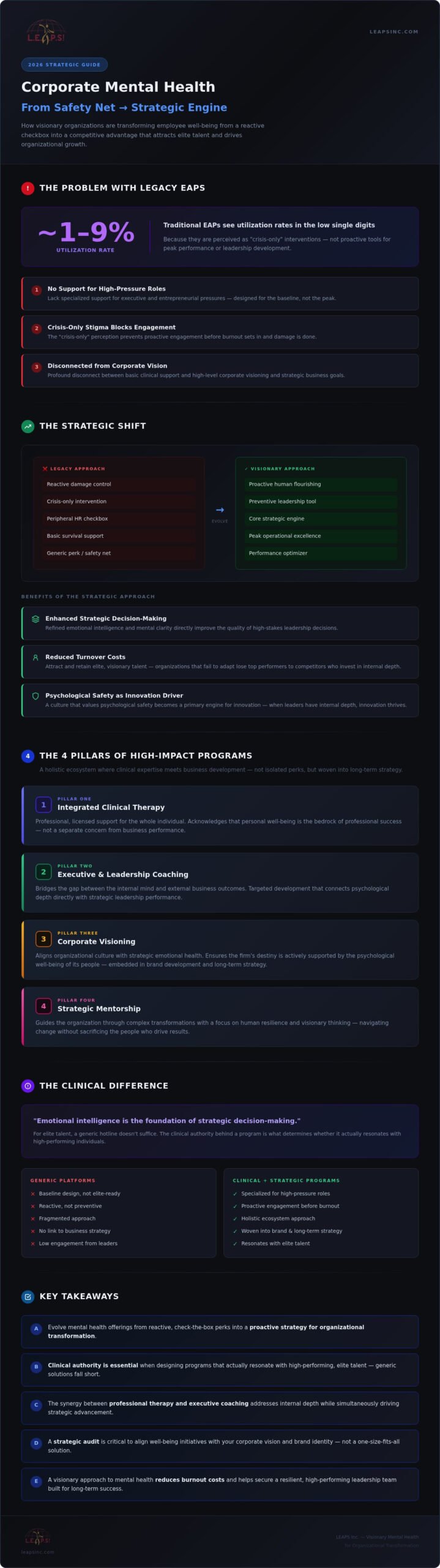
- Learn how to evolve your mental health offerings from reactive, “check-the-box” perks into a proactive strategy for organizational transformation.
- Discover why clinical authority is essential when designing corporate mental health programs that actually resonate with high-performing, elite talent.
- Explore the synergy between professional therapy and executive coaching to address the internal depth of your team while driving strategic advancement.
- Identify the critical steps for conducting a strategic audit to align your well-being initiatives with your corporate vision and brand identity.
- Understand how a visionary approach to mental health reduces burnout costs and helps you secure a resilient, high-performing leadership team.
Beyond the EAP: The Strategic Evolution of Corporate Mental Health
The era of treating mental health as a peripheral HR checkbox has ended. By 2026, the most successful organizations have realized that corporate mental health programs are no longer just safety nets for crisis management; they’re strategic engines for organizational transformation. This evolution represents a fundamental shift from offering “perks” to optimizing “performance.” Forward-thinking leaders recognize that the emotional health of their workforce is the primary driver of their competitive edge. It’s a movement away from reactive damage control toward a proactive philosophy of human flourishing. It requires a sophisticated blend of clinical authority and aspirational energy to move talent from a state of mere survival to peak operational excellence. Organizations that fail to adapt will find themselves losing elite talent to visionaries who prioritize internal depth as much as external growth. By integrating clinical depth with executive strategy, you create a culture that doesn’t just survive pressure but uses it as a catalyst for professional destiny.
The Limitations of Legacy Employee Assistance Programs
Traditional Employee Assistance Programs (EAPs) often suffer from a fatal flaw: they’re designed for the baseline, not the peak. Most organizations see utilization rates in the low single digits because these services are perceived as “crisis-only” interventions. For the elite visionary, a generic hotline doesn’t suffice. Standard employee assistance programs fail because:
- They lack specialized support for high-pressure executive and entrepreneurial roles.
- The stigma of “crisis-only” utility prevents proactive engagement before burnout occurs.
- There’s a profound disconnect between basic clinical support and high-level corporate visioning.
Mental Health as a Catalyst for Visionary Leadership
True resilience isn’t just about bouncing back; it’s about moving forward with clarity. Emotional intelligence is the foundation of strategic decision-making. When leaders possess high levels of internal depth, innovation thrives because they’ve reclaimed their personal power within the corporate structure. This integrated approach to corporate mental health programs delivers:
- Enhanced strategic decision-making through refined emotional intelligence and clarity.
- Reduced turnover costs by attracting and retaining elite, visionary talent.
- A corporate culture that values psychological safety as a primary innovation driver.
Essential Pillars of High-Impact Mental Health Programs
High-impact corporate mental health programs are built on four foundational pillars that transcend basic wellness. These pillars don’t just mitigate risk; they actively cultivate the psychological capital required for elite performance. By integrating individual therapy with executive coaching, organizations can address the internal depth of their leaders while driving strategic growth. This isn’t a fragmented approach. It’s a holistic ecosystem where clinical expertise meets business development. A structured framework ensures that mental health initiatives aren’t isolated perks but are instead woven into the fabric of your brand development and long-term strategy.
The four pillars include:
- Integrated Clinical Therapy: Providing professional, licensed support for the whole individual, acknowledging that personal well-being is the bedrock of professional success.
- Executive and Leadership Coaching: Bridging the gap between the internal mind and external business outcomes through targeted development.
- Corporate Visioning: Aligning organizational culture with strategic emotional health to ensure the firm’s destiny is supported by its people.
- Strategic Mentorship: Guiding the organization through complex transformations with a focus on human resilience and visionary thinking.
As leaders face increasing pressure, understanding the nuances of workplace stress and mental health becomes a non-negotiable skill set for those steering modern enterprises.
The Synergy of Therapy and Coaching
Many high-achievers struggle because they try to solve psychological blocks with business logic. Therapy focuses on healing and resolving internal barriers, while coaching targets professional milestones and skill acquisition. A truly visionary framework integrates both, allowing a leader to heal the past while building the future. For a deeper dive into how these disciplines overlap and differ, explore our Therapy vs. Coaching: A Visionary Guide. This dual approach ensures that growth is sustainable and deeply rooted in a leader’s core identity.
Crisis Intervention vs. Continuous Growth
Designing effective corporate mental health programs requires moving beyond the 3-session EAP model. The legacy approach is a band-aid for a systemic wound. Visionary firms are moving toward continuous growth models that value proactive intervention. Therapy intensives offer rapid leadership breakthroughs that traditional weekly sessions might take months to achieve. This shift transforms the workplace from a site of stress into a laboratory for fulfilling one’s life purpose. When you align your corporate visioning with these clinical resources, you create a culture of destiny. If you’re ready to elevate your leadership team’s resilience, you can speak with a clinical expert to begin your transformation.
The Clinical Difference: Why Generic Platforms Fall Short
The rise of digital wellness apps has created a trend that many industry experts call “mental health lite.” While these tools offer surface-level awareness, they often lack the clinical depth required to address the complex psychological needs of high-performing leaders. Effective corporate mental health programs must be anchored in clinical authority rather than just user-friendly interfaces. When an executive faces a crisis or a profound block in their leadership, they don’t need a meditation app; they need a seasoned professional who understands the intersection of clinical psychology and business strategy. This clinical difference is what separates a standard benefit from a truly visionary resource. It’s about moving beyond awareness and into the territory of deep, structural transformation.
Generic platforms often rely on unqualified “wellness coaches” who lack the training to handle deep-seated trauma, severe anxiety, or the intricate dynamics of family therapy within a business context. High-level leadership requires a secure, confidential environment where the internal life of the leader is treated with the same rigor as a strategic audit. Scientific research into mental health support and clinical care emphasizes that evidence-based interventions are essential for long-term recovery and resilience. Without this foundation, mental health initiatives remain superficial. They fail to produce the lasting transformation your organization’s destiny demands. Clinical authority ensures that the support provided is safe, effective, and tailored to the unique pressures of the executive suite.
Credentialing and Expertise in Mental Health Delivery
The gap between a “wellness coach” and a clinical therapist is vast. While a coach might help with goal-setting, a licensed therapist navigates the subconscious patterns that hinder performance. C-suite leaders require seasoned experts who can provide confidential, high-level support for workplace stress and anxiety. By utilizing evidence-based practices, these professionals ensure that corporate mental health programs deliver measurable psychological growth rather than just temporary relief. This expertise is non-negotiable for those operating in high-stakes environments where every decision carries significant weight. You wouldn’t hire an uncertified accountant to manage your firm’s finances; you shouldn’t hire an uncertified coach to manage your team’s psychological health.
Integrating Worldviews into Corporate Wellness
Deep transformation happens when mental health support respects an individual’s core values. Whether through Christian counseling or other faith-based perspectives, integrating worldviews into therapy creates a more cohesive and resilient organizational culture. This holistic approach ensures that a leader’s personal purpose and corporate vision are in perfect alignment. To understand how to build these comprehensive frameworks, read our guide on Corporate Wellness Solutions. When a firm values the inner life of its people, it unlocks a level of loyalty and innovation that generic platforms simply cannot replicate. It creates a culture where people feel seen, known, and empowered to reach their maximum potential.
Designing an Integrated Mental Health Strategy for Leaders and Teams
Designing effective corporate mental health programs requires more than a cursory glance at employee headcount. It demands a rigorous, clinical assessment of your organizational ecosystem. You must align your mental health pillars with your broader corporate visioning and brand development. This integration ensures that well-being isn’t a separate initiative but a core component of your firm’s identity. By implementing multi-level support, ranging from individual therapy to group therapy and executive coaching, you create a resilient network that supports every tier of your talent. Measuring the success of these initiatives must move beyond simple utilization rates. Instead, focus on Leadership Impact metrics that track improvements in strategic decision-making and organizational innovation.
Step 1: Auditing the Organizational Ecosystem
To build a transformative strategy, you must first identify the hidden fractures within your high-performance teams. This audit goes beyond surface-level surveys to uncover signs of burnout and “quiet quitting” that often plague elite talent. Evaluate your current EAP providers with a critical eye. Do they offer the clinical depth required for your leadership, or are they merely providing “mental health lite”? Defining the “maximum potential” of your human capital requires understanding the psychological blocks holding your team back. This diagnostic phase is essential for moving from a reactive stance to a proactive, visionary strategy that views emotional health as a performance engine.
Step 2: Customizing the Intervention Framework
Once you’ve mapped the ecosystem, the next step is selecting the right clinical tools. Some scenarios require traditional counseling, while others demand the rapid breakthroughs found in intensive therapy formats. Integrating strategic marketing and brand depth into your internal culture reinforces the message that mental health is a strategic asset. This alignment facilitates long-term sustainability and elite talent retention. By treating emotional resilience as a professional competency, you empower your leaders to fulfill their destiny and lead with clarity. If you’re ready to design a bespoke strategy for your organization, schedule a strategic consultation with our clinical team today to begin your transformation.
LEAPS Inc.: Visionary Mental Health for Organizational Transformation
LEAPS Inc. stands at the intersection of clinical excellence and strategic leadership. We don’t just provide care. We facilitate destiny. Our philosophy is rooted in the belief that the maximum potential of an organization is tethered to the psychological health of its people. By merging clinical depth with executive strategy, we’ve moved beyond the passive role of a service provider to become a mission-oriented partner in your growth. Our approach to corporate mental health programs is structured, professional, and deeply transformative. We challenge leaders to look past immediate hurdles and focus on the latent abilities waiting to be unlocked within their teams. This visionary lens treats individual emotional health and professional success as two sides of the same coin, creating a comprehensive support system that drives both personal fulfillment and business ROI.
A Suite of Specialized Professional Services
Our framework is designed for the high-achiever who requires more than generic support. We offer Executive Coaching and Entrepreneurship Coaching that helps leaders navigate the unique pressures of the C-suite. For those requiring a deeper exploration of internal blocks, our Individual Therapy provides a confidential, clinically-grounded space for healing and professional refinement. We also facilitate organizational alignment through Corporate Visioning services. These interventions ensure your strategic goals are built on a foundation of psychological resilience. By utilizing a series of powerful, evidence-based interventions, we help your workforce move from a state of survival to one of peak operational excellence.
Partnering for Future-Focused Growth
Under the leadership and insights of Dr. John E. N. Daniel, LEAPS Inc. acts as a visionary mentor for organizations ready for change. We move methodically from establishing a philosophical foundation to offering specific, structured solutions. One of our most impactful offerings is the Corporate Consulting Intensive. This high-energy catalyst is designed for firms seeking rapid breakthroughs, merging clinical authority with strategic advancement. We believe that redefining your corporate mental health programs is the most important strategic move you can make in 2026. It’s time to build a culture that attracts elite talent and nurtures visionary thinking. Your organization’s peak state is not just a goal; it’s your destiny. Schedule a consultation to redefine your corporate mental health strategy and begin the journey toward organizational transformation today.
Securing Your Organization’s Visionary Future
The evolution of your organization depends on a fundamental shift in how you view human potential. We’ve explored how corporate mental health programs must move beyond the limitations of traditional, “check-the-box” services to become strategic catalysts for growth. By prioritizing clinical authority and integrating specialized executive coaching, you ensure that your leadership team possesses the internal depth required for high-stakes decision-making. This alignment between psychological resilience and corporate visioning is the hallmark of the most successful firms in 2026.
LEAPS Inc. is uniquely positioned to guide this transformation. Our team is clinically-led by experienced therapists and features an integrated executive coaching division specifically tailored for C-suite performance. We specialize in the high-achiever mindset, ensuring that your mental health initiatives align perfectly with your strategic goals. Whether you’re conducting a strategic audit or redefining your brand culture, we provide the structured frameworks necessary to unlock your team’s destiny. Elevate your organization with a Visionary Employee Assistance Program and begin your journey toward peak operational excellence today. Your organization’s highest potential is not just a possibility; it’s your professional destiny.
Frequently Asked Questions
What are the key components of a successful corporate mental health program?
A high-impact strategy integrates clinical therapy, executive coaching, and corporate visioning to support the whole individual. Successful corporate mental health programs move beyond generic wellness apps by providing licensed clinical support and evidence-based interventions. These components ensure that mental health is a proactive strategy for performance rather than a reactive safety net. By combining therapeutic depth with strategic advancement, organizations can unlock the maximum potential of their leadership teams and foster sustainable professional growth.
How do corporate mental health programs improve employee retention?
Proactive initiatives reduce the high burnout rates that often drive elite talent away from high-stakes environments. When employees feel that their internal depth and well-being are genuinely valued, loyalty increases and turnover costs decrease. These programs create a culture of psychological safety that attracts visionary leaders who prioritize long-term resilience. By treating mental health as a strategic asset, firms secure their human capital and build a resilient workforce capable of fulfilling the organization’s destiny.
What is the difference between a traditional EAP and a modern mental health program?
Traditional EAPs often function as reactive, crisis-only hotlines with limited utilization and surface-level support. In contrast, modern corporate mental health programs are proactive and clinically-led, integrating therapy with executive development. They focus on long-term transformation rather than just short-term problem-solving. This modern approach addresses the complex psychological needs of high-achievers, bridging the gap between individual emotional health and strategic business success through structured, evidence-based frameworks and seasoned clinical authority.
How can a company measure the ROI of its mental health initiatives?
Companies can track ROI by monitoring “Leadership Impact” metrics, such as improvements in strategic decision-making and team innovation rates. Beyond simple utilization, organizations should evaluate the reduction in turnover costs and the speed of leadership breakthroughs. Measuring the alignment between internal culture and corporate visioning provides a clearer picture of how mental health drives growth. This data-driven approach proves that investing in psychological resilience directly fuels organizational transformation and long-term financial stability.
Are corporate mental health programs confidential for executives?
Yes, professional clinical services are governed by strict confidentiality standards that protect the privacy of all participants, including C-suite leaders. At LEAPS Inc., we maintain a high level of professionalism that ensures a secure environment for exploring sensitive internal blocks. This confidentiality is non-negotiable for executive-level support, allowing leaders to address emotional vulnerability without compromising their professional standing. Trust is the foundation of our work, enabling deep transformation within a secure framework.
How do I choose the right mental health provider for my leadership team?
Look for providers who offer a sophisticated blend of clinical authority and executive strategy. The right partner should have seasoned experience working with high-achievers and possess the credentials to deliver evidence-based therapy. Avoid generic platforms that rely on unqualified coaches; instead, prioritize firms that integrate individual therapy with organizational development. Choosing a provider like LEAPS Inc. ensures your leadership team receives the clinical depth and strategic advancement necessary to reach their peak potential.
Can mental health programs be integrated with executive coaching?
Absolutely, and this integration is essential for sustainable leadership excellence. While therapy resolves the internal blocks and subconscious patterns that hinder performance, coaching focuses on achieving specific professional milestones. This dual approach ensures that growth is deeply rooted in a leader’s core identity. By weaving these disciplines together, visionary organizations create a comprehensive growth framework that addresses both the emotional well-being and the strategic advancement of their most valuable human assets.
What role does corporate visioning play in workplace wellness?
Corporate visioning serves as the strategic bridge between an organization’s goals and its culture of wellness. It ensures that mental health initiatives aren’t isolated perks but are instead aligned with the firm’s long-term identity and purpose. When a company’s vision incorporates the psychological health of its people, it creates a sense of shared destiny. This alignment fosters a culture where employees feel their personal purpose is supported, driving higher engagement and visionary innovation.