

What if the key to growing your business isn’t doing more, but leading with greater clarity? An executive coach for small business owners can help you step back from daily demands, examine difficult decisions, and connect your leadership development with the direction of your company. That perspective can be especially useful when there’s no obvious colleague to test an idea with and every priority seems urgent.
You may already know that a business needs clear goals, capable people, and thoughtful leadership. The challenge is aligning those needs with your capacity and vision as the owner. Coaching provides a structured space to reflect, challenge assumptions, and make deliberate choices, while keeping your personal development connected to business strategy.
This guide explains how coaching can support your effectiveness as a leader and your company’s development. You’ll learn how executive and business coaching relate to small-business ownership, what a coaching relationship can help you work through, and how to assess whether an approach fits your goals. LEAPS Inc. offers business and executive coaching to help owners clarify priorities and align leadership decisions with organizational direction.
Key Takeaways
- Recognize when daily demands are crowding out the leadership and strategic thinking your business needs.
- An executive coach for small business owners can help connect your leadership priorities with your company’s direction.
- Evaluate a coaching relationship by its relevance to owner-led business challenges, shared goals, and approach to reviewing progress.
- Prepare for coaching by identifying a challenge, the change you want to make, and the context behind recurring decisions.
- Explore how LEAPS Inc.’s executive, business, and entrepreneurship coaching can support focused reflection and business development.
When Does a Small-Business Owner Need an Executive Coach?
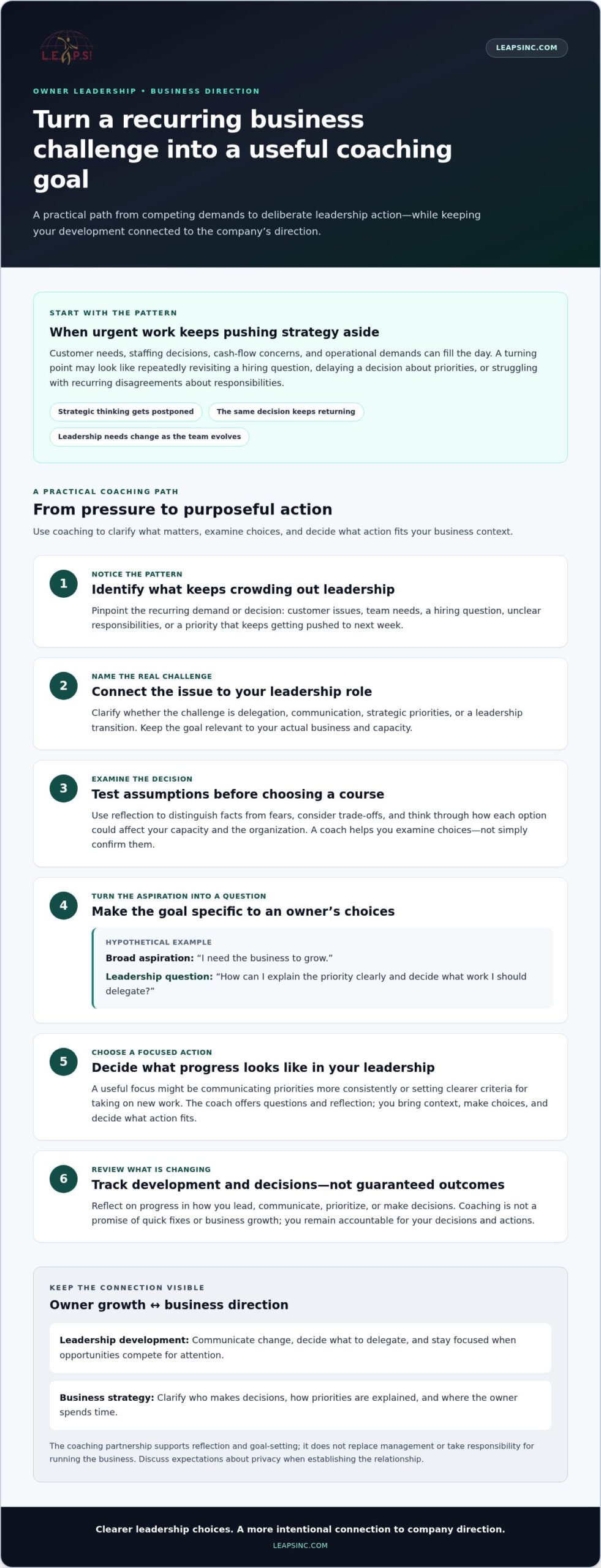
A small-business owner can spend an entire day resolving immediate problems and still feel unsure whether the company is moving toward the future they envision. Customer needs, staffing decisions, cash-flow concerns, and operational demands compete for attention. Over time, urgent tasks can crowd out the deliberate work of setting direction and leading the business through change.
An executive coach provides a structured partnership for examining leadership choices, setting goals, and thinking through decisions. Rather than supplying ready-made answers, a coach helps you clarify what matters, examine assumptions, and choose a course of action that fits your business’s circumstances. For a broader overview of coaching and how it differs from related approaches, see What is Coaching?
Executive coaching for small-business owners is a reflective, goal-focused partnership that helps an owner strengthen leadership and make decisions aligned with the company’s direction. It isn’t a promise of quick fixes or guaranteed growth, and it doesn’t replace management or take responsibility for running the business. You remain accountable for your decisions and actions.
Signals that owner-led leadership has reached a turning point
A turning point may show up as a pattern rather than a single crisis. You might revisit the same hiring question, delay a decision about which products or services to prioritize, or struggle to resolve a recurring disagreement about responsibilities. Experience still matters, but familiar instincts may no longer be enough as the business changes.
Strategic thinking can also become difficult to protect. If every available hour goes to customer issues or team needs, long-term questions keep getting pushed to next week. Coaching can help you bring those questions into focus: What deserves your attention now? Which responsibility could you delegate? What decision would move the company closer to its vision?
Leadership demands change as a business and its team evolve. An owner who once made every call may need to set clearer expectations, delegate decisions, or communicate priorities across a growing team. If these transitions are difficult to manage alone, executive coaching can give you space to examine the leadership challenge alongside the company’s changing needs.
Why small-business owners may seek a confidential sounding board
Some decisions are difficult to discuss openly with employees or business partners. Sharing uncertainty about a major change, a team member’s role, or the company’s direction may affect relationships or cause concern before you’re ready to communicate a decision. A coach can provide a structured space to consider options before deciding what to share and with whom. Discuss expectations about privacy when establishing the working relationship.
That space is most useful when it helps you test assumptions rather than simply confirm them. A coach may help you distinguish facts from fears, identify trade-offs, and consider how a choice could affect both your capacity and the organization. Goals should reflect your actual context, whether the central question concerns delegation, communication, strategic priorities, or a leadership transition. The aim is not to pursue an abstract ideal of executive performance, but to make considered progress on challenges that matter to your business.
How Executive Coaching Connects Owner Growth With Business Strategy
An aspiration such as “grow sustainably” can point toward a meaningful future, but it’s too broad to guide everyday leadership on its own. Coaching helps you translate that ambition into development priorities: how to communicate a change, decide what to delegate, or stay focused when new opportunities compete for attention. The process is collaborative. The coach asks questions and offers reflection; you bring context, make choices, and decide what action fits.
When you develop as a leader, the business gains a clearer path; when the business strategy becomes clearer, you can lead with greater intention. Choices about who makes decisions, how priorities are explained, and where you spend time can shape how the organization responds to its direction. This is one reason a small-business leader may seek an executive coach for small business owners: not to separate personal growth from business concerns, but to examine how each affects the other. The Vistage Small Business Program also discusses coaching in relation to owners’ strategic decisions, growth, and teams.
From a business challenge to a useful coaching goal
Hypothetical example: An owner plans to focus on a new service, but returning customers need more attention and the team is unsure which work takes priority. “I need the business to grow” names an aspiration, not a leadership goal. A more useful question might be, “How can I explain the priority clearly and decide what work I should delegate?” That question focuses on actions within the owner’s role without promising a particular revenue or growth outcome.
You and the coach can explore what’s driving the competing demands, what assumptions shape the decision, and what different choices may mean for the team. A focused goal might involve communicating priorities more consistently or setting clearer criteria for taking on new work. Review progress in relation to your development and decisions, rather than treating it as a guaranteed company result.
The owner’s leadership and the organization’s direction
Your values influence what you protect, communication shapes what employees understand, and decision-making habits can clarify or blur responsibility. Coaching gives you room to examine a business challenge from several perspectives: the intended strategy, the team’s experience of it, and the leadership behavior that may support or obstruct it. Business coaching can be useful when you want to reflect on leadership alongside business priorities.
Coaching is distinct from consulting. A consultant typically provides project-specific recommendations or expertise, while coaching centers on your reflection, learning, and development. These approaches serve different needs: coaching may help you clarify how to lead through a decision, while consulting may provide recommendations for a defined business project. To explore how coaching can relate to your leadership and strategy, start a coaching conversation.
How to Evaluate an Executive Coach for a Small Business
The right fit depends less on impressive executive terminology than on whether the coach understands the realities of an owner-led business. In a small company, you may be setting direction while also managing customers, staff, and daily operations. An executive coach for small business owners should connect leadership development to that context, help clarify what the work will focus on, and agree with you on how to review progress.
Use these areas to assess the substance of a coaching relationship, not just its language.
| Area | What to explore |
|---|---|
| Goals | Can the coach help translate your priorities into clear development goals tied to your role? |
| Business context | Does the conversation make room for owner-led realities, such as limited capacity, close team relationships, and competing demands? |
| Working relationship | Is the approach candid, respectful, and constructive, with clear expectations on both sides? |
| Progress review | Will you revisit agreed goals and discuss what you’re learning, rather than assume outcomes? |
A coach doesn’t need to use small-business jargon to be relevant. What matters is whether they listen closely, ask useful questions about your circumstances, and avoid treating a lean owner-led company like a large corporation with layers of leadership. For a broader perspective on the purpose and value of executive coaching, FranklinCovey on Executive Coaching offers an overview.
Questions that reveal coaching fit
Ask how conversations will connect to your goals, how confidentiality is handled, and what each person is expected to bring to the relationship. You might also ask how you’ll discuss progress and what happens if a goal needs to change. Notice whether the coach responds with curiosity and clarity. A good fit should allow for respectful challenge, not just reassurance.
Executive coaching, business coaching, or entrepreneurship coaching?
These labels can overlap, so focus on the work you want to do. Executive coaching tends to center on leadership responsibilities and decision-making. Business coaching may connect leadership choices with business priorities, while entrepreneurship coaching can focus on your development as an entrepreneur. Consider entrepreneurship coaching if that emphasis matches your goals.
Before choosing a direction, define what you want to examine and agree on how you’ll reflect on progress. Review coaching against those shared goals, not promised or assumed results. If a focused conversation would help you clarify what you need, start a coaching conversation.
How to Prepare for Coaching and Make Progress Visible
Coaching is more useful when you bring a real leadership question rather than a polished account of what you think you should be working on. An executive coach for small business owners can help you examine a challenge, but your context and priorities shape the conversation. Before you meet, identify what feels unresolved, what you’d like to approach differently, and what’s influencing the situation.
Use this simple sequence to prepare:
- Identify the challenge. Name a recurring decision, tension, or responsibility that’s taking more attention than you’d like. Be specific: “I’m delaying a decision about who should own customer follow-up” gives you more to explore than “I need to be a better leader.”
- Define the desired change. Consider what you want to understand, decide, or practice differently. The goal might be to communicate priorities more clearly, not to guarantee a particular business result.
- Bring relevant context. Note who is involved, what you’ve tried, which constraints matter, and what competing priorities affect your options. This keeps reflection grounded in the business you actually lead.
What to bring into an initial coaching conversation
You don’t need to arrive with every answer. Bring a concise picture of the business, your role in the challenge, and the question you most want to think through. Notes on recurring decisions, leadership questions, and current priorities can help you identify patterns. Be open about constraints, uncertainty, and the direction you hope to pursue; those details give the conversation substance.
A short preparation note could include:
- A decision or conversation that keeps resurfacing
- What makes the issue difficult to resolve
- What you’ve already considered or tried
- What a more intentional response might look like
Reviewing direction without reducing progress to one metric
Progress can be visible in the way you lead, even when outside conditions are unpredictable. Revisit the goals you agreed on and consider what has changed in your clarity, choices, or leadership practice. Did you communicate a priority more directly? Did you pause to weigh options before deciding? These observations help you assess learning without treating coaching as a guaranteed performance intervention.
Separate actions within your influence from outcomes shaped by customers, the market, or other circumstances. You can choose to clarify team responsibilities, but you can’t control every response or result. If business conditions shift, revisit your coaching priorities together so the work remains relevant rather than tied to an outdated concern. Ongoing reflection helps connect personal development with the company’s evolving needs.
If you’re ready to bring a leadership question into a structured conversation, schedule an appointment with LEAPS Inc.
How LEAPS Inc. Supports Small-Business Owners Through Coaching
For a small-business owner, leadership development and business direction are closely connected. How you set priorities, make decisions, and guide your team shapes how the organization pursues its vision. LEAPS Inc. offers executive, business, and entrepreneurship coaching for business leaders and entrepreneurs who want a structured space to reflect on their role and their company’s direction.
Choosing an executive coach for small business owners is not simply about finding someone who uses the right title. Consider whether the coaching conversation can stay grounded in your goals, responsibilities, and business realities. LEAPS Inc.’s coaching helps you bring a leadership question into focus, examine the assumptions behind it, and consider development priorities that fit your next chapter. The practice is founded and led by Dr. John E. N. Daniel.
Connecting coaching to the owner’s next chapter
Owner development and business strategy can inform one another. A question about delegation, for example, may also raise broader issues about decision-making, team roles, and the kind of organization you’re building. LEAPS Inc.’s executive coaching supports leaders who want to reflect on how they lead while considering business priorities.
Some concerns may extend beyond leadership reflection to a wider organizational need. If you’re considering how to develop the business or align its direction with a new opportunity, business development support may be relevant alongside coaching. Strategic marketing, brand development, and corporate visioning can also address broader questions about how the company presents itself and where it is headed. The focus differs: coaching centers on your development and decisions, while related business services address organizational questions.
Business, executive, and entrepreneurship coaching can overlap, but each points toward a different emphasis. You might be focused on leadership responsibilities, developing the business, or growing as an entrepreneur. Naming that emphasis helps shape a useful conversation without assuming every owner needs the same approach.
Taking a considered first step
Before a conversation, identify one question you want to address. It could concern a leadership transition, a difficult decision, or the relationship between your priorities and the company’s direction. You don’t need to arrive with a complete plan. A clear description of what’s happening, what feels unresolved, and what you hope to understand can provide a meaningful starting point.
A first conversation can help clarify your goals and the coaching focus that fits them. From there, you can consider whether the work aligns with your needs and what you want to explore. If you’re ready to discuss your goals with LEAPS Inc., schedule an appointment and take a considered step toward your next chapter as a business owner.
Make Space for the Leader You’re Becoming
The next stage of your business may ask something different of you as its owner. Rather than waiting until every decision feels certain, consider what kind of leadership the future you envision will require: clearer boundaries, greater trust in your team, or a more deliberate way to choose priorities. A thoughtful coaching relationship can help you examine that question and shape a direction that reflects both your values and your company’s needs.
LEAPS Inc. offers executive, business, and entrepreneurship coaching through a practice founded and led by Dr. John E. N. Daniel. If you’re considering an executive coach for small business owners, bring the leadership question that feels most important right now. A conversation can help you clarify what you want to work toward and whether coaching fits your next chapter.
Schedule an appointment to discuss your coaching goals and take a considered step toward leading with greater purpose. Your future direction begins with the questions you’re ready to explore.
Frequently Asked Questions
Is executive coaching only for leaders at large companies?
No. An executive coach for small business owners can work with a leader whose decisions affect a compact team, a solo operation, or a growing company. The relevant factor is the leadership challenge, not the size of the organization. For example, an owner may want to decide how to spend limited time, set boundaries with clients, or prepare to take on a new responsibility without a corporate leadership structure.
How long does executive coaching for a small-business owner take?
There isn’t one standard duration. It depends on your goals, the issues being explored, and how the work develops. A focused decision may need a different scope than a broader leadership transition. Discuss the intended focus and when you’ll review it at the outset. That makes it easier to assess whether the work remains relevant, should shift to a new priority, or has reached a useful pause point.
Can a small-business owner benefit from coaching without employees?
Yes. Leadership isn’t limited to managing a team. A solo owner still makes decisions about clients, workload, business direction, and how to allocate limited time and attention. Coaching may help you examine patterns such as accepting work that conflicts with your priorities or postponing a strategic choice. The conversation can focus on how you want to lead the business, even if there are no employees to delegate to.
How often should a business owner meet with an executive coach?
You and your coach should agree on meeting frequency based on the goals and practical needs of the work. Consider how much time you can protect for reflection and whether you’ll have opportunities to apply insights between conversations. If a major decision is approaching, the rhythm may need to support that focus; ongoing development may call for a different arrangement. Review the schedule if your priorities change.
Can coaching help when a business owner feels uncertain about the next stage?
Yes. Coaching can help you examine what feels uncertain, distinguish immediate pressures from longer-term questions, and consider possible directions. For instance, an owner weighing whether to expand services might explore what is motivating the choice, what capacity it would require, and which trade-offs matter most. Coaching can support clearer thinking, but it can’t remove uncertainty or guarantee that a particular business direction will succeed.
What is the difference between an executive coach and a mentor?
An executive coach generally supports a leader’s reflection and development through questions, goal-focused discussion, and examination of choices. A mentor more often shares personal experience, perspective, or advice based on their own path. The roles can overlap, but the distinction matters: consider whether you need help thinking through your own approach, practical guidance from someone with relevant experience, or a combination of both.
Can coaching support both leadership development and business development?
Yes. Your leadership habits can influence how business priorities are communicated, how decisions are made, and how opportunities are assessed. Coaching can help you examine those habits while keeping the company’s direction in view. If a concern also requires project-specific work, such as developing a marketing strategy, that need may be distinct from coaching. Clarifying the focus helps determine what kind of support best fits the question.