

What if your next leap as a leader depends less on doing more and more on seeing your choices clearly? High-stakes decisions leave little room for reflection, and strengths that helped you advance may not translate into consistent impact across a team. Leadership coaching for executives creates structured space to examine leadership patterns and connect personal insight with professional goals.
Leadership growth takes more than a generic course. The right development work should speak to the realities of your role, whether you want to strengthen decision-making, communicate with greater intention, or work through a specific challenge.
This guide explains how executive coaching works, what it can help you develop, and how to assess whether it fits your leadership goals. You’ll learn what the coaching process can involve, how it differs from other forms of support, and how to prepare for a useful conversation. At LEAPS Inc., executive coaching is led by founder Dr. John E. N. Daniel and connects personal growth with leadership effectiveness.
Key Takeaways
- Executive coaching focuses on your leadership role and goals, creating space to reflect and practise more intentional responses.
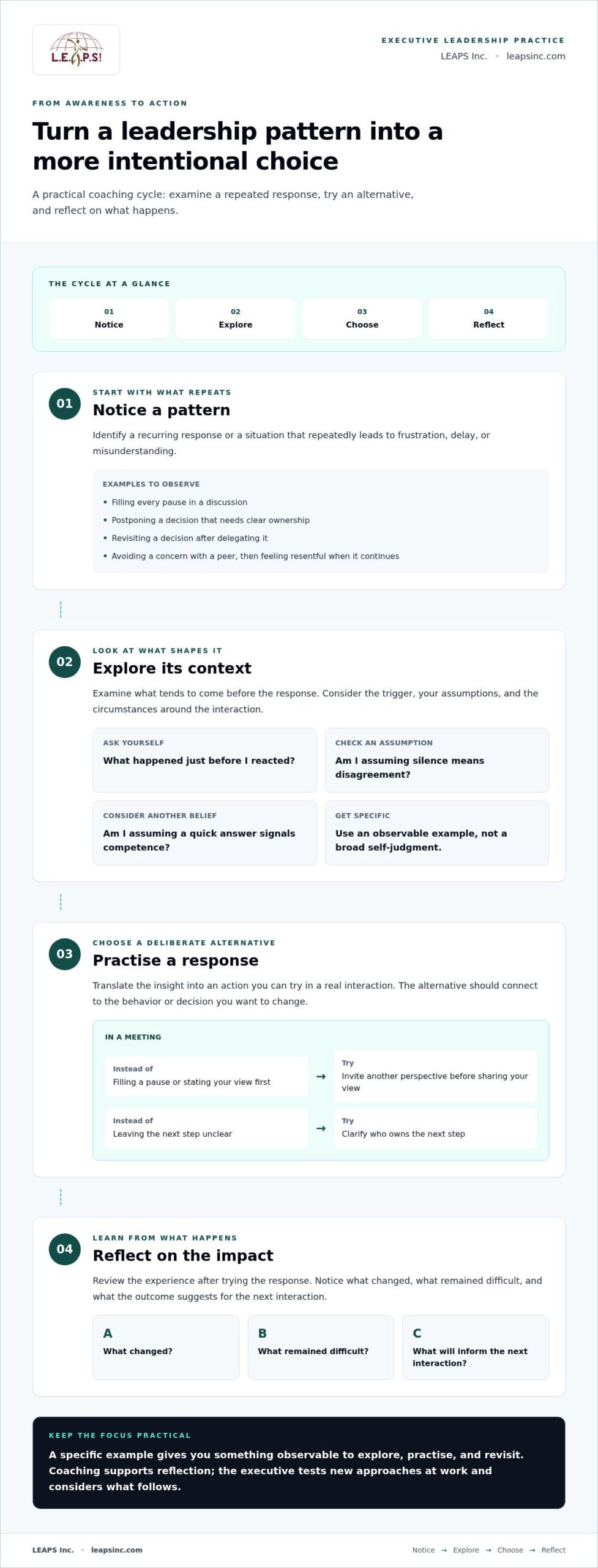
- Turn self-awareness into practice: notice a pattern, explore its context, choose a response, and reflect on what follows.
- Distinguish coaching from training, consulting, and therapy by the purpose and form of support each provides.
- Prepare for leadership coaching for executives by identifying a specific challenge and defining an observable change you want to make.
- LEAPS Inc.’s executive coaching connects personal insight with professional leadership goals.
What Is Leadership Coaching for Executives, and What Can It Change?
Leadership coaching for executives is individualized development focused on an executive’s role, current challenges, and professional goals. Instead of applying a universal formula, coaching gives a leader space to examine how they make decisions, communicate, and influence others, then identify what they want to approach differently. The discussion is grounded in the executive’s responsibilities and development priorities.
Executive roles can leave little time to consider the effects of familiar habits. Coaching can help bring those habits into view, explore relevant feedback, and identify where intentional practice may help. The broader executive coaching field includes development focused on business and leadership contexts, shaped by a person’s goals and circumstances.
For a closer look at the topic, watch this guide to nonprofit executive leadership coaching:
Coaching isn’t a quick fix or a substitute for experience, organizational support, or a leader’s own judgment. It’s a developmental process: the executive takes part, tests new approaches at work, and reflects on what happens. Executive coaching is a focused partnership for examining leadership choices and developing practices aligned with an executive’s goals. Outcomes depend on the person, their context, and how they apply what they learn.
What makes executive coaching different from general leadership development?
General leadership development may offer a broad curriculum, shared concepts, or guidance for a wide audience. Coaching can focus on one executive’s role and circumstances, such as a current decision, a team dynamic, or a transition in responsibility. The executive’s priorities shape the focus, alongside workplace experience and organizational resources.
Which leadership challenges can coaching help executives examine?
Common topics include preparing for a difficult conversation, delegating without over-controlling, weighing competing priorities, and adjusting to broader responsibility. These are areas to explore, not outcomes a coach can promise. A broad concern becomes easier to work with when you translate it into a behavior or decision you can observe and revisit.
- Difficult conversations: Notice when you avoid a necessary discussion, then clarify the message and response you want to practise.
- Delegation: Identify which decisions you hold on to and consider what appropriate ownership could look like for your team.
- Decision-making: Examine assumptions or emotional reactions that may be narrowing your view of a complex choice.
- Changing responsibilities: Identify which leadership behaviors may need to change as your scope or influence expands.
LEAPS Inc., founded and led by Dr. John E. N. Daniel, offers executive coaching to connect leadership reflection with professional goals. The work focuses on development in the executive role and on how personal insight can inform more intentional choices at work.
How Executive Coaching Connects Self-Awareness to Leadership Impact
Leadership influence often takes shape in small, repeated moments: how a leader responds to a challenge, interprets silence in a meeting, or reacts when plans change. Self-awareness helps an executive notice these responses before they become automatic. Executive self-awareness creates room for more deliberate leadership choices.
In leadership coaching for executives, reflection can become a practical cycle rather than an abstract exercise. A leader examines an interaction, considers what shaped their response, identifies an alternative, and notices what happens when they try it. Relevant feedback can add another perspective on how that behavior affects colleagues.
- Notice a pattern. Identify a recurring response, such as filling every pause in a discussion or postponing a decision that needs clear ownership.
- Explore its context. Ask what tends to come before the response. Are you assuming silence means disagreement, or that a quick answer signals competence?
- Choose a response. Consider an intentional alternative, such as inviting another perspective before stating your view or clarifying who owns the next step.
- Reflect on the impact. Review what changed, what remained difficult, and what the experience suggests for the next interaction.
How can an executive recognize patterns that limit leadership effectiveness?
Look for situations that repeatedly produce frustration, delay, or misunderstanding. You might avoid raising concerns with a peer, then feel resentful when the issue continues. Or you may revisit decisions after delegating them, unintentionally signaling a lack of trust. These patterns aren’t diagnoses or fixed traits. They’re opportunities to examine triggers, assumptions, and consequences.
Ask yourself: What happened just before I reacted? What did I assume about the other person’s intent? What effect might my response have had on the discussion or decision? A specific example is more useful than a broad judgment such as “I’m a poor communicator.” It gives you something observable to explore and, if useful, discuss in coaching.
How does coaching turn insight into practical leadership practice?
Insight becomes useful when it guides an action. Before a meeting, for example, a leader who tends to respond defensively to questions might decide to pause, clarify what the person is asking, and consider the concern before answering. The goal isn’t to perform perfectly. It’s to test a deliberate behavior in a real situation and learn from the experience.
Afterward, consider what you noticed: Did the pause change the conversation? Did your response address the question? What might you adjust next time? Reviewing observable actions keeps development grounded and helps carry learning into future interactions. LEAPS Inc.’s coaching provides structured space to connect this reflection with leadership goals. To explore executive coaching for your role, schedule an appointment.
Executive Coaching, Leadership Training, Consulting, or Therapy: Which Fits?
Choose support based on the question you need answered. Do you want to develop your leadership practice, learn a defined set of skills, solve an organizational problem, or address your mental and emotional health? These approaches can complement one another, but they serve different purposes. Leadership coaching for executives centers on the leader’s goals and work, rather than delivering a standard curriculum or prescribing an organizational solution.
Executive coaching
Purpose: Develop an executive’s leadership practice.
Primary focus: The leader’s goals, choices, and role-specific challenges.
Typical support: Goal-oriented reflection and discussion connected to the executive’s work.
Leadership training
Purpose: Build knowledge or skills across a defined topic.
Primary focus: Shared learning objectives and course content.
Typical support: Structured instruction, activities, and practice for individuals or groups.
Consulting
Purpose: Address a business or organizational need.
Primary focus: The organization’s strategy, structure, or operating challenge.
Typical support: Analysis, recommendations, or problem-solving guidance.
Therapy
Purpose: Support mental and emotional health.
Primary focus: A person’s psychological wellbeing and related concerns.
Typical support: Clinical care provided within a therapeutic relationship.
The best fit depends on the need. A leader learning a new framework may benefit from training; an organization seeking recommendations about its structure may need consulting. Coaching is suited to examining how an executive approaches their role and translating reflection into intentional development. It doesn’t replace workplace experience, organizational support, or clinical care.
When is one-to-one executive coaching a better fit than a course?
A course can provide valuable shared instruction, especially when you want foundational knowledge or a common language with colleagues. One-to-one coaching may be a better fit when you want to apply learning to a specific responsibility, relationship, or decision. It offers focused space for role-specific reflection. LEAPS Inc. provides executive coaching shaped around leadership development.
How is coaching different from therapy and organizational consulting?
Coaching addresses professional goals and leadership development; therapy addresses mental and emotional health. Coaching isn’t mental health treatment and shouldn’t be used as a substitute for clinical care. When considering therapy versus coaching, keep the purpose in view: professional development differs from care for psychological wellbeing.
Consulting focuses on an organization’s needs, such as strategy or structure, rather than primarily on one executive’s development. These distinctions matter when a workplace challenge also carries personal weight. Clarifying the central need helps you choose support that matches it. If executive growth is your focus, schedule an appointment to explore coaching with LEAPS Inc.
How Executives Can Prepare for Leadership Coaching
You don’t need a complete development plan to prepare. A clear example from your work can be enough to begin a useful conversation. For leadership coaching for executives, connect a current challenge with a change you can observe, while considering your role, relationships, and organizational context.
Use this sequence to organize your thinking:
- Identify a challenge. Choose a situation that matters to your leadership, such as prioritizing competing requests, aligning stakeholders, or communicating a change in direction. Focus on a real moment rather than a broad judgment about yourself.
- Define the change you want. Describe what you hope to do differently. Instead of “be more strategic,” you might set decision criteria before a planning discussion or make ownership clear before work begins.
- Gather relevant context. Consider the responsibilities, people, expectations, and constraints involved. Note what is within your influence and what depends on others. You don’t need to prepare sensitive details that aren’t necessary.
How can you set meaningful executive coaching goals?
Translate an ambition such as “be a better leader” into a behavior or situation you can revisit. For example, define what effective communication would look like in a meeting: summarizing the decision, naming unresolved questions, and confirming next steps. That gives reflection something concrete to examine.
Separate your own actions from wider business outcomes. You can work on how you frame a decision or invite input, but market conditions and other people’s choices also shape results. Revisit your goals as your responsibilities, team needs, or organizational priorities change.
What should you bring into an initial coaching conversation?
Bring one or two current challenges and a sense of the change you hope to make. Relevant feedback or a brief example can clarify the situation, but avoid sharing confidential workplace information that isn’t necessary. A pattern or paraphrase may be enough to explain what happened and why it matters to you.
Use the conversation to discuss expectations and working preferences, including what would make reflection useful and how you might recognize progress. Practical signs of progress could include stating priorities clearly, following through on a difficult discussion, or making decisions more consistently. The purpose is to set a meaningful direction, not to arrive with every answer resolved.
Preparation can help you enter coaching with focus while leaving room for new insight. Your goals may become more precise as you examine them in context. If you’re ready to explore what you want to develop in your leadership role, discuss your leadership goals.
How LEAPS Inc. Supports Executive Leadership Growth
Leadership development can begin with a clear question: What do you want to approach differently in your role, and why does that change matter? LEAPS Inc. offers executive coaching for executives, entrepreneurs, and businesses. Founded and led by Dr. John E. N. Daniel, the practice connects professional development with personal insight, recognizing that how a leader understands themselves can inform how they lead.
LEAPS Inc.’s executive coaching supports executives, entrepreneurs, and businesses with leadership and professional development. Coaching focuses on professional growth, not clinical therapy. Reflection on values, assumptions, or responses may be relevant to leadership, but coaching does not serve as mental health treatment.
A coaching conversation grounded in professional growth
Coaching offers space to clarify leadership goals and examine challenges in the context of your work. You might bring a question about your responsibilities, a relationship at work, or the direction you want your development to take. The conversation can connect the professional concern with your perspective and choices, without assuming there is one right answer for every executive.
LEAPS Inc. also offers specialized therapy intensives as a separate clinical service. Executive coaching remains focused on professional growth and your leadership goals. The development process depends on your priorities, context, and participation.
Personal insight can complement executive development without blurring the distinction between coaching and therapy. You may reflect on how your values or habitual responses shape workplace choices, then consider how to act with greater intention. The purpose remains professional: to explore leadership questions and growth in relation to your work.
Choose a next step aligned with your leadership goals
You don’t need to arrive with a polished plan. Bring a current leadership question, a development priority, or a responsibility you’re working through. It may help to identify what you hope will be different, while leaving room to clarify the goal through conversation. A thoughtful starting point can help you explore whether executive coaching aligns with what you want to develop.
Consider what matters most now: strengthening your leadership presence, examining a professional challenge, or clarifying the direction you want to take. To explore your goals with LEAPS Inc., schedule an appointment.
Make Your Next Leadership Choice More Intentional
Your next stage of growth doesn’t require having every answer in advance. It can begin with a willingness to examine how you lead, decide what matters most, and take one considered step toward the executive you aspire to become. Leadership coaching for executives can help bring that intention into sharper focus and connect your professional direction with the choices you make each day.
Consider the question you want to carry forward: What would you like your leadership to make possible for your team, your organization, and yourself? Naming that aspiration can turn reflection into a meaningful starting point. From there, development grows through attention, choice, and a willingness to keep learning as your responsibilities evolve.
To explore your next step, schedule an appointment with LEAPS Inc. to discuss your leadership goals. You can shape your leadership with greater purpose, one intentional choice at a time.
Frequently Asked Questions
What does leadership coaching for executives involve?
Leadership coaching for executives involves focused conversations about how you want to lead and the demands of your role. You might bring a decision, relationship, or upcoming change, then examine options and identify a next action. A coach doesn’t make decisions for you or act as your manager. The process creates deliberate space to think before returning to the demands of work.
Is executive coaching worth it for experienced leaders?
It can be useful for experienced leaders when a new challenge calls for a fresh perspective, even if they already have substantial knowledge and responsibility. For example, a leader taking on a larger team may want to reconsider how they set priorities or share authority. Coaching isn’t automatically valuable because of someone’s title; its usefulness depends on having a meaningful goal and a willingness to examine your approach.
How long does executive coaching usually take?
There isn’t one standard duration that suits every executive. The timeframe depends on the development goal, the complexity of the situation, and how the coaching is arranged. A focused question may call for a different scope than a broader leadership priority. Before beginning, clarify the goal and discuss how you’ll review whether the work remains useful. Revisit that conversation if your role or priorities shift.
Can executive coaching help with difficult conversations?
Yes. Coaching can help you prepare for a challenging discussion by clarifying its purpose, the message you need to communicate, and the response you hope to invite. Before addressing missed commitments, for instance, distinguish observable facts from assumptions and decide what specific request to make. You remain responsible for the conversation, but preparation can help you enter with greater clarity and respond thoughtfully if it takes an unexpected turn.
What is the difference between executive coaching and leadership training?
Leadership training typically teaches concepts or skills through a planned curriculum, while executive coaching focuses on applying development to an individual leader’s circumstances. A training course might explain how to give feedback; coaching could help you consider how to use that skill in a particular relationship or situation. The approaches can complement each other: instruction builds knowledge, while individualized reflection helps you decide how to use it.
Is executive coaching confidential?
Confidentiality depends on the coaching arrangement and the expectations agreed upon. Before sharing sensitive details, discuss what information remains between participants and whether updates are shared with an employer or sponsor. Ask how notes and progress information are handled, especially if the organization supports the coaching. Clear boundaries at the outset help everyone understand the space for candid discussion without assuming every arrangement offers identical privacy.