

What if the next step in your leadership growth depends not on pushing harder, but on understanding what is getting in the way? Professional success can coexist with emotional exhaustion, a gap between personal values and business strategy, or the feeling that therapy moves too slowly while coaching stays too close to the surface. Holistic mental health and coaching offers a way to consider both emotional wellbeing and professional goals.
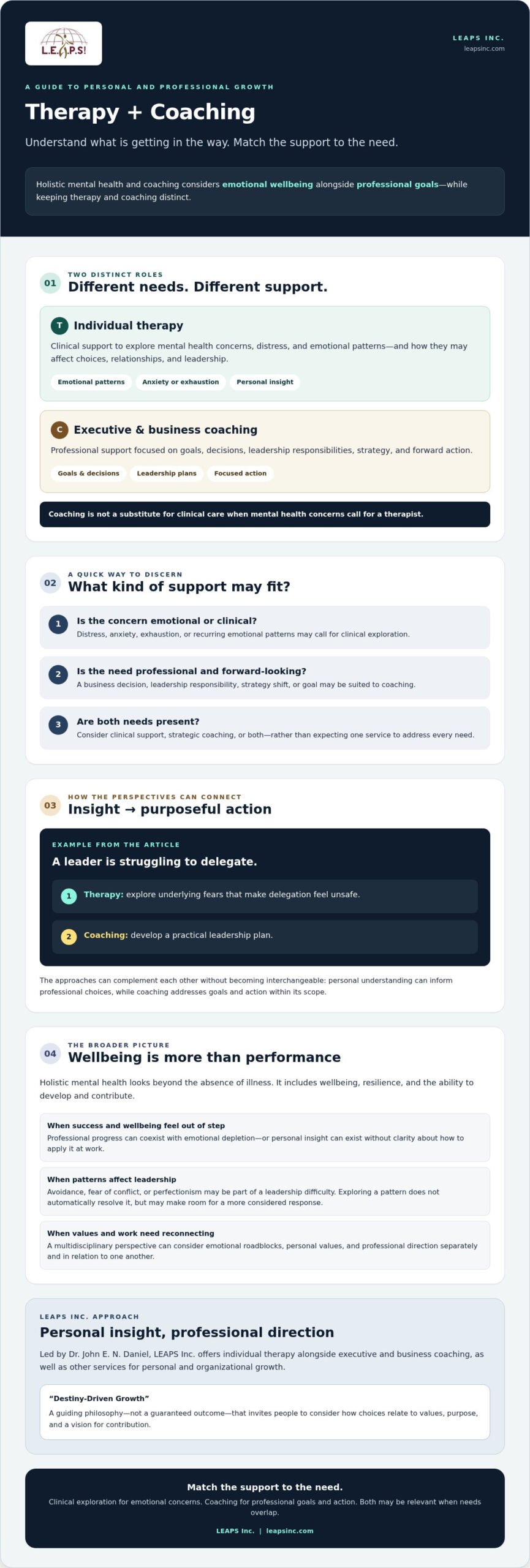
Insight alone doesn’t always create momentum, and ambition without emotional grounding can contribute to burnout. Therapy and coaching have distinct roles: therapy addresses mental health concerns and emotional patterns, while coaching focuses on goals, decisions, and forward action. When the need for each is clear, they can complement one another and connect personal resilience with purposeful leadership.
This article explains how to clarify your goals, recognize what kind of support may fit, and connect personal insight with professional direction. We’ll explore how LEAPS Inc., led by Dr. John E. N. Daniel, offers individual therapy alongside executive and business coaching, and what to consider when deciding whether one or both types of support may be relevant.
Key Takeaways
- Holistic mental health and coaching considers emotional wellbeing and professional goals while respecting the distinct roles of therapy and coaching.
- Individual therapy can help you explore emotional patterns that may affect your choices, relationships, and leadership.
- Executive and entrepreneurship coaching can help translate self-understanding into focused decisions and action.
- Consider whether a challenge calls for clinical support, strategic coaching, or both, rather than assuming one service can address every need.
- LEAPS Inc. offers individual therapy, executive and business coaching, and other services for personal and organizational growth.
Defining Holistic Mental Health and Coaching: The Integrated Approach
High achievement can conceal a gap between professional progress and personal wellbeing. A leader may make strategic gains while feeling emotionally depleted, or gain personal insight without knowing how to apply it at work. Holistic mental health and coaching considers inner wellbeing and professional purpose together, without treating therapy and coaching as interchangeable.
Holistic mental health looks beyond the absence of illness to include wellbeing, resilience, and the ability to develop and contribute. The holistic model of mental health provides a broader context for this perspective. For a leader, applying it might mean exploring what drives a recurring conflict and separately deciding how to respond differently in a work setting.
The idea of combining clinical depth with strategic growth is straightforward: therapy can help someone explore emotional patterns and distress, while coaching can support goals, decisions, and action. These roles remain distinct. Coaching isn’t a substitute for clinical care when mental health concerns call for a therapist. An integrated approach means considering the person and the professional context, then identifying the appropriate support for each.
The Limits of Treating Growth in Separate Spheres
Coaching may not address the full picture if avoidance, fear of conflict, or perfectionism is part of a leader’s difficulty. Therapy can deepen self-understanding, but it may not directly address a business decision, leadership responsibility, or strategy shift. Neither approach is inherently inadequate. The question is whether the chosen support matches the need. A coordinated perspective can help distinguish concerns that call for clinical exploration from those suited to professional coaching, while keeping the boundaries between them clear.
A Multidisciplinary Approach to Growth
High-achievers may need more than a productivity plan. They might need to understand emotional roadblocks, reconnect work with personal values, and translate insight into a specific leadership choice. A multidisciplinary approach considers these needs separately and in relation to one another. For example, someone who struggles to delegate might explore the underlying fears in therapy, then use coaching to develop a practical leadership plan.
At LEAPS Inc., Dr. John E. N. Daniel leads an approach that brings individual therapy together with executive and business coaching. Leaders considering a professional goal can learn more about executive coaching as one option for turning clarity into purposeful action.
Destiny-Driven Growth is a guiding philosophy, not a guaranteed outcome. It invites people to consider how their choices relate to their values, purpose, and vision for contribution. By making room for emotional concerns as well as professional goals, high-achievers can pursue growth with greater intention rather than simply demanding more from themselves.
The Clinical Pillar: Exploring Emotional Patterns Through Therapy
Professional performance doesn’t exist apart from emotional wellbeing. Anxiety, exhaustion, or difficulty trusting colleagues can affect decisions, communication, and leadership, even when outward success appears strong. Individual therapy offers a clinical setting to explore these experiences, consider their context, and examine possible responses. Therapy isn’t a shortcut to business results. It can be a starting point for personal growth that informs professional choices.
In therapy, someone might notice that avoiding difficult conversations echoes earlier family dynamics, or that perfectionism makes delegation feel unsafe. Recognizing a pattern doesn’t automatically resolve it, but it can make room for a more considered response. This work can complement leadership development without turning therapy into a substitute for business strategy.
Clinical Support for High-Achieving Minds
Anxiety and burnout deserve attention as concerns affecting wellbeing, not simply as obstacles to productivity. A therapist can help explore what may be contributing to distress and how it affects daily life. A coach, in turn, can address professional goals within the appropriate scope of coaching. Family relationships may also shape a leader’s current style. Someone accustomed to keeping the peace, for example, might find it difficult to set clear expectations at work.
If you’re unsure where to begin, Therapy vs. Coaching: A Visionary Guide to Integrated Growth in 2026 offers context for distinguishing clinical support from goal-focused coaching. Start by identifying what you want help with and whether it involves emotional distress, a professional goal, or both.
Considering Therapy Intensives
A Therapy Intensive offers a focused format for deeper personal exploration. LEAPS Inc. offers Therapy Intensives, but this format shouldn’t be treated as a guaranteed breakthrough or a replacement for ongoing care. Concentrated work may suit some people, but the person’s circumstances and clinical needs should guide the choice. Ask what the format involves and whether it fits your needs. The aim is thoughtful exploration and meaningful progress, not speed for its own sake.
Emotional vulnerability can support leadership when it involves acknowledging uncertainty, receiving feedback, and taking responsibility while maintaining sound judgment. Understanding your reactions may help you listen and respond more thoughtfully. The National Center for Complementary and Integrative Health provides information on integrative health approaches related to mental health. Such approaches don’t replace individualized clinical guidance.
If you’re considering focused clinical support, LEAPS Inc. provides a way to request an appointment and explore its services. Therapy can support emotional understanding, while professional strategy remains a distinct area of support.
The Coaching Catalyst: Turning Clarity into Strategic Action
Self-understanding becomes more practical when it informs decisions, priorities, and leadership behavior. Executive coaching can help leaders clarify what they want to accomplish, examine how their approach affects the organization, and identify deliberate next steps. Coaching is strategic, not clinical. When emotional distress calls for therapeutic care, that belongs with a qualified mental health professional.
For a senior leader, this might mean recognizing that reluctance to delegate is limiting the team, then identifying responsibilities to share and deciding how to communicate expectations. From a holistic mental health and coaching perspective, clinical insight and coaching can complement one another while serving distinct purposes. Research on synergistic approaches to behavior change offers context for how coaching and health-related support may work together to support change.
Strategic Support for Entrepreneurs
Founders often face decisions that affect their company, team, and personal life. Entrepreneurship coaching can provide a structured space to examine priorities, test assumptions, and define practical next steps. It can’t remove uncertainty, but it can help founders approach growth more intentionally rather than treating relentless overwork as the only route forward.
Self-awareness can also inform business decisions. A founder who knows which principles they won’t compromise may make clearer choices about customers, partnerships, and the company’s public identity. Connecting those values to brand development can help ensure the brand expresses a coherent purpose rather than disconnected messages.
Executive Performance and Visionary Leadership
Leadership growth involves more than individual performance. Strategic marketing and corporate visioning can help leaders connect a long-term direction with organizational communication and priorities. Business coaching can support professional development by focusing on goals, roles, and the conditions people need to contribute. LEAPS Inc. offers coaching alongside services such as strategic marketing and brand development, bringing personal and organizational growth into the same broader conversation.
If you’re considering structured coaching, executive coaching is one service offered by LEAPS Inc. Before choosing support, identify the outcomes you want to work toward:
- Clearer priorities: Connect daily decisions to the organization’s larger direction.
- Stronger alignment: Consider how leadership values, brand identity, and business strategy relate to one another.
- More intentional development: Identify where people, roles, and communication can better support shared goals.
- Sustainable leadership: Pursue performance without assuming personal wellbeing must be sacrificed.
Coaching doesn’t replace clinical therapy, and strategy alone can’t resolve every personal challenge. When appropriately applied, these forms of support can help leaders turn self-awareness into purposeful action. If you’re weighing coaching against your goals, you can explore an appointment with LEAPS Inc.
When to Combine Therapy and Coaching
A professional challenge can have practical and emotional dimensions. A leadership transition may call for a clearer strategy, for example, while persistent distress or deeply rooted patterns make it difficult to act on that strategy. With holistic mental health and coaching, the goal isn’t to merge therapy and coaching into one role. It’s to identify what kind of support each concern calls for and whether the two may complement one another while respecting clinical boundaries.
A Practical Way to Identify the Right Support
Use the nature and persistence of the difficulty as a starting point, not as a diagnosis. Persistent anxiety, recurring relationship patterns, or unresolved trauma may be reasons to seek assessment and support from a qualified therapist. Strategic stagnation, a leadership transition, or a gap between personal vision and professional direction may be appropriate coaching concerns. If both are present, consider clinical support alongside coaching, or prioritize clinical support when needed. Keep the roles and goals clear.
A Therapy Intensive can provide a concentrated setting for focused clinical work when appropriate to a person’s needs. It isn’t a guaranteed breakthrough or an automatic prerequisite for coaching. A clinician and client can consider whether intensive work fits, then discuss what support may make sense next. The aim is to address personal concerns and shape future goals, not to “fix” the past before pursuing growth.
Family and Business Relationships
Co-regulation describes how people can influence one another’s emotional state through interaction, communication, and responses. In families, patterns of listening, conflict, and repair affect how members relate. In organizations, a leader’s response to pressure can influence a team’s emotional tone. Business outcomes also depend on strategy, resources, and wider conditions, so leadership wellbeing is only one part of the picture.
Family therapy and leadership development aren’t interchangeable. Still, paying attention to interaction patterns can be useful in both settings. Notice who speaks, how disagreement is handled, and whether people can repair a rupture. Individual therapy may help a leader understand personal reactions, while coaching may support concrete changes in communication, decision-making, or direction.
LEAPS Inc. offers clinical therapy and coaching as distinct services. An appropriate starting point depends on the concern: clinical care is relevant when a person needs assessment or treatment, while coaching focuses on professional and organizational goals.
If you’re considering how therapy and coaching might fit your goals, schedule an appointment with LEAPS Inc. to explore its services and discuss a suitable starting point.
Choosing a Path with LEAPS Inc.
Integrated growth starts with identifying what you want help with: emotional wellbeing, professional direction, or concerns that touch both. LEAPS Inc. offers individual therapy alongside executive and business coaching, as well as services such as corporate visioning. Led by Dr. John E. N. Daniel, the practice offers support across personal and organizational growth. Consider your circumstances rather than assuming in advance which service is the right fit.
Preparing for an Initial Conversation
Start by describing what you hope to address and asking how the available services may fit. If personal and professional concerns affect one another, explain how. Ask about the purpose and scope of each service, how privacy is handled, and what professional boundaries apply. These questions can help you make an informed choice without assuming therapy and coaching are interchangeable or that every client follows the same process.
Corporate visioning can help organizations examine their direction and mission in relation to leadership purpose. A company’s strategy and an individual’s values won’t always align automatically. A structured discussion can help clarify where they converge and where thoughtful decisions may be needed. LEAPS Inc. also offers group therapy and family therapy, which may be relevant when a leader’s support system is part of the concern. Suitability depends on the needs and circumstances involved.
Your Next Step
Progress may mean regaining a sense of agency, building emotional resilience, or making professional choices with greater intention. These outcomes aren’t guaranteed, and different forms of support may be appropriate over time. A methodical approach can help you name the challenge, identify a relevant service, and connect personal insight with practical direction.
If you’re exploring an Employee Assistance Program or an individual service, ask LEAPS Inc. which option may fit your needs and what the next steps involve. A useful first step is to explain what you hope to address and ask which service is appropriate.
Build a Future That Reflects Your Whole Self
Leadership growth asks for more than ambition. It also calls for emotional awareness, clarity about what matters, and practical choices that connect professional direction with personal values. Holistic mental health and coaching considers these dimensions together while respecting the distinct roles of therapy and coaching: therapy can address clinical concerns, while coaching can help turn goals into strategic action.
Personal wellbeing and professional impact can influence one another. Thoughtful support can help you explore what’s getting in the way, clarify the direction you want to take, and pursue progress without treating burnout as the price of achievement.
LEAPS Inc., led by Dr. John E. N. Daniel, offers clinical therapy alongside executive and business coaching. To discuss what you’re looking for and explore an appropriate service, schedule an appointment with LEAPS Inc.
Your next chapter can begin with an honest look at where you are and what you want to build.
Frequently Asked Questions
What is the primary difference between holistic mental health and traditional coaching?
Holistic mental health and coaching considers emotional wellbeing alongside personal and professional goals, while coaching generally focuses on objectives and action. Therapy and coaching still have distinct roles: therapy addresses mental health concerns and emotional patterns, while coaching supports leadership, business, and organizational development. An integrated perspective doesn’t make coaching a form of therapy. It helps clarify which kind of support may fit each need.
Can I do therapy and executive coaching at the same time?
Yes. Therapy and executive coaching can be pursued at the same time when each has a clear purpose and appropriate boundaries. Therapy may help you explore emotional distress or recurring personal patterns, while executive coaching can focus on leadership goals and professional decisions. Discuss how the two forms of support may fit together with the relevant providers. Coaching isn’t a replacement for clinical care when mental health concerns call for a therapist.
How do I know if my professional struggles require a clinical therapist?
Consider seeking a clinical assessment if anxiety, emotional distress, or recurring relationship patterns are persistent or affecting your daily life. A professional challenge alone doesn’t establish a diagnosis, and a coach shouldn’t diagnose or treat mental health conditions. Coaching may be suitable for goals such as preparing for a leadership transition or improving strategic focus. If you’re unsure, a qualified mental health professional can help assess what support is appropriate.
What is a therapy intensive and is it right for a busy professional?
A Therapy Intensive is a focused clinical service for deeper, concentrated therapeutic work. LEAPS Inc. offers Therapy Intensives, but suitability depends on your needs and circumstances, not simply a busy schedule. Ask about the format, expectations, and whether it fits your clinical goals before deciding. An intensive isn’t a guaranteed shortcut or automatically a substitute for ongoing therapy. A qualified provider can help you consider an appropriate approach.
Does LEAPS Inc. offer corporate wellness programs for entire teams?
LEAPS Inc. offers an Employee Assistance Program (EAP), along with group therapy, business coaching, and organizational services. Ask LEAPS Inc. what its EAP includes and whether it fits your organization’s needs. Clarify who the service is intended for, what support it provides, and how participation and privacy are handled.
How does corporate visioning help my business grow?
Corporate visioning can help a business clarify its mission and direction, then consider how leadership and organizational priorities relate to that purpose. For example, a company refining its brand may examine whether its messaging reflects the vision leaders want to advance. Visioning can inform strategic decisions, but it doesn’t guarantee business growth. LEAPS Inc. offers corporate visioning; discuss your organization’s goals to understand whether the service may fit.
Is the coaching provided by LEAPS Inc. focused on business strategy or personal mindset?
LEAPS Inc.’s coaching is tailored to executives, entrepreneurs, and businesses, with a focus on leadership and organizational development. Its services also include business development, strategic marketing, brand development, and corporate visioning. Personal reflection may inform professional decisions, but coaching isn’t clinical therapy and doesn’t diagnose or treat mental health conditions. Ask about the specific coaching service that aligns with your priorities, whether they involve leadership, business strategy, or organizational direction.
What should I expect during my first integrated consultation?
Use an initial conversation to explain the personal or professional concerns you want to address, share your goals, and ask which LEAPS Inc. services may be relevant. The information available doesn’t specify one standard consultation process or promise a combined therapy-and-coaching appointment. You can ask how clinical therapy differs from coaching, what next steps may involve, and how privacy is handled. This can help you make an informed choice about where to begin.