


Article by
Dr. John E. N. Daniel
Dr. John E. N. Daniel is a visionary with a burning desire to coach, counsel, teach and empower individuals from diverse backgrounds towards the attainment of their maximum potential, life purpose and destiny. He coaches, counsels, consults, mentors, and ministers to the global community through diverse media and environments.
What if anxiety could become something you learn to respond to, rather than something that directs every decision? Cognitive behavioral therapy for anxiety online can help by applying CBT’s practical principles with a therapist through digital sessions, exercises, and reflection. Its focus is not simply to discuss anxious feelings, but to recognize the thought-and-behavior patterns that can keep them going and develop more helpful responses.
It’s reasonable to wonder whether therapy through a screen can offer meaningful support. Online care can use the same evidence-based CBT principles as in-person therapy, while giving you a structured way to work with a therapist. The right approach depends on your needs, goals, and the kind of guidance that helps you stay engaged.
This article explains how online CBT works, how it compares with face-to-face care, and which emotional regulation strategies it may use, from examining automatic thoughts to gradually approaching situations that trigger anxiety. You’ll get a clearer picture of what professional support involves and how it may help you build steadier responses over time.
Key Takeaways
- See how thought patterns, emotions, and physical sensations can reinforce anxiety, and what therapy helps you notice.
- Understand what professional guidance adds to online CBT and when self-guided practice may not be enough.
- Compare online and face-to-face care by considering the structure and support each approach provides.
- Explore how CBT strategies can help you respond to anxious thoughts and feelings with greater intention.
- Learn how LEAPS’s therapy offerings can support your next steps toward emotional well-being.
How CBT connects thoughts, emotions, and physical sensations
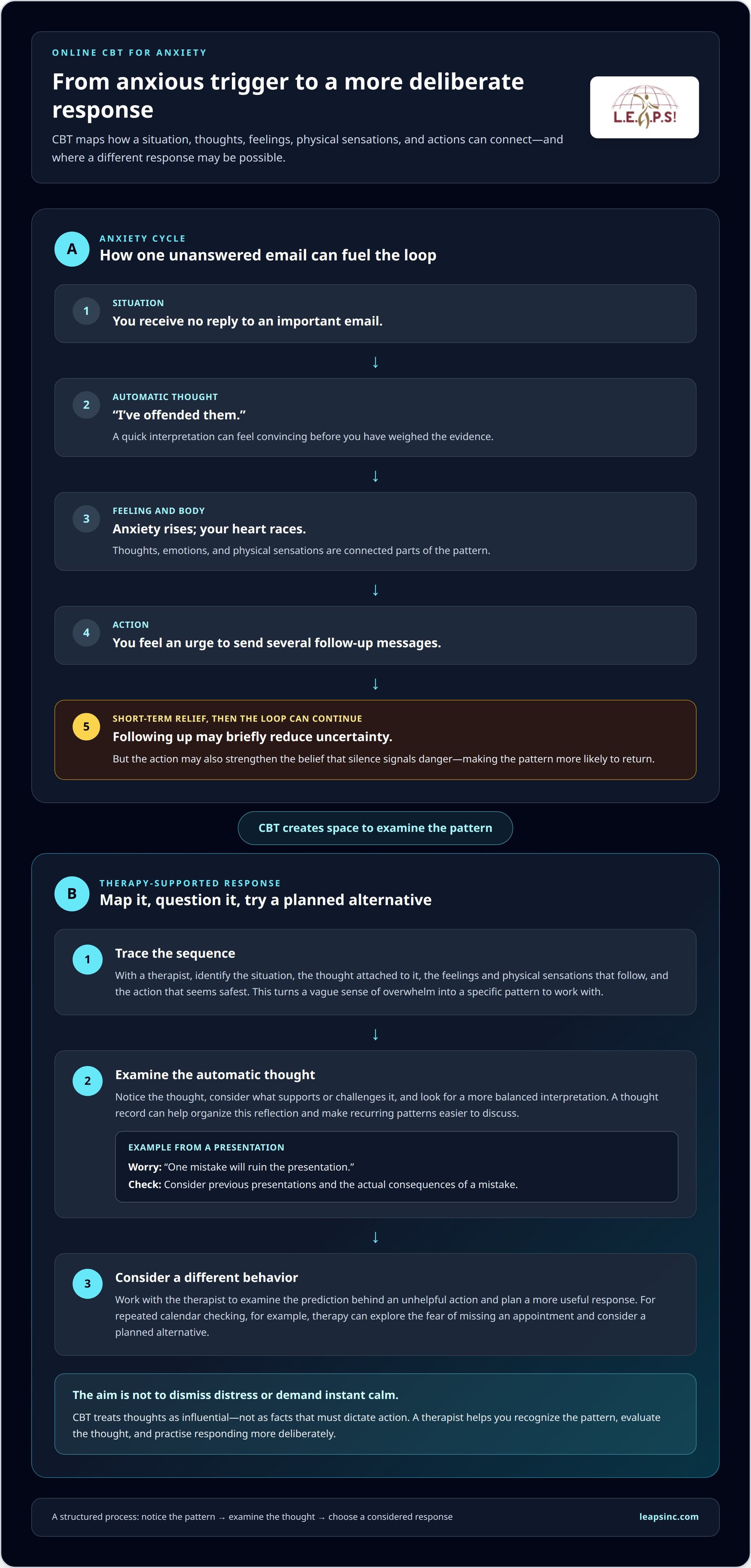
CBT examines how a situation can shape thoughts, feelings, bodily sensations, and actions. In a therapy session, tracing that sequence can reveal where a different response may be possible.
Consider receiving no reply to an important email. The automatic thought, “I’ve offended them,” may bring anxiety, a racing heart, and an urge to send several follow-up messages. Those actions can briefly reduce uncertainty, yet they may also strengthen the belief that silence signals danger. CBT helps map these connections rather than treating each reaction as separate.
The same sequence can work in reverse. Avoiding a meeting may lower anxiety immediately, but it can leave the feared prediction untested. A therapist helps examine the situation, the thought attached to it, the feelings and physical sensations that follow, and the action that seems safest. This map gives the person and therapist a specific pattern to work with, rather than a vague sense of being overwhelmed.
Thoughts, Feelings, and Actions
CBT looks at how an interpretation influences feelings and behavior. Before a presentation, the thought “I’ll lose my place” might increase fear and tension; cancelling could then bring short-term relief. The useful question isn’t whether the feeling is real, but what thoughts and actions are connected to it. Identifying that sequence in a session helps clarify which response may be reinforcing the anxiety.
Cognitive Restructuring and Automatic Thoughts
Automatic thoughts can appear quickly, before a person has time to weigh the evidence. Cognitive restructuring means noticing one of these thoughts, examining what supports or challenges it, and considering a more balanced interpretation. For example, “One mistake will ruin the presentation” can be considered alongside previous presentations and the actual consequences of a mistake. A thought record can help organize this process and make recurring patterns easier to discuss with a therapist.
Breaking Unhelpful Thought and Behavior Cycles
CBT addresses cycles by helping people recognize the thought or behavior that keeps anxiety active, then develop a more useful response. For instance, someone who repeatedly checks a calendar for fear of missing an appointment may feel temporary relief, followed by renewed doubt. Therapy can examine the prediction behind checking and consider a planned alternative. The goal is to learn new ways of responding, not dismiss distress or demand instant calm.
Throughout these steps, CBT treats thoughts as influential, not as facts that must dictate action. A therapist can help identify the pattern, evaluate the automatic thought, and consider a different behavior. This structured attention connects inner experience with everyday choices, building practical skills for responding more deliberately when anxiety appears.
Can I do CBT therapy online?
Online CBT for anxiety is therapist-supported talking therapy delivered digitally, with a clinician assessing concerns, setting goals, and guiding exercises. Insurance coverage depends on your plan and care arrangement; costs reflect session format and clinician, while choosing care means prioritizing a therapist licensed in your state with CBT experience for anxiety.
Therapist-Supported Online CBT for Anxiety
Self-guided CBT can help you learn concepts and practise structured exercises at home. A workbook may suggest completing one part per week, giving you time to reflect between sections. That structure doesn’t provide the same individualized guidance as therapy: a therapist can connect an exercise to your specific mental health concerns, discuss your responses, and help adjust the work when an exercise feels difficult or misses the underlying pattern.
In therapist-supported online CBT, sessions use digital conversations, reflections, and practical exercises to address specific concerns. A therapist may begin by asking when anxiety appears, what thoughts accompany it, and how it affects daily choices. Together, you can identify a focus, review progress, and develop skills suited to the situations you face. The format is online, but the work still depends on active discussion and a clear therapeutic direction.
Choosing Therapist-Supported Online CBT for Anxiety
Self-guided resources offer flexibility, while therapist support adds assessment, tailored feedback, and a space to work through barriers. Consider which format fits the complexity of your concerns and your ability to stay engaged independently. If several weeks of self-guided practice haven’t helped, or anxiety is interfering with daily activities, a therapist can help assess your needs and shape a more focused plan.
Self-awareness helps make that assessment concrete. For example, a therapist may explore whether anxiety centers on social situations, uncertainty, or recurring physical sensations, and how those patterns affect work, sleep, or relationships. These details help clarify treatment goals; they aren’t a diagnosis on their own. A therapist can use your account of triggers and responses to determine which CBT skills and exercises may be relevant.
Choosing a Licensed Online CBT Therapist
Start with the essential criteria: the therapist should be licensed in your state and experienced in CBT for anxiety. Ask how they assess concerns, set goals, and review progress during online sessions. A clear explanation of the process helps you understand the therapist’s approach before committing to care, while discussing privacy and session format can clarify how online meetings work.
Seek support when self-guided exercises leave important questions unanswered, when the same patterns persist, or when anxiety disrupts daily life. A therapist can assess those concerns and provide structured guidance rather than relying on a workbook alone. If you’re considering professional support, you can schedule an appointment to discuss your needs and therapy goals.
Online CBT compared with face-to-face treatment
Therapist-provided online CBT uses the same evidence-based principles as traditional therapy, delivered through digital sessions and exercises. Both formats can follow a structured treatment plan; the practical difference is how you meet and engage with the therapist.
Techniques and Treatment Goals
In either format, a therapist can tailor CBT techniques to the concerns identified during assessment. Goals might include responding differently to anxious predictions, reducing avoidance, or gradually approaching a feared situation. Online programs may combine therapist guidance with digital reflections and exercises; face-to-face care works through these goals in person. Look for a clear link between each technique and the specific change you want to make.
Treatment Duration and Progress
According to the American Psychological Association, CBT is often delivered in 5-20 sessions. That range is a guide, not a fixed schedule: treatment length can vary with your goals and circumstances. Progress is considered in relation to the concerns brought into therapy, such as whether you can approach a previously avoided task or respond to anxious thoughts with greater flexibility. The therapist can revisit goals and adjust the plan as treatment develops.
Online and in-person care can both provide a structured process, but the sessions may differ. Online work can include digital exercises and reflections alongside therapist guidance; face-to-face treatment keeps conversation and exercises within an in-person session. Either way, a personalized plan connects therapeutic techniques to situations that matter in your daily life, rather than relying on a general program alone.
Adherence to Online CBT
Online CBT treatment adherence is reported as 82%. Adherence describes participation in the treatment, not whether every participant reaches the same result. A useful plan makes expectations clear: what happens during sessions, which exercises support the work, and how progress will be discussed. Motivation can be easier to sustain when activities connect directly to a goal, such as taking part in a meeting that anxiety once led you to avoid.
Comparing Therapist-Provided Online CBT Options
Compare options by examining how the therapist builds your treatment plan, provides guidance, and reviews progress. Ask how a program balances teaching with individualized discussion, and whether the techniques address your specific anxiety patterns. In-person care offers meetings in the same physical setting; online care uses digital sessions and resources. The better fit depends on which setting helps you participate consistently and work toward meaningful goals.
Both formats can offer structured CBT with therapist involvement. Focus on the treatment process, the relevance of its techniques, and how progress is reviewed, rather than assuming that delivery format alone determines the quality of care.
Benefits and uses of CBT
CBT is a first-line treatment for anxiety disorders and is commonly used for depression, stress, panic attacks, and relationship difficulties. The National Institute of Mental Health identifies CBT as an evidence-based treatment for anxiety and depression. Its structured approach helps connect treatment goals with specific concerns, such as avoiding social situations or struggling to sleep before a demanding workday.
For anxiety, CBT can help someone recognize unhelpful thoughts and behaviors, then practise alternative responses. A person who repeatedly avoids speaking in meetings, for example, can work with a therapist to understand the fear and consider a gradual way to participate. The focus isn’t on forcing a positive thought. It’s on examining an interpretation, assessing what supports it, and choosing an action that better serves the person’s goals.
CBT can also address symptoms that affect daily routines. If stress makes it difficult to fall asleep, therapy can examine the thoughts and habits surrounding bedtime. If panic attacks lead someone to avoid driving, treatment can focus on the feared situation and responses that maintain avoidance. These examples show how CBT links a broad concern to observable patterns, making it easier to discuss what is changing and what still needs attention.
Relationship difficulties can involve anxiety, assumptions, and behavior that reinforces conflict. For example, someone who interprets a delayed reply as rejection might repeatedly seek reassurance or withdraw from a conversation. CBT can help examine that interpretation and explore a more constructive response. The goal isn’t to decide that every concern is unfounded; it’s to distinguish a reasonable concern from an automatic conclusion and act with greater clarity.
For depression and anxiety, CBT offers a framework for identifying problems and working through them step by step. The therapist and client can define a practical goal, such as returning to an activity that has been avoided, then review what happened and refine the approach. This process can build coping skills for emotional and behavioral challenges. Rather than measuring progress only by whether symptoms disappear, therapy can also consider changes in participation, daily functioning, and the ability to respond differently.
CBT’s range of uses makes it important to connect each technique to the concern being addressed. For one person, the priority may be panic symptoms; for another, it may be stress, low mood, sleep problems, or a strained relationship. A clear treatment focus helps keep the work relevant, while regular discussion allows goals to develop as new insights emerge. The central benefit is a practical method for turning awareness into more intentional choices.
Emotional regulation strategies
Emotional regulation in CBT means learning to notice feelings, understand what influences them, and choose a considered response. A therapist may help someone distinguish the feeling itself from the thinking attached to it. For example, anxiety before a difficult conversation is real, but the prediction “This will end the relationship” can be evaluated separately from the feeling.
One strategy is to identify the situation, the emotion, and the urge that follows. A therapist might explore what happens when a person receives critical feedback: tension rises, thinking turns toward failure, and the person avoids the next discussion. Naming each part helps clarify where a new response could interrupt the sequence. The purpose isn’t to suppress emotion, but to respond with greater awareness.
CBT can also help people evaluate interpretations instead of treating them as settled facts. In a work situation, “I made one mistake, so I’m incapable” turns a specific event into a sweeping conclusion. Therapy can examine what supports that thought, what evidence complicates it, and what a more balanced view might be. This process can support emotional regulation by changing how a situation is understood.
Another strategy involves gradually approaching situations that trigger anxiety. If someone avoids speaking in a group, a therapist may help plan a manageable step toward participating, then review what happened. Avoidance can provide immediate relief while leaving the feared prediction untested. A carefully considered approach allows the person to gather new information and build confidence through experience, rather than waiting for fear to vanish first.
These strategies can apply to anxiety, stress, and depression, though the therapist tailors the work to the person’s concerns. With depression, for example, treatment might examine how low mood affects engagement with meaningful activities and identify a realistic way to reconnect. Emotional regulation doesn’t mean feeling positive at all times. It means recognizing emotional signals, understanding the situation, and choosing actions aligned with personal goals.
The difference between reacting automatically and responding deliberately can be subtle at first. A therapist can help track what changes across situations: whether a person can stay in a conversation, reconsider a harsh self-judgment, or approach a previously avoided task. Reviewing these examples makes progress concrete and helps identify which strategies need refinement. The aim is greater flexibility, not perfect control over every feeling.
With professional guidance, emotional regulation strategies can become part of a focused plan for addressing anxiety and related challenges. Schedule an appointment to discuss your therapy goals and the support that fits them.
LEAPS
LEAPS Inc. offers professional therapy and coaching to support emotional well-being and personal growth. If anxiety is affecting your relationships or making daily decisions feel harder, a structured conversation can help clarify the concerns you want to address and the support that fits your goals.
Therapy Intensive, Group Therapy, and Family Therapy offer different settings for working through personal or relational challenges. Business Coaching supports leadership and organizational development when professional demands are part of the picture. Consider which area of life you want support with and what change you hope to work toward.
For a conversation about your needs and potential next steps, contact LEAPS Inc.
Take the Next Step Toward Greater Clarity
Choosing cognitive behavioral therapy for anxiety online can be part of a broader commitment to understanding what you need and moving toward it with intention. Before taking a next step, consider what you want daily life to make room for: a more confident voice at work, fuller participation in relationships, or the freedom to make decisions without anxiety setting every limit.
Those priorities can shape a meaningful conversation about support. You might describe the situations you want to handle differently, what you hope will change, and what questions you still have about therapy. You don’t need a perfect plan before reaching out. A clear starting point is enough to begin exploring a direction that aligns with your goals.
If you’re ready to discuss your therapy goals and questions, connect with LEAPS Inc. Your next step can be thoughtful, personal, and focused on the future you want to build.
Frequently Asked Questions
Does Online CBT Work for Anxiety?
Yes, online CBT can provide structured support for anxiety with a therapist’s guidance. For example, sessions can focus on a situation you’ve been avoiding, then help you set a specific goal for addressing it. Digital exercises and reflections can support the work between conversations. The value comes from connecting therapy activities to your concerns and reviewing how they fit your daily life, rather than simply completing online material.
What is cognitive behavioral therapy?
Cognitive behavioral therapy is a talking therapy that helps people address specific problems by examining how thoughts and actions affect their experiences. A therapist may help someone who dreads opening work messages identify what they expect to find and how that expectation shapes their response. Together, they can identify a practical goal and consider ways to approach the problem. CBT focuses on developing skills that can be applied beyond the session.
Can a therapist provide CBT online for use at home?
Yes, a therapist can guide CBT online while you participate from home. The therapist can discuss a concern, explain an exercise, and review how it relates to your everyday routine. For instance, if a difficult phone call is on your mind, you can discuss what you want to communicate and what might make the conversation challenging. Online sessions bring professional guidance into a setting where daily concerns arise.
Can a therapist provide CBT online for anxiety?
Yes. Cognitive behavioral therapy for anxiety online can involve a therapist who helps identify treatment priorities, select relevant exercises, and review your responses. If you feel anxious before making a phone call, a session might examine what you anticipate and what outcome you want. The therapist can then help shape an approach that fits that concern. Online delivery changes the meeting format, not the need for individualized attention.
How Effective is CBT?
CBT is an evidence-based treatment for anxiety and depression, and the National Institute of Mental Health identifies it as such. Its usefulness is assessed in relation to a person’s concerns and goals, rather than by assuming the same result for everyone. For example, someone may track whether they resume a meaningful activity or handle a challenging conversation differently. The therapist can review these changes and adjust the treatment focus as needed.
How much does CBT online cost?
Online CBT costs vary by clinician, session arrangement, and insurance coverage, so there isn’t one universal fee to apply. LEAPS Inc. offers self-pay, and insurance coverage may be available depending on your plan. Behavioral-health benefits can differ, so review your plan’s coverage details to understand your options. Cost is one consideration; the therapist’s approach and how the care fits your needs also matter when deciding on treatment.
Is CBT different from regular therapy?
CBT is one type of therapy, not a separate alternative to therapy. It often uses a structured approach focused on specific concerns, while other therapeutic approaches may explore experiences differently or emphasize other goals. For example, a person seeking help with recurring conflict might use CBT to work on a specific interaction pattern. The approach should make sense for the concern being addressed and the outcomes you want to pursue.
How effective is online CBT for anxiety compared with in-person therapy?
Both online and in-person care can involve therapist-guided CBT, but the setting shapes how sessions fit into your life. Consider whether digital meetings make it easier to attend consistently, or whether an in-person setting supports your focus better. Also consider how the therapist personalizes exercises and follows progress. These practical factors help you evaluate fit without assuming that a screen or a shared room determines the quality of care.