

Your “Sunday Scaries” aren’t a lack of resilience; they’re a physiological alarm system signaling that your professional destiny is under siege. You’ve likely felt the weight of being silenced in meetings or the confusion of navigating inconsistent leadership, wondering if you’re simply overreacting to standard pressure. You aren’t. With 68.9% of workers reporting signs of a toxic work environment in 2026, the reality is that systemic dysfunction often masquerades as a high-performance culture. It’s time to validate your experience and stop letting a misaligned organizational vision stunt your ultimate potential.
This article provides a strategic framework to help you categorize the toxicity you’re facing and protect your mental well-being. We’ll bridge the gap between therapeutic insight and executive strategy to identify red flags that threaten your inner life and professional credibility. By examining leadership accountability and organizational health, we’ll provide a clear roadmap for your emotional and professional recovery. You’ll gain the criteria needed to distinguish between temporary friction and a terminal culture, facilitating a move toward a peak state of fulfillment and purpose.
Key Takeaways
- Distinguish between high-performance pressure and systemic toxicity so your career trajectory doesn’t stall.
- Identify the ten critical signs of a toxic work environment, focusing on fear-based leadership and the subtle erosion of your professional autonomy.
- Recognize how workplace trauma impacts your mental health and personal relationships, highlighting the need for specialized emotional support.
- Master strategic methods to document organizational dysfunction while establishing the boundaries you’ll need to protect your professional destiny.
- Learn how a blend of therapy and executive coaching helps you reclaim your power and move toward a peak state of fulfillment.
Defining the Landscape: What is a Toxic Work Culture in 2026?
Workplace toxicity is more than a collection of bad days or a difficult manager; it’s a systemic failure where psychological safety and visionary alignment have completely eroded. In 2026, identifying the signs of a toxic work environment requires looking past surface-level friction to the structural rot beneath. It’s vital to distinguish between a high-pressure environment and a truly toxic work culture. High pressure often exists within a healthy framework where challenges lead to growth and achievement. Toxicity, however, is a destructive force that provides no purpose for the pain it inflicts.
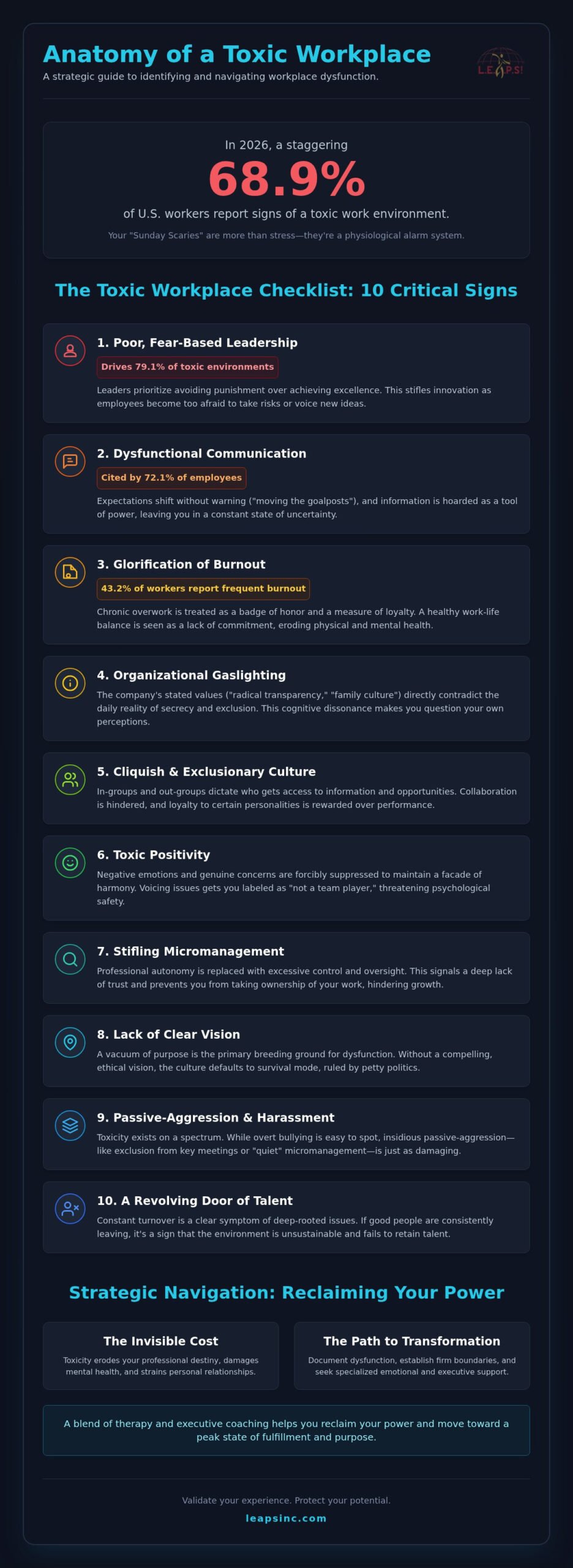
One of the most damaging elements of modern workplace dysfunction is organizational gaslighting. This occurs when the company’s stated mission directly contradicts the daily reality of the employees. You might be told the culture values “radical transparency” while being excluded from decisions that affect your career. This misalignment creates a cognitive dissonance that drains your mental energy and leaves you questioning your own perceptions. From the perspective of a Visionary Mentor, these dynamics aren’t just HR issues. They are active barriers to fulfilling your destiny and reaching your peak professional potential.
The Spectrum of Toxicity: From Subtle to Overt
Toxicity exists on a spectrum, and understanding its range is crucial for your professional survival. Overt toxicity is easily identified through harassment, bullying, or clear labor violations that demand immediate intervention. Subtle toxicity is often more insidious, manifesting as passive-aggression, exclusion from key meetings, or “quiet” micromanagement. A particularly pervasive trend in 2026 is the rise of toxic positivity. Toxic positivity is the forced suppression of negative emotions to maintain a facade of harmony. When you aren’t allowed to express genuine concerns without being labeled “not a team player,” the environment has become a threat to your emotional well-being.
Why Company Vision Matters
A vacuum of purpose is the primary breeding ground for dysfunction. When an organization lacks clear corporate visioning, it creates a space where petty office politics and fear-based leadership can thrive. Leaders are the architects of the emotional ecosystem. If they fail to provide a compelling, ethical vision, the culture defaults to survival mode. Linking your individual purpose to organizational health is not a luxury; it’s a strategic necessity. When the vision is absent or fractured, your professional development stalls, and your inner life begins to suffer the consequences of a mismatched destiny.
The Toxic Workplace Checklist: 10 Critical Signs of a Toxic Work Environment
Recognizing the signs of a toxic work environment requires more than just a gut feeling; it demands a strategic assessment of organizational health. In 2026, 68.9% of U.S. workers report navigating these dysfunctional landscapes, often struggling to name the specific red flags that hinder their growth. True toxicity isn’t just about a “bad boss” but a collection of systemic failures. According to 2026 research, poor leadership drives 79.1% of these environments, manifesting as fear-based decision-making where employees prioritize avoiding punishment over achieving excellence. When fear dictates the workflow, innovation dies and professional autonomy is replaced by stifling micromanagement.
Information hoarding is another hallmark of a culture in decline. In healthy organizations, data is a resource for collective growth; in toxic ones, it’s used as a tool of power and control. This lack of transparency often coexists with a “cliquish” culture where exclusionary social dynamics hinder collaboration and reward loyalty to personalities rather than the company vision. Furthermore, the glorification of burnout has become a dangerous metric of loyalty. With 43.2% of workers reporting frequent burnout, a workplace that treats chronic overwork as a badge of honor can quickly erode your professional destiny and physical health.
Communication Red Flags
Dysfunctional communication is cited by 72.1% of employees as a primary cause of workplace toxicity. This often manifests as “moving the goalposts,” where performance expectations shift without warning, leaving you in a state of perpetual uncertainty. You may notice an absence of healthy conflict resolution, replaced by “backchannel” gossip and passive-aggressive behavior. Utilizing group therapy frameworks can help you identify these systemic communication breakdowns, allowing you to depersonalize the dysfunction and protect your inner peace. If your daily interactions feel like a strategic minefield, you are likely operating in a high-conflict culture.
The Stagnation Signal
A toxic environment doesn’t just hurt your current well-being; it stunts your future potential. Stagnation occurs when professional development opportunities are limited or reserved for those who conform to toxic norms. You might find yourself burdened with “invisible labor”—high-effort tasks that carry no weight in performance reviews—while high-value projects are distributed based on favoritism rather than merit. If the path to advancement requires sacrificing your integrity or mental health, your growth has reached an artificial ceiling. If you are questioning your worth due to these dynamics, it is essential to schedule a consultation with a mentor who can help you reclaim your visionary power.
The Invisible Cost: How Toxic Dynamics Erode Your Professional Destiny
How do we quantify the destruction of a professional soul? While culture-driven turnover has cost U.S. businesses an estimated $223 billion, the personal cost for the individual is often immeasurable. High-achievers in “prestige” roles frequently fall into a specific trap, internalizing the signs of a toxic work environment as personal inadequacies rather than systemic failures. This internalization erodes your self-efficacy, making you believe that your inability to “fix” a broken system is a flaw in your own leadership or resilience. Over time, this cognitive distortion stunts your visionary thinking and replaces your burning desire for impact with a cold, hollow need for survival.
This psychological erosion often manifests as clinical anxiety or depression that feels impossible to shake. When 32.4% of workers report crying at work due to toxicity, the impact isn’t just a bad day; it’s a profound injury to your professional identity. This trauma rarely stays confined to the office. It bleeds into your evening hours and weekend recovery, often creating a desperate need for family therapy as the stress alters how you show up for those you love most. You lose the ability to be present, as your mind remains trapped in a loop of defending your worth against an environment designed to diminish it.
Physical and Emotional Manifestations
Physical symptoms are the body’s way of sounding the alarm before the mind fully acknowledges the threat. You might experience the “Sunday Scaries” not as mere dread, but as chronic cortisol elevation that disrupts sleep, impairs digestion, and fragments your cognitive focus. With 43.2% of workers feeling “always” or “often” burned out in 2026, these physical markers are clear indicators of an unsustainable ecosystem. Chronic workplace stress can lead to complex trauma requiring individual therapy.
The Cost of Compliance
Survival in a high-conflict culture often demands a “cost of compliance” that results in moral injury. You may find yourself witnessing or even participating in toxic dynamics just to maintain your position, a process that forces you to shrink your visionary thinking to fit into a narrow, safe space. This compromise stunts your long-term career confidence and makes you play “small” when you were meant for a peak state of fulfillment. Understanding why people go to therapy for personal and professional growth is the first step in reclaiming the destiny that toxicity tried to steal. You must stop adapting to dysfunction and start planning your strategic evolution.
Strategic Navigation: Reclaiming Your Power in a High-Conflict Culture
Reclaiming your agency in a dysfunctional workplace requires a shift from reactive survival to proactive strategy. When you recognize the signs of a toxic work environment, your primary objective must be the preservation of your professional destiny. This isn’t about “fixing” a broken culture; it’s about insulating your inner life and preparing for a visionary leap. You must move from being a target of dysfunction to becoming the architect of your own exit. This transition involves a methodical approach to documentation, boundary setting, and external auditing.
- Step 1: Document everything. Shift from emotional reaction to objective data collection. By recording dates, times, and specific interactions, you transform a nebulous emotional weight into a structured dataset. This documentation serves as your armor, providing the evidence needed for legal counsel or HR interventions.
- Step 2: Establish psychological and professional boundaries. You must preserve your energy for the people and projects that actually serve your purpose. This means declining non-essential “invisible” labor and protecting your non-working hours with clinical precision.
- Step 3: Seek external perspective. Toxicity often warps your perception of reality. Utilizing executive coaching allows you to audit your situation through a neutral, expert lens, ensuring that your next move is strategic rather than desperate.
- Step 4: Build your Exit Vision. Align your next move with your core values rather than just running away from pain. A well-defined exit strategy ensures that you move toward growth, not just away from toxicity.
Setting Boundaries as a Strategic Act
In high-conflict cultures, boundaries are often viewed as provocations. To navigate this, you can employ the “Gray Rock” method. This involves becoming as uninteresting and non-responsive as possible to toxic individuals, effectively starving them of the emotional reactions they crave. You must communicate limits on your availability without inviting retaliation; do this by framing your boundaries around productivity and organizational goals. To ensure these limits align with your long-term purpose, consult our Strategic Guide on identifying your core professional values. When your boundaries are rooted in a clear vision, they become harder for others to breach.
Leveraging Support Systems
You shouldn’t navigate a career crisis in isolation. Many organizations provide an Employee Assistance Program (EAP) that offers confidential support for mental health and workplace stress. While these programs are proactive wellness solutions, they’re only one piece of the puzzle. Mentorship outside your current ecosystem is vital for maintaining a sense of what “normal” professional excellence looks like. If you find that the stress is manifesting as chronic physical symptoms or a complete loss of self-efficacy, it’s time to transition from self-help to professional clinical intervention. You don’t have to wait for a total collapse to schedule a consultation and begin your recovery. Your potential is too valuable to be sacrificed to an environment that cannot see your worth.
From Toxicity to Transformation: Building a Visionary Work Life
Your professional destiny is not a casualty of your current circumstances; it’s a vision waiting for a strategic catalyst to unlock its potential. LEAPS Inc. serves as this catalyst, bridging the gap between clinical recovery and executive advancement through a dual-pathway approach. When you’ve spent years navigating the signs of a toxic work environment, your internal compass often requires a profound recalibration to distinguish between healthy challenge and systemic rot. This is where understanding the nuance of therapy vs coaching becomes vital for your evolution. While therapy heals the deep wounds of workplace trauma and moral injury, coaching prepares you to wield your power with precision in your next high-level role. For those who need to break the cycle of burnout and stagnation quickly, a Therapy Intensive provides a concentrated, secure space for rapid emotional recalibration. This structured intervention allows you to process years of organizational dysfunction in a matter of days, clearing the path for a future defined by purpose rather than pain.
Healing the Internal Narratives
Toxic feedback is a form of psychological architecture. It builds an “insufficient” narrative that can haunt even the most accomplished leaders long after they’ve left a dysfunctional office. You must actively deconstruct these stories through expert clinical support to rebuild a visionary mindset that isn’t clouded by past failures. This process isn’t just about emotional relief; it’s about strategic preparation. By addressing the internal depth of your experience, you prepare the emotional ground for your next peak state of fulfillment. You ensure that you don’t carry the reactive baggage of a previous toxic culture into your next leadership opportunity, allowing you to lead with clarity and visionary energy.
Designing Your Next Chapter
Transformation means moving from a state of defensive survival to a state of visionary creation. For many high-achievers, this involves utilizing entrepreneurship coaching to build their own visionary culture from the ground up. This ensures that the dysfunction you survived never takes root in the organizations you lead. For those committed to staying and leading the change from within, the “Leadership Impact Intensive” offers a structured framework to transform a fractured ecosystem into a model of psychological safety. Your destiny is defined by your response to these signs of a toxic work environment, not by the environment itself. It’s time to stop adapting to dysfunction and start designing your next chapter. Schedule a consultation to begin your transformation and reclaim your professional power today.
Reclaim Your Professional Destiny
Recognizing the signs of a toxic work environment is the first step in a larger strategic evolution. You’ve learned that workplace dysfunction isn’t a personal failure but a systemic misalignment that stunts your visionary potential and erodes your well-being. By establishing firm boundaries, documenting organizational failures, and seeking external auditing, you can move from a state of survival to one of peak fulfillment. Recovery requires a holistic approach that addresses both the psychological trauma of high-conflict cultures and the strategic needs of your career trajectory.
LEAPS Inc. provides the dual-pathway expertise needed for this transformation. Our national reach combines clinical therapy with executive coaching, offering specialized Therapy Intensives for rapid emotional recalibration. We don’t just help you survive a difficult office; we act as your Visionary Mentor to help you design a career that aligns with your ultimate purpose. Your current environment is merely a chapter, not the final destination of your professional life. You possess the power to choose a path that honors your expertise and your humanity.
Ready to reclaim your visionary potential? Schedule your consultation with LEAPS Inc. today.
Frequently Asked Questions
What are the most common signs of a toxic work environment?
Common signs of a toxic work environment include fear-based leadership, chronic overwork, and the complete erosion of psychological safety. You might notice that information is used as a tool of power rather than a resource for collective growth. Cliquish social dynamics and the glorification of burnout are also frequent indicators. These elements create a persistent state of high-stress that hinders your professional destiny and prevents you from reaching your peak potential.
Can a toxic work environment cause PTSD or trauma?
Prolonged exposure to workplace toxicity can lead to complex trauma and symptoms mirroring PTSD. When you’re constantly subjected to harassment, bullying, or organizational gaslighting, your nervous system remains in a state of hyper-arousal. This can manifest as chronic anxiety, depression, or a total loss of self-efficacy. Individual therapy is often necessary to deconstruct these internal injuries and reclaim your emotional well-being after experiencing the deep wounds of a dysfunctional culture.
How do I deal with a toxic boss if I can’t quit my job right now?
Dealing with a toxic manager requires a shift to strategic preservation. You should document every interaction objectively to move from emotional reaction to data collection. Employ the “Gray Rock” method by remaining uninteresting and non-responsive to their provocations. Focus on building an “exit vision” and seeking external mentorship to maintain your perspective. Utilizing an Employee Assistance Program (EAP) can also provide a secure, confidential outlet for support while you plan your transition.
What is the difference between a high-pressure job and a toxic one?
The primary difference lies in the presence of psychological safety and visionary alignment. High-pressure roles offer challenges that lead to achievement and growth within a supportive framework. In contrast, toxicity is destructive and provides no purpose for the pain it inflicts. While a high-pressure job might demand excellence, a toxic one demands compliance at the cost of your integrity. Identifying the signs of a toxic work environment involves looking for patterns of fear rather than patterns of performance.
Should I report a toxic work environment to HR?
Reporting to HR should be a strategic decision based on your documentation and the specific labor violations occurring. It’s important to remember that HR’s primary function is to protect the organization’s interests. If you choose to report, ensure your evidence is objective and focuses on how the toxicity impacts productivity or violates policy. Seeking executive coaching before this step can help you audit the situation and decide if reporting aligns with your long-term career goals.
How can therapy help me recover from a toxic workplace?
Therapy facilitates recovery by helping you deconstruct the “not enough” narratives created by toxic feedback. A Therapy Intensive can provide rapid emotional recalibration, allowing you to process workplace trauma in a concentrated, secure setting. Clinical support helps you rebuild your visionary mindset and restores your sense of self-worth. By addressing the internal depth of your experience, you ensure that you don’t carry the baggage of a previous toxic culture into your next high-level role.
What are the signs of gaslighting in the workplace?
Workplace gaslighting occurs when leadership or colleagues cause you to doubt your own perceptions of reality. Signs include being told you “misunderstood” clear instructions, being excluded from meetings where your work is discussed, or facing “moving goalposts” on performance expectations. This organizational gaslighting creates a cognitive dissonance that drains your mental energy. It often involves a mission statement that directly contradicts the daily reality of the employees, leaving you feeling silenced and undervalued.
How do I set boundaries in a culture that doesn’t respect them?
Setting boundaries in a resistant culture is a strategic act of professional insulation. You must communicate limits on your availability by framing them around productivity and organizational impact. For example, you might decline non-essential “invisible labor” to protect your focus on high-value projects. While the culture might not respect your limits, your consistent adherence to them preserves your energy for your ultimate purpose. Professional coaching can help you develop the resilience needed to maintain these boundaries.