
Table of Contents
- The Challenge Entrepreneurs Face with Unstructured Business Models
- Why Your Business Model Matters More Than Your Idea
- How We Approach Entrepreneur Business Model Coaching at LEAPS Inc.
- Assessing Your Current Business Model and Market Fit
- Designing Systems That Support Sustainable Growth
- Overcoming Emotional and Leadership Barriers to Implementation
- Building a Resilient Financial and Operational Framework
- Scaling Your Model While Maintaining Your Vision
- The Role of Leadership Development in Business Model Success
- Real-World Application: From Theory to Actionable Results
- Your Path Forward: Starting Your Business Model Transformation
- Frequently Asked Questions (FAQ)
The Challenge Entrepreneurs Face with Unstructured Business Models
You’ve launched your business with passion and a solid idea. Your product works. Your initial customers are happy. Yet something feels unstable. Revenue fluctuates. You’re burning out managing operations that should run themselves. You sense that without structural changes, growth will stall or collapse.
This is where many entrepreneurs get stuck. They confuse having a good product with having a sustainable business model. At LEAPS Inc., we’ve worked with dozens of founders and business owners facing this exact tension. The good news: a clear business model is learnable, designable, and implementable. It’s not magic. It’s strategic architecture combined with the leadership capacity to execute it.
Most entrepreneurs start with a problem they’re passionate about solving. They build a solution, launch, and begin serving customers. What they rarely invest time in is designing the underlying business model: how customers find you, how revenue flows, what it costs to deliver, and whether the math works at scale.
Without clarity here, several predictable problems emerge:
- Revenue becomes unpredictable because customer acquisition relies on luck or personal hustle rather than repeatable systems
- Operating costs creep upward without clear visibility into profitability by product line or customer segment
- You become the bottleneck: the business depends on your personal effort rather than documented processes
- Leadership decisions get made emotionally rather than data-driven, creating whiplash and team confusion
- Growth feels risky because you can’t confidently forecast what will happen if you double your customer base
The hidden cost isn’t just financial. Entrepreneurs working in unstructured models often report exhaustion, anxiety about sustainability, and a creeping sense that they’re not actually in control of their own business. Over time, this emotional weight creates decision paralysis and erodes the confidence needed to scale deliberately.
Why Your Business Model Matters More Than Your Idea
We see this distinction repeatedly: the entrepreneur with a mediocre idea and a brilliant business model will outpace the founder with a brilliant idea and a broken model.
Your business model is the mechanism through which your idea creates value and captures revenue. It answers:
- Who are your ideal customers and how do they find you?
- What problem are you solving and why will they pay for it?
- What does delivery cost and what margin remains?
- How do you retain customers and expand their lifetime value?
- What processes and systems must exist for the business to run without you?
A clear model gives you a strategic filter. When opportunities arise—new product ideas, channel partnerships, geographic expansion—you can evaluate them against your model instead of chasing every shiny object. This clarity alone accelerates growth because you move with intention rather than reactivity.
Additionally, a documented model becomes your communication tool. Your team understands what success looks like. Investors see viability. Customers understand why you’re structured the way you are. You transform from “a solo operator with a good idea” into “a founder building an enterprise.”
How We Approach Entrepreneur Business Model Coaching at LEAPS Inc.
Our entrepreneurship coaching process integrates strategic business architecture with leadership development. We recognize that your business model exists within you: your mindset, habits, decision-making patterns, and emotional resilience directly shape what you build and how sustainable it becomes.
Here’s how we work:
Strategic Clarity Phase: We map your current model using proven frameworks. Where is revenue actually coming from? What’s your true customer acquisition cost? What percentage of revenue is profit? This isn’t theoretical. We use real numbers from your business.
Model Design Phase: Based on your goals, resources, and market position, we design a target model that’s ambitious yet achievable. We stress-test assumptions and identify what must change operationally to make the model work.
Leadership and Implementation Phase: Here’s where most coaching falls short. Knowing what to do and actually doing it are different challenges. We work with you on the emotional, behavioral, and organizational barriers that prevent implementation. How do you build and lead a team that executes this model? How do you manage the anxiety of growth? How do you stay aligned with your original vision while scaling?
Unlike generic business coaching, we don’t treat your psychology as separate from your business strategy. The habits, beliefs, and emotional patterns that show up in your entrepreneurial decisions matter. When you understand them, you make better choices faster.
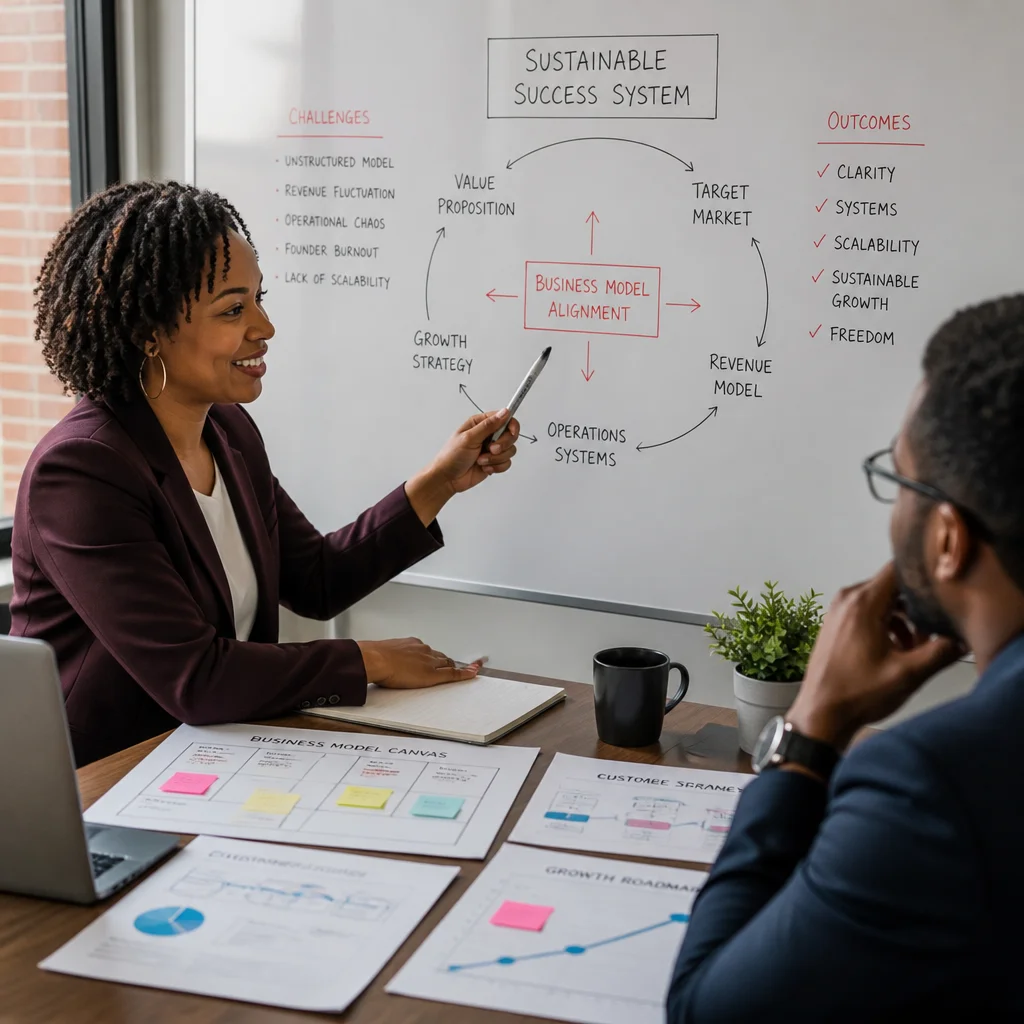
Assessing Your Current Business Model and Market Fit
Before designing anything new, you need honest visibility into what’s working and what’s not.
Start with these diagnostics:
Revenue Reality Check: Track where your last 20 customers came from. Not broad categories like “marketing.” Specific sources. How much did each acquisition actually cost? What’s your repeat purchase rate? This reveals whether your model is sustainable or whether you’re on a customer treadmill.
Unit Economics: Calculate the true cost to deliver one unit of your product or service. Include direct costs, allocated overhead, and the time you personally spend. Multiply by typical customer volume. Does the math work? If you doubled customers tomorrow, would profit increase proportionally, or would costs spike?
Customer Concentration: What percentage of revenue comes from your top five customers? If it’s more than 40%, your model is fragile. A single customer loss becomes a crisis.
Operational Dependency: List every critical function. For each, answer: if you disappeared tomorrow, would this get done? Could someone else do it? Is there a documented process? Functions where the answer is “no” represent scaling bottlenecks.
This assessment isn’t about shame. Many early-stage businesses fail this audit. The value is in seeing clearly, which empowers intentional change.
Designing Systems That Support Sustainable Growth
Once you understand where you are, design deliberate systems for where you’re going.
A sustainable model has repeatable systems across five domains:
Customer Acquisition: Define your ideal customer profile in detail. How will they discover you consistently and predictably? What marketing channels align with your resources? What’s your target cost per acquisition?
Delivery Excellence: Document your core process. What steps transform a customer’s problem into a solved state? Where do delays or errors typically occur? What can be automated or templated?
Revenue Retention: How will you keep customers coming back? What triggers expansion or upsell? How will you identify and prevent churn?
Financial Management: Set up systems that give you weekly visibility into cash, revenue, and profitability. Most entrepreneurs fly blind on financials. Real-time visibility changes your decision-making entirely.
Team and Culture: Define roles, responsibilities, and decision authorities. What does your ideal team look like at your next revenue milestone? What values guide how you work together?
Each system needs an owner, metrics, and regular review cycles. This isn’t bureaucracy for a startup. It’s the difference between a business and a lifestyle business.
Overcoming Emotional and Leadership Barriers to Implementation
Here’s what we know from working with hundreds of entrepreneurs: clarity isn’t the problem. Most founders can design a solid model when guided. Implementation is where things break down.
Common barriers include:
- Fear of delegating work (control and perfectionism)
- Discomfort with systematic thinking (preferring intuition)
- Anxiety about forecasting and commitment (uncertainty avoidance)
- Guilt about prioritizing some customers over others (people-pleasing patterns)
- Self-doubt about whether the model will actually work (imposter thinking)
These patterns aren’t character flaws. They’re usually adaptive responses from earlier life experiences. A perfectionist might have learned that love was conditional on achievement. A people-pleaser might have learned that their worth depends on others’ approval.
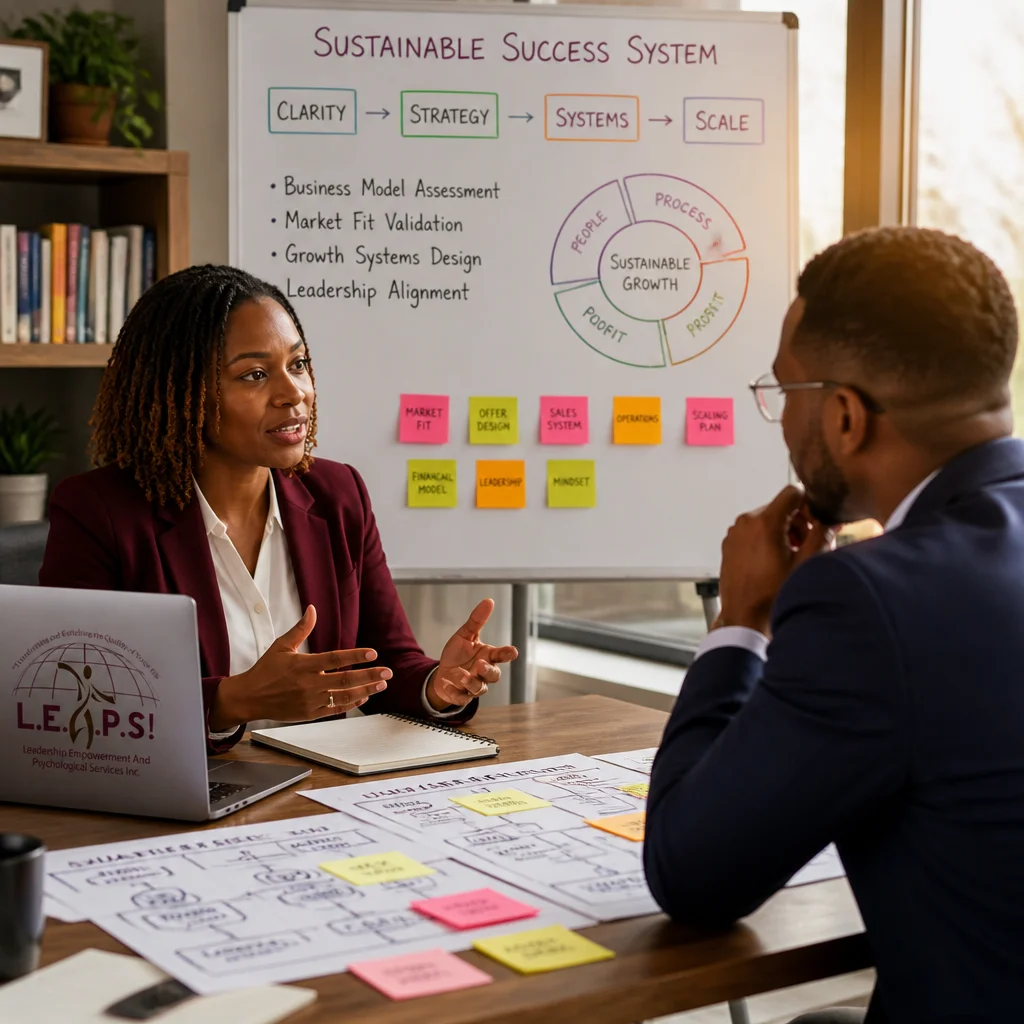
When you’re designing a business model, these patterns emerge. The perfectionist resists delegating because they fear quality will drop. The people-pleaser struggles to set boundaries with customers, eroding margins. The risk-avoider freezes when asked to commit to growth targets.
Sustainable business model implementation requires you to understand these patterns, not fight them. You learn where they serve you and where they sabotage you. This self-awareness accelerates change because you’re not white-knuckling against yourself.
Building a Resilient Financial and Operational Framework
Your business model lives in spreadsheets and processes, but it must be built on solid financial foundations.
A resilient framework includes:
Cash Flow Projections: Model three years ahead. How much cash do you need to reach profitability? When? What happens if growth is 50% slower than projected? Having answers before crisis hits keeps you calm and strategic.
Profitability by Customer or Product: Not all revenue is created equal. Some customers are profitable, others aren’t. Some products have healthy margins, others are margin-killers. Track this ruthlessly. It guides which opportunities to pursue and which to decline.
Operational Scalability: As revenue grows, does your cost structure grow proportionally? Ideally, fixed costs stay relatively flat while revenue rises. If you hire proportionally to every dollar of new revenue, you’ll never be profitable. Build leverage into your model through technology, templates, or systematized delivery.
Contingency Planning: What happens if your largest customer leaves? If a key team member quits? If the market shifts? Build redundancy into customer acquisition and have documented responses to crises. This isn’t pessimism. It’s prudent design.
Scaling Your Model While Maintaining Your Vision
Growth can corrupt a business model. Pressure to scale often pushes founders toward customers or markets that don’t align with the original vision. Margins erode. Culture dilutes. The business that felt purposeful becomes just another thing.
Intentional scaling requires clarity on non-negotiables: what aspects of your business model must never change, and what aspects must evolve?
Non-negotiables might include your core values, quality standards, or customer experience. Everything else is potentially negotiable if it serves sustainable growth. You might shift from direct service to productized service, or from B2B to B2C, but your core principle stays intact.
Set a scaling hypothesis: “If we maintain X quality while moving to Y channel and serving Z customer type, we can grow to [target revenue] while keeping profitability at [target margin].” Then test it with real customers before fully committing resources. This prevents scaling mistakes.
Regular reflection keeps you grounded. Quarterly, ask: Are we still solving the original problem? Are we serving customers we’re genuinely equipped to serve? Are we making decisions aligned with our values? Scaling without this reflection often leads to burnout because you’ve built something that no longer reflects who you are.
The Role of Leadership Development in Business Model Success
Your business model is only as strong as your capacity to lead its execution.
As a founder, you wear many hats: visionary, decision-maker, team builder, fundraiser, strategist. The skills required for launch differ dramatically from the skills required for scale. Many founders plateau not because their model is flawed but because their leadership development hasn’t kept pace with their business growth.
Key leadership capacities for sustainable models include:
- Strategic thinking: ability to stay focused on the model while managing daily fires
- Emotional regulation: capacity to remain calm and clear during uncertainty and setbacks
- Delegation: trusting others and building accountability without micromanaging
- Communication: articulating the model and vision so your team understands and aligns
- Resilience: bouncing back from setbacks and learning from failures without losing momentum
These aren’t innate traits. They’re learnable skills, and our coaching focuses on developing them deliberately. When your leadership capacity matches your business ambitions, execution becomes natural rather than forced.
Real-World Application: From Theory to Actionable Results
Let’s ground this in an example. Consider a service-based entrepreneur we worked with: a marketing consultant generating $200K annually through one-on-one client work. Revenue felt good, but 80% came from one referral source. Growth had stalled. She worked constantly and felt burnt out.
Her initial model: “I help small businesses with marketing strategy. I charge hourly. More hours equals more revenue.”
We diagnosed the problem: The model was entirely dependent on her personal time. As long as her value came from her expertise, she couldn’t scale without burning out further.
We designed a new model: Productize the core framework into a signature offer (three-month intensive), hire contractors for implementation support, build a referral system with specific trigger points for outreach, and create a scalable revenue stream through group workshops.
The shift required leadership changes: She had to move from “I’m the expert doing the work” to “I’m the architect designing systems others execute.” This triggered control anxieties and imposter feelings initially.
Within 18 months, revenue tripled while her direct hours decreased by 40%. The business became profitable even without her. Equally important, she felt energized rather than depleted.
This outcome wasn’t luck. It was systematic design combined with conscious leadership development.
Your Path Forward: Starting Your Business Model Transformation
If your current model feels unstable or limiting, here’s where to start:
Week One: Document your current model honestly. Where does revenue come from? What does delivery cost? What percentage of revenue is genuine profit? Where are you dependent on personal effort? Spend two hours on this. Accuracy matters more than perfection.
Week Two: Identify three specific ways your model limits growth. Is it customer acquisition? Delivery scalability? Financial margins? Team capacity? Pick the biggest constraint.
Week Three: Design one small change that addresses that constraint. Test it with a few customers or over one cycle. Gather feedback.
This iterative approach beats perfectionism. You learn by doing, not by endless planning. We’re here to guide this process and help you work through the emotional and strategic dimensions together.
At LEAPS Inc., we understand that building a sustainable business model isn’t just a business strategy challenge. It’s a personal development journey. As you design stronger systems, you grow as a leader. As you address the emotional patterns that have held you back, your business model becomes more innovative and resilient.
Your next step is to have a conversation about where you are and where you want to go. Let’s explore whether our approach aligns with your vision.
Call us today for a free 15 minute consultation.
Frequently Asked Questions (FAQ)
What makes your entrepreneur business model coaching different from general business consulting?
We combine strategic business development with executive coaching and emotional intelligence work. Our approach recognizes that sustainable business models require both sound systems and aligned leadership, so we address the internal barriers—like perfectionism, fear of delegation, or burnout—that often sabotage implementation. We’ve found that entrepreneurs with solid strategies still struggle without this integrated foundation.
How long does it typically take to develop and implement a new business model with your coaching?
The timeline depends on where you’re starting, but we typically work with entrepreneurs over 3 to 6 months for meaningful model redesign and initial implementation. We guide you through assessment of your current structure, design of sustainable systems, and the leadership shifts needed to execute effectively. Most clients see actionable progress within the first 8-12 weeks.
Do you work with early-stage startups, or do you focus only on established businesses looking to scale?
We work with entrepreneurs at all stages, from those launching their first venture to established leaders scaling existing models. Whether you’re building your initial structure or redesigning for growth, we help you create systems that align with your vision while addressing the real obstacles you face in execution.