
Table of Contents
- The Hidden Crisis: Understanding Caregiver Burnout in Faith-Centered Professionals
- Why Traditional Burnout Solutions Miss the Mark for Faith-Driven Caregivers
- The Spiritual Dimension of Caregiver Exhaustion
- How We Integrate Faith and Evidence-Based Therapy for Sustainable Healing
- Our Comprehensive Approach to Restoring Purpose and Professional Resilience
- Leadership Empowerment Through Intentional Caregiver Recovery
- Taking the First Step Toward Restored Wholeness
- Frequently Asked Questions (FAQ)
The Hidden Crisis: Understanding Caregiver Burnout in Faith-Centered Professionals
Caregiver burnout among faith-centered professionals—nurses, counselors, clergy, social workers, and healthcare leaders—represents a quiet crisis we’re witnessing across our communities. These individuals entered their vocations driven by a calling rooted in compassion and service, yet many now find themselves emotionally drained, spiritually depleted, and struggling to recognize the purpose that once sustained them.
The burnout statistics are sobering. Research consistently shows that healthcare workers and faith leaders experience burnout rates significantly higher than the general population. But for those whose work is inseparable from their faith identity, the exhaustion cuts deeper. It’s not just professional fatigue; it feels like a betrayal of the spiritual foundation that once energized them.
Consider Sarah, a hospice nurse and devoted Christian who spent fifteen years providing end-of-life care with grace and presence. After a particularly difficult patient loss, she found herself unable to pray, unable to feel the connection to her faith that had always sustained her, and questioning whether continuing in her role was even possible. She wasn’t experiencing typical job stress—she was experiencing a fracture in the spiritual bedrock of her calling.
This scenario plays out repeatedly across faith communities and healthcare settings. High-achievers who chose service-oriented careers often struggle to admit when they’re struggling, fearing judgment or viewing their burnout as a personal or spiritual failure rather than what it actually is: a natural consequence of prolonged emotional labor without adequate support and restoration.
Why Traditional Burnout Solutions Miss the Mark for Faith-Driven Caregivers
Standard burnout interventions—wellness apps, time-management workshops, generic stress-reduction protocols—often fall short for faith-centered professionals. Why? Because they address the symptoms of exhaustion without acknowledging the unique spiritual and existential dimensions that shape a caregiver’s sense of meaning and purpose.
A meditation app that encourages “letting go of stress” may actually conflict with a Christian caregiver’s theology of offering burdens to God in prayer. A boundary-setting workshop that emphasizes protecting personal time might create guilt in someone whose faith tradition values self-sacrifice. Generic solutions feel disconnected from the deeper conflict these professionals are actually experiencing.
What gets missed in conventional approaches is the central question burning beneath the surface: “If I’m living out my faith through my calling, why do I feel so empty?” This isn’t a productivity problem or a time-management issue. It’s an integration problem—a disconnect between what they believe and what they’re experiencing in their body, heart, and spirit.
Faith-centered caregivers also face unique social pressures. Religious communities sometimes carry unspoken expectations that “true faith” should sustain you indefinitely, that burnout signals weak trust or insufficient prayer. This cultural messaging can trap caregivers in shame, preventing them from seeking help and intensifying the very isolation that deepens burnout.
We’ve learned that sustainable healing requires acknowledging these spiritual and relational dimensions explicitly, not brushing past them with secular wellness language.
The Spiritual Dimension of Caregiver Exhaustion
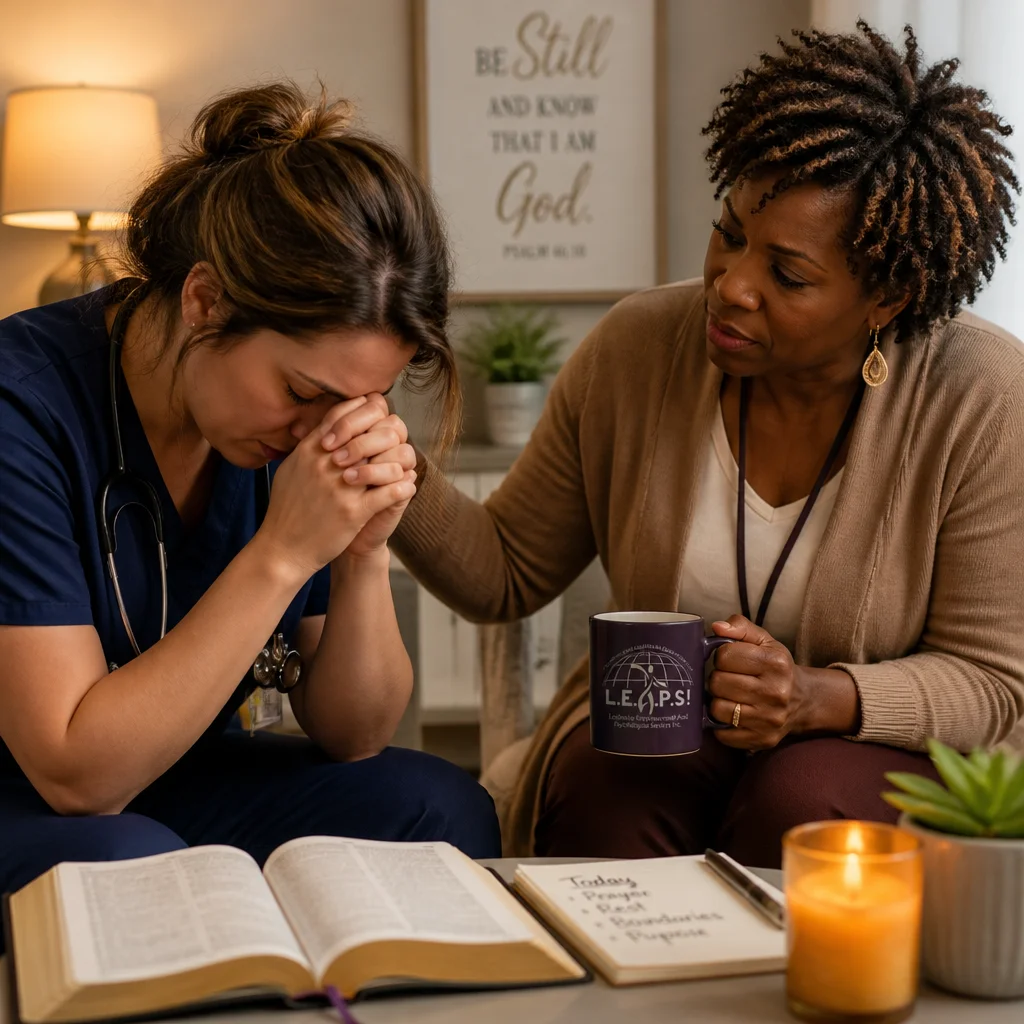
Burnout in faith-centered professionals isn’t purely emotional or physical—it’s deeply spiritual. When someone’s identity, calling, and faith all converge in caregiving work, exhaustion becomes intertwined with questions about God’s presence, personal worth, and the meaning of suffering.
Many caregivers experience what we might call “compassion fatigue with spiritual texture.” They’ve absorbed the pain of those they’ve served—and because their faith teaches them that suffering matters and that presence with the suffering honors God’s love—they often carry that emotional weight as a spiritual responsibility rather than recognizing it as a form of vicarious trauma that requires active recovery.
The spiritual dimensions at play often include:
- Loss of spiritual consolation and felt connection to faith practices
- Conflicted feelings about suffering and theodicy (why God allows pain)
- Grief that their calling, once life-giving, now feels like obligation
- Questions about their worthiness, competence, or faithfulness
- Moral injury when systemic constraints prevent the quality of care their ethics demand
- Spiritual bypassing, where faith language is used to suppress legitimate emotional needs
A Christian social worker might feel condemned by Scriptures about “bearing one another’s burdens” while secretly resenting the relentless emotional demands of her clients. A clergy member might preach about God’s peace while privately doubting whether God is present at all. These contradictions create internal fractures that standard therapy often doesn’t address.
Healing happens when we create space to acknowledge both the spiritual reality of their calling and the honest, sometimes uncomfortable emotions beneath it—without requiring them to resolve this tension through more faith or harder work.
How We Integrate Faith and Evidence-Based Therapy for Sustainable Healing
At LEAPS Inc., we bring together evidence-based therapeutic practices with genuine respect for faith as a central organizing principle of meaning and healing. This isn’t about imposing religious frameworks onto clinical work; it’s about honoring what our clients actually believe while providing rigorous psychological and spiritual support.
Our approach integrates several layers:
Clinical understanding of trauma and burnout: We work with validated frameworks for understanding compassion fatigue, vicarious trauma, and occupational stress—recognizing caregiver burnout as a real psychological condition that deserves clinical attention.
Theological literacy: Our therapists understand Christian theology, faith traditions, and spiritual frameworks well enough to dialogue meaningfully with clients about how their suffering fits (or doesn’t fit) their understanding of God and redemption.
Somatic and emotional processing: We help caregivers access and process the grief, anger, fear, and loss that often remain unspoken because faith language sometimes discourages emotional expression.
Faith-integrated counseling practices that honor the client’s actual beliefs while gently challenging unhelpful spiritual narratives (like the idea that burnout reflects weak faith or that caregivers shouldn’t need restoration).
Through this integration, we help caregivers move from “I should be able to handle this” to “This is human; I deserve support,” and from “My faith should sustain me indefinitely” to “My faith includes room for healing, rest, and honest struggle.”

Our Comprehensive Approach to Restoring Purpose and Professional Resilience
Restoring a burned-out caregiver requires more than addressing symptoms. We work to rebuild the integrated foundation—spiritual, emotional, relational, and practical—that allows sustainable caregiving.
Our comprehensive approach includes:
Individual therapy focused on processing burnout and vicarious trauma, exploring the relationship between faith and suffering, and rebuilding sense of self beyond the caregiving role.
Executive and leadership coaching for healthcare administrators and faith leaders navigating the paradox of leading others while managing their own depletion. This includes strategic conversations about organizational culture, boundary-setting with integrity, and modeling sustainable leadership.
Intensive retreat experiences that offer deeper, immersive work. These allow caregivers to step away from daily demands, access restored spiritual grounding, and develop concrete practices for ongoing resilience.
Skills training in specific areas like emotional regulation, spiritual practices that genuinely replenish (not further obligate), boundary-setting with compassion, and meaning-making practices that help integrate difficult experiences.
Couples and family work when caregiver burnout is affecting primary relationships, helping partners understand the spiritual and emotional dimensions and rebuild connection.
Throughout this work, we emphasize that restoration is not selfish; it’s faithful stewardship of the life and calling you’ve been given. A caregiver who ignores their own depletion isn’t being sacrificial—they’re eventually becoming unavailable to those who need them most.
Leadership Empowerment Through Intentional Caregiver Recovery
For healthcare leaders, faith leaders, and organizational decision-makers, supporting caregiver wellbeing isn’t a peripheral concern—it’s central to organizational health and mission fulfillment.
Organizations that take caregiver burnout seriously often find that investment in recovery and resilience practices yields surprising returns: improved retention, better patient or client outcomes, stronger team cohesion, and renewed sense of shared purpose.
This requires intentional leadership:
- Creating cultures where admitting burnout is viewed as wisdom, not weakness
- Normalizing professional support and counseling as part of leadership development
- Examining organizational practices that inadvertently reinforce unhealthy sacrifice narratives
- Ensuring workload and staffing align with the care standards your faith community actually values
- Modeling your own engagement with healing and professional development
We partner with leaders to implement these shifts—not through guilt-driven messaging, but through strategic conversations about how organizational culture either supports or undermines the wellbeing of those doing the most emotionally demanding work.
Taking the First Step Toward Restored Wholeness
If you’re a caregiver experiencing the particular form of exhaustion that comes from doing meaningful work while your faith deepens the responsibility you feel—you’re not weak, and you’re not alone. What you’re experiencing is real, it matters, and it deserves professional, compassionate attention.
The first step is often the simplest: reaching out to speak with a therapist or counselor who understands both the clinical dimensions of burnout and the spiritual reality that shapes your life. This conversation doesn’t require you to have everything figured out. It simply requires honesty about where you are right now.
At LEAPS Inc., we specialize in supporting high-achieving professionals—including caregivers and faith leaders—through exactly this kind of integrated recovery work. We understand the unique terrain of faith-centered professional life, and we bring both clinical expertise and genuine respect for what your faith means to you.
If you’re ready to explore how faith-integrated support might help you restore purpose, resilience, and wholeness in your caregiving life, we invite you to reach out. Your calling doesn’t require endless depletion—and your faith includes room for honest healing.
For further reading: Faith-integrated counseling.
Call us today for a free 15 minute consultation.
Frequently Asked Questions (FAQ)
How do we incorporate faith into caregiver burnout therapy without pushing any particular denomination?
We recognize that faith looks different for each person, so our approach honors your spiritual foundation while respecting theological diversity. Our therapists are trained in faith-integrated therapy, allowing us to weave your Christian values into evidence-based treatment without imposing specific denominational beliefs. Whether your faith is central to your identity or part of your healing journey, we create space for both the spiritual and practical dimensions of your exhaustion.
What makes our approach different for healthcare workers and faith-centered caregivers specifically?
We understand that caregivers often suppress their own pain to serve others, and faith-driven professionals may wrestle with guilt when their own needs surface. Our therapy addresses this unique tension by validating your calling while establishing boundaries that prevent compassion fatigue. We help you reconnect with the purpose that drew you to caregiving in the first place, so you can sustain your work without sacrificing your wellbeing.
How long does faith-integrated caregiver recovery typically take?
The timeline varies based on your situation, burnout severity, and personal goals. Some clients experience meaningful shifts within 8-12 weeks of consistent work, while others benefit from ongoing support over several months. We also offer intensive therapy and coaching retreats for those seeking accelerated healing and deeper transformation.