

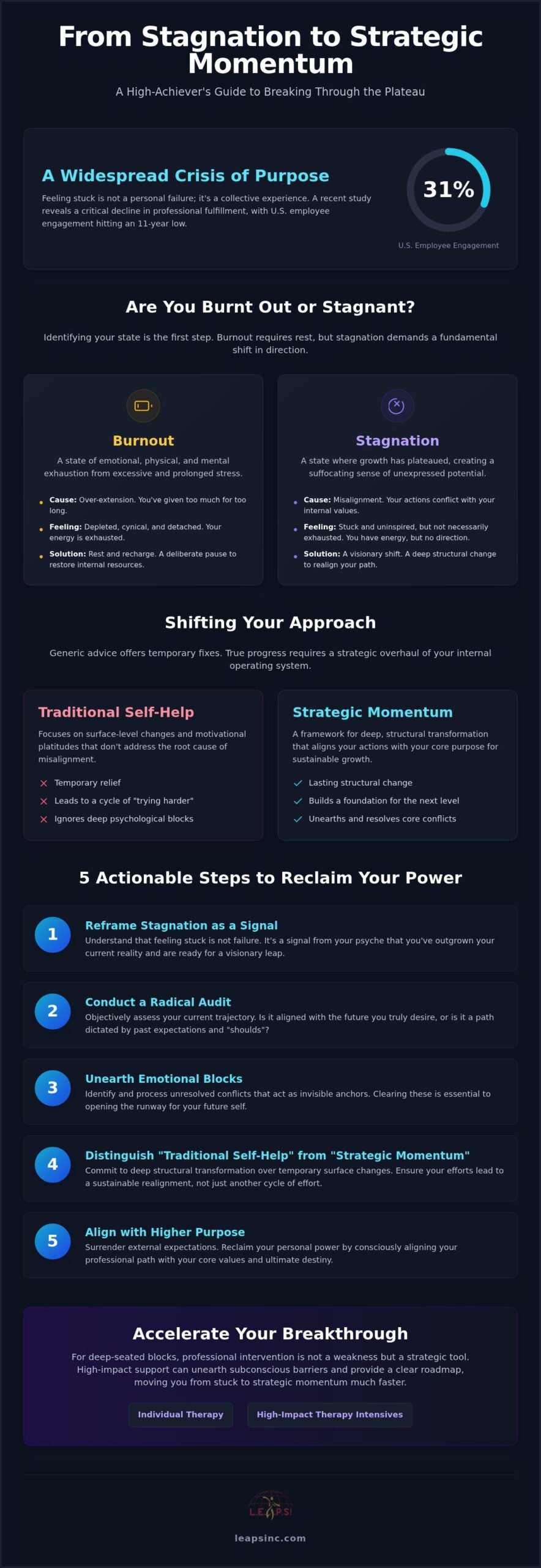
What if the suffocating sensation of “drowning in mud” isn’t a sign of failure, but a sophisticated signal that you’ve outgrown your current reality? You’ve likely achieved the outward markers of success, yet you’re haunted by a persistent anxiety about missed potential and the weight of lost time. It’s a confusing intersection where you’re left wondering if the issue is a mental health hurdle or a fundamental career misalignment. Many high achievers reach this plateau and find themselves searching for what to do when you feel stuck in life, only to find generic advice that fails to address their visionary drive. In 2026, U.S. employee engagement hit an 11-year low of 31 percent, proving that this internal friction is a widespread crisis of purpose.
We understand that your struggle is real and deserves professional validation. This guide provides a structured framework to help you distinguish between the restorative power of rest and the corrosive nature of stagnation. You’ll discover the psychological roots of your current state and gain a clear roadmap to move from “stuck” to strategic momentum. It’s time to stop merely surviving and start aligning your professional path with your higher purpose and ultimate destiny.
Key Takeaways
- Reframe stagnation as a vital psychological signal that your current worldview has reached its capacity, requiring a visionary leap to your next level of development.
- Distinguish between “Traditional Self-Help” and “Strategic Momentum” to ensure your efforts lead to deep structural transformation rather than temporary surface changes.
- Master a five-step framework to determine exactly what to do when you feel stuck in life, starting with a radical audit of your current trajectory versus your desired future.
- Identify when to leverage professional interventions, such as Individual Therapy or high-impact Therapy Intensives, to unearth the emotional blocks hindering your progress.
- Learn to surrender external expectations and “shoulds” to reclaim your personal power and align your professional path with your higher purpose.
Understanding the Psychology of Feeling Stuck
Stagnation is a state where your emotional and professional growth has plateaued. It’s a heavy, suffocating experience that often feels like you’re carrying the weight of your potential without the means to express it. This paralysis often triggers the quicksand effect. When you feel the pressure to move but lack a clear direction, your instinct is to thrash, work harder, and force a breakthrough. However, forcing movement without a strategic foundation leads to deeper overwhelm. Understanding the psychology of feeling stuck reveals that your brain is actually engaging a protective mechanism. It stalls when it lacks a clear, safe path forward, effectively pausing your progress to prevent you from heading further down a misaligned track.
There’s a profound difference between healthy rest and stagnant “stuckness.” Rest is a deliberate choice to pause and recharge your internal resources, leaving you feel energized and ready to return to your mission. Stagnation is a passive, involuntary drain. It siphons your energy because your psyche is constantly fighting against a reality that no longer fits. When you’re searching for what to do when you feel stuck in life, you must first recognize that your brain isn’t failing you; it’s waiting for a better map.
The Signal in the Silence
Your mind uses this period of paralysis to signal that your current environment or habits no longer serve your growth. It’s an invitation to lean into emotional vulnerability and decode what your psyche is trying to tell you. This signal often surfaces when you’ve reached the limit of your current worldview. Stagnation is a misalignment between internal values and external actions. When these two forces pull in opposite directions, the result is a total loss of momentum that requires a visionary shift to resolve.
The Difference Between Burnout and Stagnation
Identifying your specific state is vital to determining the right intervention. Burnout is the result of over-extension; you’ve given too much for too long, leaving you physically and emotionally depleted. Stagnation is different. You may still have the energy to perform, but you lack a compelling direction or purpose. If you’re wondering what to do when you feel stuck in life, the first step is recognizing that you aren’t tired, you’re misaligned. While burnout requires rest, stagnation requires deep structural shifts. For many, this is the ideal time to engage in Individual Therapy to unearth the emotional blocks that keep your visionary potential locked behind a wall of indecision.
Identifying Why You Have Hit a Plateau
Paralysis often stems from an outdated worldview. When your internal operating system no longer matches the complexity of your current life, you experience a profound sense of friction. This misalignment creates a psychological ceiling. You might feel like you’ve hit a “Ceiling of Achievement,” a state where you reach the goals you once prized only to find the results feel hollow. It’s a confusing space for high achievers. You’ve done everything “right,” yet you’re searching for what to do when you feel stuck in life. This emptiness isn’t a sign of ingratitude. It’s a signal that your old map has reached its edge and you require a new compass to navigate toward your maximum potential.
Fear of success can be just as paralyzing as the fear of failure. While the fear of failure keeps you safe in the known, the fear of success challenges your very identity. It forces you to ask: “Who will I become if I actually reach my destiny?” This existential tension often leads to subtle self-sabotage, keeping you tethered to a version of yourself that you’ve already outgrown. Shifting from Stagnation requires identifying these psychological barriers and acknowledging that your current plateau is merely a preparation phase for a visionary leap. You aren’t failing; you’re simply outgrowing your current container.
The Weight of Unprocessed Emotions
Past traumas and unresolved conflicts act as invisible anchor weights. They drag behind you, siphoning the high-energy catalyst you need for strategic advancement. From a visionary perspective, we view these emotional residues as obstacles that must be cleared to open the runway for your future. Engaging in individual therapy allows you to identify these hidden weights and release them with clinical precision. By addressing these internal depths, you stop fighting against your own history and begin moving with a sense of liberated momentum.
Misalignment with Life Purpose
Drifting away from your core purpose creates a persistent internal friction that feels like drowning in mud. This is the heavy psychological cost of living a life that looks impressive on paper but feels fundamentally wrong in practice. When your daily actions don’t align with your “burning desire,” you lose the visionary energy required for transformation. Introspection is your primary tool for recovery. You must look inward to find where your original spark was extinguished and decide to reclaim it. If the path forward remains clouded despite your best efforts, you may find it helpful to consult with a professional mentor who can help bridge the gap between your emotional well-being and your executive goals.
Shifting from Stagnation to Strategic Momentum
Traditional self-help often suggests random habit changes like waking up earlier or adjusting your morning routine. While these aren’t harmful, they are surface-level interventions that ignore the structural roots of your plateau. When searching for what to do when you feel stuck in life, you must transition from aimless activity to Strategic Momentum. This is defined as movement with a precise, visionary purpose. Trying harder at the wrong tasks only deepens your exhaustion and reinforces the feeling of being trapped. You need a professional mirror, such as a clinical expert or high-level mentor, to reveal the blind spots that are invisible from within your own perspective.
Worldview Expansion vs. Habit Modification
Changing what you do will eventually fail if you don’t change how you see. If your underlying worldview remains limited, you’ll replicate the same stagnation in different contexts. This is why leadership coaching is a vital catalyst for professional expansion. It challenges you to look beyond immediate problems toward your maximum potential and destiny. The following table highlights the difference between standard fixes and visionary transformation:
| Traditional Approach | Visionary Growth Approach |
|---|---|
| Surface habit modification | Deep structural worldview shifts |
| Short-term symptom relief | Long-term alignment with purpose |
| Incremental, linear progress | Exponential, transformative breakthroughs |
| External validation-seeking | Internal authority and destiny-focused |
Embracing Emotional Vulnerability as a Catalyst
Avoiding the discomfort of your current state only prolongs your paralysis. “Feeling the stuckness” is the essential first step toward leaving it behind. By acknowledging the pain of misalignment, you allow your maximum potential to finally emerge from the shadows of your ego. Vulnerability is the precursor to a visionary breakthrough. It creates the internal space necessary for a new, more expansive reality to take hold. When you stop resisting the truth of your situation, you unlock the high-energy catalyst required for strategic advancement. This process isn’t about being “soft,” it’s about being strategically honest so you can determine exactly what to do when you feel stuck in life and move forward with clinical precision.
5 Actionable Steps to Reclaim Your Personal Power
Moving from the “quicksand effect” to strategic momentum requires a structured intervention. You cannot simply think your way out of a plateau; you must act your way into a new reality. These five clinical and visionary steps provide a clear framework for what to do when you feel stuck in life so you can reclaim your trajectory and align with your maximum potential.
- Conduct a Radical Honest Audit: Evaluate your current reality without the filter of your ego or past successes.
- Surrender the “Shoulds”: Identify which goals are truly yours and which were inherited from external expectations or outdated societal norms.
- Define a New Worldview: Replace the limited operating system that led to this plateau with an expansive perspective that supports your next level of growth.
- Engage in “Micro-Leaps”: Commit to small, high-impact actions that trigger a neurological shift toward momentum and break the cycle of overthinking.
- Seek Expert Mentorship: Transition from solo struggle to a professional partnership that provides the clinical and strategic insight necessary for a breakthrough.
The Audit: Facing Your Reality
Effective change begins with non-judgmental observation. Use structured journaling to categorize the primary areas of your life, including career, relationships, and internal well-being, into three distinct states: “Growing,” “Stagnant,” or “Decaying.” This process isn’t about self-criticism. It’s about gathering clinical data. Identifying what is decaying allows you to prune the dead weight and clear space for new growth. Many individuals find that Life Coaching provides the necessary external structure to complete this audit with the radical honesty required for transformation.
The Visionary Leap: Setting a New North Star
Once you’ve cleared the runway, you must move beyond mere problem-solving toward vision-building. Identify your “burning desire” for this next phase of life. This isn’t about fixing what’s broken; it’s about defining what is possible. Craft a “destiny statement,” a single, powerful sentence that encapsulates your purpose for the next 90 days. This statement serves as your strategic North Star, filtering every decision through the lens of your future potential rather than your past limitations. If you’re ready to bridge the gap between your current plateau and your ultimate destiny, schedule an appointment for a professional consultation to start your visionary leap.
When to Seek Professional Support: Therapy and Coaching
Reaching your maximum potential often requires a level of objectivity that self-reflection alone cannot provide. While the previous sections outlined strategic steps for what to do when you feel stuck in life, professional intervention offers the precision needed to dismantle complex psychological barriers. Individual Therapy serves as a foundational tool to unearth deep-seated emotional blocks that act as invisible anchors on your progress. For those facing an acute crisis of purpose or requiring a rapid, deep-dive breakthrough, Therapy Intensives provide a concentrated environment for transformation, compressing months of traditional work into a high-impact clinical experience.
In contrast, Executive Coaching addresses professional stagnation by focusing on strategic advancement and leadership development. While therapy heals the past to clear the runway, coaching optimizes the future to ensure you reach your destiny. Viewing these services as a visionary investment in your internal depth, rather than a sign of weakness, is the hallmark of a prestige professional mindset. You are not just solving a problem; you are unlocking latent abilities that have been suppressed by your current plateau.
The Synergy of Mind and Business
Your emotional health is the primary engine of your professional leadership and entrepreneurship. High-achieving founders often find that internal friction manifests as business bottlenecks, making a holistic approach essential for sustainable growth. By merging clinical depth with strategic initiatives like brand development or corporate visioning, you create a powerful alignment between your inner life and your external impact. Many successful leaders utilize this integrated support to maintain both scale and sanity, ensuring their personal well-being evolves at the same rate as their professional empire.
Taking the First Step Toward Your Destiny
Waiting for the “right time” is a sophisticated form of procrastination that only keeps you stuck longer. Real transformation requires a courageous decision to enter a structured, confidential framework designed for your specific visionary needs. There is profound relief in moving from a solo struggle to a professional partnership that values your ultimate potential. This is the moment to transition from theoretical planning to clinical action. Schedule a consultation to begin your visionary breakthrough and reclaim the momentum your future demands.
Reclaiming Your Visionary Trajectory
Feeling paralyzed by a plateau is not a sign of failure; it is a vital psychological signal that you’re ready for your next level of development. You’ve learned that true transformation requires moving beyond surface-level habits to address the deep-seated emotional and structural roots of stagnation. Knowing exactly what to do when you feel stuck in life involves a blend of radical honesty and professional partnership. It’s about aligning your daily actions with your ultimate destiny and maximum potential.
Led by Dr. John E. N. Daniel, a visionary mentor in clinical and professional growth, our practice offers a structured path toward transformation. We provide comprehensive services ranging from individual therapy to executive coaching, including specialized “Intensives” designed for deep, rapid transformation. You don’t have to navigate this transition alone. Our multi-disciplinary approach ensures that your emotional well-being and professional success evolve in tandem. Begin your journey toward personal power and schedule an appointment today. Your future potential is waiting for you to claim it.
Frequently Asked Questions
Is feeling stuck in life a sign of depression?
Feeling stuck can be a symptom of clinical depression, especially if it’s accompanied by persistent low mood or loss of interest. However, for many high achievers, it’s often a state of stagnation where your growth has simply plateaued. Distinguishing between the two requires professional validation. If your paralysis feels more like a lack of direction despite having energy, you’re likely facing a visionary misalignment rather than a clinical mood disorder.
How do I know if I need therapy or a life coach?
You need therapy if your paralysis is rooted in past trauma, unresolved emotional weights, or clinical symptoms like anxiety. Therapy heals the foundation. You need a life coach if your foundation is secure but you lack a strategic roadmap for your future potential. Many visionary clients benefit from a multi-disciplinary approach that merges the clinical depth of individual therapy with the strategic advancement of executive coaching to achieve their maximum potential.
What is a therapy intensive and can it help me get unstuck faster?
A therapy intensive is a concentrated, high-impact clinical intervention designed for rapid transformation. Instead of hourly weekly sessions, you engage in deep-dive work over several consecutive days. This format is exceptionally effective for those who need to get unstuck faster because it bypasses the “warm-up” time of traditional sessions. It allows you to dismantle complex blocks and reclaim your strategic momentum with clinical precision in a compressed, powerful timeframe.
What are some immediate things I can do when I feel paralyzed by choices?
When choice paralysis strikes, the most effective strategy is to engage in “Micro-Leaps.” Pick one small, high-impact action that moves you toward your desired future and execute it immediately. This neurological shift breaks the cycle of overthinking. Additionally, conducting a radical honest audit of your current trajectory helps filter your options. Focus on which choice aligns with your destiny rather than trying to solve every perceived problem at once.
Can professional coaching help with personal stagnation?
Professional coaching is a powerful catalyst for breaking through personal stagnation. It provides a structured, confidential framework to examine your life through a visionary lens. A coach acts as a professional mirror, revealing the blind spots that keep you tethered to your current plateau. By realigning your daily actions with your burning desire, coaching helps you move from a state of passive existence into a state of strategic, purpose-driven momentum.
How does my worldview affect my ability to move forward?
Your worldview is the internal operating system that dictates how you perceive opportunities and limitations. If your worldview is outdated, you’ll feel stuck because your current perspective can’t handle your future’s complexity. Expanding how you see is often more important than changing what you do. When you’re deciding what to do when you feel stuck in life, upgrading your worldview allows you to see paths and possibilities that were previously invisible.
What happens if I just wait for the feeling of being stuck to pass?
Waiting for stagnation to pass often leads to the “quicksand effect,” where passive waiting deepens the sense of overwhelm. Stagnation is rarely a phase that resolves on its own; it’s a signal that your environment or habits no longer serve your growth. If you’re wondering what to do when you feel stuck in life, remember that unaddressed stagnation can transition into emotional decay or burnout. Proactive, clinical intervention is usually necessary to reclaim your personal power.
How do I explain to my family that I feel stuck and need professional help?
Explain your situation by framing professional help as a strategic investment in your maximum potential. Use clear, authoritative language to describe the “drowning in mud” sensation and your desire for a structured roadmap forward. Focus on the desired outcome: you want to be more present, purpose-driven, and aligned with your destiny. This shifts the conversation from a place of problem-fixing to a proactive mission for your next level of visionary growth.